









Which exchange gives Swedish traders a proper crypto futures account?
Kraken is the most convincing starting choice for a Swedish resident who wants crypto perpetuals and dated futures in one regional account. Its Swedish product page identifies the European derivatives company and advertises eligible contracts up to 10x. Coinbase is worth comparing for its cash-margined contracts; OKX X-Perps provides another EEA futures service where the product has been enabled.
The local complication is money, not a lack of crypto apps. You may earn and measure results in SEK while the exchange funds or settles the futures account in EUR, USD or supported crypto collateral. A platform that is convenient for buying Bitcoin with Swish is not necessarily the most direct place to trade a leveraged contract.
Kraken when contract choice comes first
Kraken’s EEA specifications cover perpetuals and dated crypto contracts. That suits a trader comparing an ongoing BTC position with an expiry-based trade without wanting a separate account for each format. Its EUR collateral option is also useful after converting kronor, although it does not turn the service into a SEK-denominated futures market.
The recommendation rests on those documented features. We do not assume that the Swedish-language page’s marketing claims about market depth establish the best fill for every altcoin order. The particular regional contract and its order book remain the meaningful execution comparison.
Coinbase for cash-margined contracts
Coinbase’s European derivatives account uses a different cash-based setup. It can appeal to someone already using Coinbase who wants the supported listed futures rather than transferring assets into another exchange. Small Bitcoin and Ether contract units can make the product accessible, but orders still use whole contracts.
Before choosing it over Kraken, compare the amount of exposure created by the smallest contract and the conversion needed to fund the derivatives balance. A familiar app is an advantage only if the actual account matches the intended trade.
OKX for a further European execution choice
OKX’s X-Perps are expiry futures with funding, not simply the global perpetual product renamed in Swedish. They add a useful comparison when the desired contract is enabled and the executable price is attractive. Its starting commission matches Kraken’s reviewed entry rates, so the article does not award it a cost advantage without considering the complete order.
| Service | Reason to shortlist | SEK-related consideration |
|---|---|---|
| Kraken EEA derivatives | Perpetual and dated crypto contracts | EUR is supported collateral; SEK conversion may come first |
| Coinbase European futures | Cash-margined listed contracts | Read the funding balance and contract unit before converting kronor |
| OKX X-Perps | Alternative EEA expiry futures with funding | Use the enabled European account and supported collateral |
| Safello | Swedish crypto purchase and transfer service | Useful Swish access, but not evidence of a leveraged futures product |
What is the simplest way to fund futures from a Swedish bank?
Start by comparing a conversion from SEK into a supported cash currency with buying crypto locally and transferring it. For a Kraken EEA account, EUR funding through an available SEPA method is a sensible first quote to obtain. Sweden is in SEPA even though its national currency is the krona. SEPA transfers themselves are euro transfers; membership does not mean you can send SEK to EUR deposit instructions unchanged.
The reviewed Kraken cash-deposit list does not provide an ordinary SEK funding rail. A price displayed in kronor or a card charged in kronor is not the same thing as a SEK bank balance held on the exchange. Check what currency will actually arrive before confirming the payment.
A Swedish example: compare the conversion, not only the transfer fee
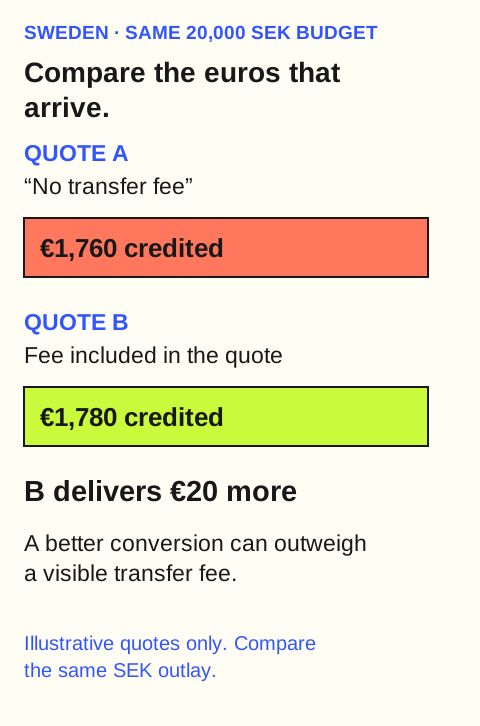
Suppose you intend to send 20,000 SEK. One service could display no transfer charge but give a worse exchange rate; another could charge a visible fee and deliver more EUR. Compare the final amount the exchange will credit for the same SEK outlay. That avoids treating the word “free” as the answer to a currency-conversion question.
If you already have EUR from salary or savings, the calculation changes. Converting EUR back to SEK and then into EUR again solely to use a preferred payment app adds another exchange. The useful comparison starts with the currency you actually own.
EUR collateral does not mean every trading number is in euros
Kraken lists EUR as EEA derivatives collateral without a haircut. The wallet values collateral in USD for margin calculations. That lets you use euros to support a dollar-quoted crypto contract without first buying a dollar stablecoin, but your statement can still contain USD-denominated items.
For Sweden, keep the SEK cost of the original conversion and the exchange’s subsequent currency records. They serve different purposes: the first measures what you spent from your bank, while the contract records explain the trade. A final withdrawal converted back into kronor does not replace the history of the intervening results.
Can Swish or BankID give you access to crypto futures?
Swish makes a local crypto purchase convenient; it does not decide whether the receiving service offers futures. Safello explicitly lists Swish among its payment methods, alongside Bankgirot and SEPA. It is therefore a relevant Swedish on-ramp to discuss, but its purchase-and-transfer service should not be ranked as though it were the same leveraged product as Kraken’s EEA derivatives.
Finansinspektionen’s register confirms Safello’s crypto-service permissions. That supports using it in the local payment comparison. The permission does not, by itself, establish a perpetual futures market or an international exchange account waiting behind the Swish payment.
When a local purchase adds an unnecessary step
If the destination futures account accepts a cash currency you can send directly, buying a coin through another service may introduce a spread, a transaction charge and a withdrawal or network charge. Safello’s fee page explicitly says buy and sell prices include a spread, including during reduced-fee campaigns. It also publishes minimum purchase and sale amounts.
That does not make local purchase services useless. They can suit someone who specifically needs to acquire and transfer a supported crypto asset. The conclusion is narrower: do not describe “pay with Swish” as the cheapest futures funding path without comparing the final collateral received at the destination.
The small-deposit cost of a Swedish on-ramp
Safello’s June 2026 tariff lists a 0.49% USDC purchase fee, but a 49 SEK minimum applies to buy/sell orders. On a 1,000 SEK purchase, that minimum represents 4.9% before the spread and onward transfer. At 10,000 SEK, 49 SEK is 0.49%. The same advertised rate can therefore produce very different funding costs for a small test and a larger deposit.
Safello separately lists order-book charges of 0.6% for market orders and 0.4% for limit orders. Do not apply its instant-purchase tariff to every service. Its reviewed transfer table also lists 10 USDC for an ERC20 withdrawal; that is an additional charge when using that route.
For a futures trader, the comparison is the usable collateral arriving after those steps. A cheap local purchase can lose its advantage during the transfer. Conversely, a direct EUR conversion can be expensive if the bank’s rate is poor. Obtain both final quotes for your actual amount, rather than using either the Swish convenience or the advertised percentage as the entire answer.
BankID is identification, not a leverage approval
Safello’s terms describe electronic identification such as Swedish BankID. An international derivatives provider can instead require its own identity checks, residential information, tax identification and product assessment. Having BankID should not be confused with having completed those separate checks.
A newcomer to Sweden who is still arranging local banking should compare the exchange’s accepted identity documents and cash-transfer methods directly. The inability to use one domestic payment app is not proof that every European futures account is unavailable. Equally, another person’s Swish or bank account is not a substitute for funding and verifying your own account.
Why do Swedish guides quote both 2x and 10x?
The numbers refer to different product evidence and regulatory conditions. Finansinspektionen’s FFFS 2019:7 governs retail CFD distribution, including a 50% initial-margin requirement for crypto CFDs, equivalent to 2:1. Kraken’s Swedish futures page advertises eligible regional contracts up to 10x. The correct response is to identify the contract, rather than silently choosing whichever number looks more attractive.
ESMA clarified in February 2026 that products marketed as perpetual futures may fall within the CFD definition. When they do, the existing intervention protections apply. A perpetual label is therefore not enough to demonstrate that a Swedish retail customer can ignore the CFD measures.
For a trading decision, use the account’s regional product document and approved limit. The public 10x figure is a ceiling for eligible products, not a guarantee for every token and account. Position size or the instrument’s margin schedule can require more collateral than a small headline example suggests.
A global exchange tutorial can describe the wrong service
The reviewed Bybit EU product is spot margin with borrowing. That differs from the global Bybit perpetual platform commonly shown in videos. Borrowing costs, eligible pairs and repayment terms belong in that comparison; they should not be replaced by a global futures fee table.
Likewise, a derivatives volume ranking that lists exchanges worldwide does not prove Swedish account eligibility. This page uses the regional product sources first. The broader site catalogue remains available for research, but its size should not be read as the number of identical Swedish-approved futures accounts.
Which fee comparison is useful for a SEK-funded account?
At the reviewed base tier, Kraken’s EEA derivatives commission is 0.02% maker and 0.05% taker. OKX X-Perps publishes the same starting rates. The trading fee alone therefore does not choose between those two for an otherwise equivalent order.
For someone funding from kronor, a small percentage difference in currency conversion can outweigh a commission difference on a single trade. Keep the comparison in one unit: the SEK spent to fund, the account value after conversion and the SEK eventually returned. Then distinguish those money movements from the trading result used for tax.
Repeated conversion versus keeping supported collateral
If you trade frequently, converting SEK into EUR and back for every small position can add avoidable conversion costs. Keeping an appropriate supported balance between trades avoids repeating that particular conversion, but leaves money exposed to the exchange and to currency changes. This is a trade-off about funding convenience, not a recommendation to leave every krona on a platform.
A trader who already owns supported crypto can instead compare depositing that asset. The calculation must include the sending platform’s withdrawal charge, the network and the receiving account’s collateral treatment. A coin that is accepted for spot deposits is not necessarily accepted as derivatives collateral on the same terms.
What a promotion leaves out
A temporary trading-fee offer can reduce commissions while leaving funding payments, spreads and conversion costs unchanged. Calculate the ongoing cost after the promotion as well. For a Swedish trader whose largest cost is getting SEK into and out of the account, a short commission holiday may be less important than a better funding arrangement.
The recommendation stays with the account that fits the contract and money flow. It does not move to a different exchange merely because one screen displays a temporary zero.
How does Sweden tax a crypto futures result?
Swedish tax treatment follows the instrument and its underlying asset. Skatteverket explains that a CFD is a derivative and that the underlying exposure determines its capital-tax category. A Bitcoin-linked contract is not treated as ordinary foreign currency merely because its trading symbol ends in USD.
This distinction matters when choosing tax software. A file of crypto futures should not automatically be processed as a collection of spot coin sales, nor should every dollar-quoted derivative be put into the foreign-currency section. Keep the contract description with the trading export so the category can be checked.
Why a break-even trading year can still produce tax
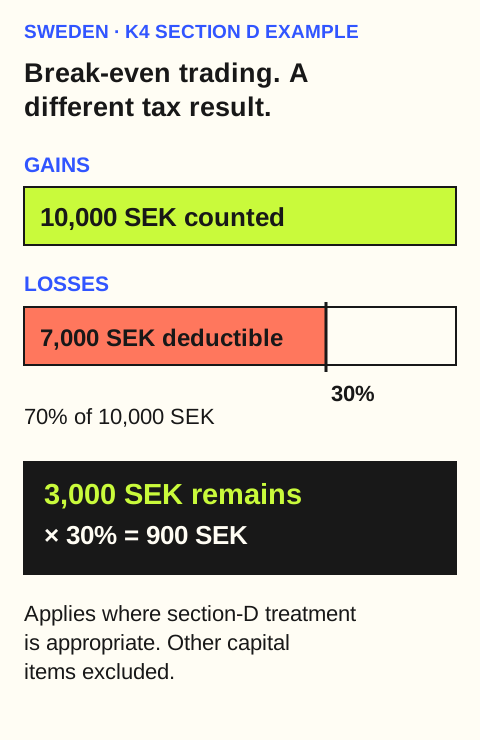
For a qualifying crypto-linked result in K4 section D, full gains and the limited deductibility of losses can create an uneven outcome. As an illustration, 10,000 SEK of gains and 10,000 SEK of losses do not necessarily cancel for tax when only 70% of the losses are deductible. That leaves 3,000 SEK in the simplified taxable calculation, or 900 SEK at 30%, assuming no other relevant capital items.
This example illustrates the section-D treatment; it is not a universal rule for every product called a future. The instrument’s classification and the rest of the individual’s capital position must be considered. It is especially important not to copy the full-loss offset used for a different derivative category.
Use SEK values for the tax working sheet
An exchange can report profit in USD or a stablecoin while the Swedish return needs kronor. Preserve the dates and exchange rates used to translate the relevant amounts. A USD total converted using the year-end rate can differ from the result obtained from the actual transactions.
Skatteverket also explains that movements on foreign-currency cash accounts can have their own currency consequences. Do not merge those items into a crypto contract simply because both appear in the same exchange export. A USD cash balance, a BTC-linked future and a coin sold to fund it can require separate treatment.
Will Skatteverket receive the exchange records automatically?
Do not assume that a foreign exchange has prefilled every Swedish tax field. Skatteverket’s CFD guidance identifies particular arrangements under which certain provider results appear in the return. That is not a blanket promise covering every crypto futures platform.
Sweden’s new crypto reporting rules cover the 2026 period, with the first provider reports due to Skatteverket by April 1, 2027. The provider’s deadline does not replace the individual’s return, and a report containing transfers or transaction totals is not necessarily a completed profit calculation for every instrument.
A useful export has more than one final balance
Keep closed positions, settlement entries, funding, commissions, deposits, withdrawals and conversions identifiable. The platform’s final wallet value can include fresh deposits or open exposure. It is therefore unsuitable as a stand-alone measure of taxable trading profit.
If you use both a Swedish purchase service and an international derivatives exchange, preserve the transfer between them. Otherwise the same coins can appear to be a disposal in one dataset and a new unexplained purchase in another. Keeping the transaction identifiers and original files allows the movement to be reconciled without inventing a cost basis.
What about a liquidation?
An executed closeout belongs in the realised trading history. Losing access to coins after a hack or losing a private key is a different factual situation; Skatteverket’s crypto guidance says loss of control does not automatically establish a deductible disposal. Do not label every vanished balance a trading loss.
The practical lesson is to keep the exchange record identifying what happened. A filled closeout order, a withdrawal and an inaccessible wallet are different events even when all reduce the balance shown on your screen.
Does a Swedish licence, ISK or local address change the recommendation?
Swedish authorisation versus an EEA-passported provider
FI’s July 2026 update confirmed that the transition had ended and identified both a locally authorised provider and firms authorised in other EU countries serving Sweden. The sensible comparison is not “Swedish company good, foreign company unavailable.” It is whether the particular firm has the permission for the service being offered.
Safello’s local crypto-service authorisation is relevant to buying, selling and transferring crypto. Kraken’s European derivatives service relies on a different investment-firm framework. Comparing those two permissions as if they covered the same product would obscure the main reason a leverage trader needs the latter kind of account.
Can you put this futures account inside an ISK?
A normal crypto exchange account does not become an investment savings account because you also have an ISK at a Swedish broker. A listed crypto certificate that a broker accepts in an ISK is a different holding from directly opening a perpetual on an exchange.
If the objective is a crypto futures order with the exchange’s contract controls, select and evaluate that product. Do not substitute a certificate solely to make a tax comparison look simpler. Conversely, do not assume the ordinary exchange’s profits use ISK taxation. The account structure and permitted holdings decide that treatment.
Stockholm, Gothenburg, Malmö and cross-border workers
There is no separate city-level crypto futures permission established by the reviewed Swedish rules. A resident in Malmö working in Denmark still needs their real residence correctly recorded with the exchange. Salary paid in DKK can change the funding conversion, while tax residence requires its own facts; neither follows automatically from the location of the employer.
The same point applies to a Swedish citizen who genuinely moves abroad. Update the account and retain the earlier statements instead of relying on the passport to preserve an old regional product. For Sweden, the useful local differences are the currency used to fund, the account’s approved contract and the applicable tax records, not an invented ranking for each city.
Which option fits the way you fund and trade?
Use Kraken as the first comparison when you want regional crypto derivatives and can fund in a supported currency. Its contract range and documented EUR collateral make that recommendation concrete. Compare Coinbase when listed contract units and its cash-based account fit better, and OKX when the enabled X-Perps market offers the execution you need.
Keep Swish in the payment discussion where it belongs. It can make a Swedish crypto purchase easy, but it does not decide the best futures account. The most useful shortlist separates that local convenience from the leveraged contract and from the Swedish tax treatment of the result.