










Kraken or OKX for crypto futures in Norway?
Kraken is the most straightforward starting point when your goal is a crypto futures account rather than another app for buying Bitcoin. It publishes a Norway-facing derivatives offering, an EEA contract list and separate futures fees. Norway belongs to the European Economic Area, so the international version of an exchange’s website is the wrong place to take your product limits from.
OKX deserves a place alongside it. Its European X-Perps service supports the EEA, including Norway, with account verification and a derivatives assessment. This is a genuine second crypto-exchange option; you do not need to switch the comparison to a traditional broker just because your home currency is NOK.
| Platform | Best fit | Published leverage indication | Main local consideration |
|---|---|---|---|
| Kraken EEA derivatives | A trader wanting crypto contracts and a detailed collateral schedule | Selected EEA contracts advertise up to 10x; account and contract limits apply | Use the European deposit and collateral rules |
| OKX X-Perps | An existing OKX Europe customer wanting leveraged crypto exposure | Up to 10x on eligible X-Perps | Activation, supported pairs and account eligibility determine access |
| Firi | Buying or selling crypto against Norwegian kroner | No futures product established by the services reviewed | Useful for NOK conversion, but adds a separate purchase or sale |
This shortlist is deliberately about the job each account performs. Firi’s local payment integration can be valuable without making it a substitute for Kraken’s order book. Likewise, an exchange appearing in the broader availability catalogue below does not mean its international 100x or 200x advertisement applies to a verified Norwegian resident.
Norwegian residents have documented European futures candidates. The recommendations use the linked product specifications and Norwegian rules; account opening and withdrawals have not been tested.
Which coins and leverage can a Norwegian account trade?
Match the European contract, not the global advertisement
Kraken’s EEA specification lists BTC, ETH and a wider range of crypto markets. The list describes margin classes and position limits as well as leverage. Its Norway-facing product page advertises up to 10x on eligible pairs. Treat that as a product ceiling: the order ticket and your account classification determine what you can actually select.
OKX X-Perps also advertises up to 10x. These contracts use periodic funding and have a long, defined maturity; they are not simply the international perpetuals product relabelled for Norway. A trader transferring an existing strategy should use the X-Perps specification and supported-market list, particularly when the strategy depends on a smaller altcoin.
If your main trade is BTC or ETH, start with the two European services above. If you need a specific altcoin short, availability of that exact contract may decide the choice before headline fees do. A spot listing is insufficient: an exchange can let Norwegians buy a token while offering no leveraged contract for it.
Why some Norwegian comparisons still say 2x
The familiar 2:1 figure comes from retail crypto CFD restrictions. It should not be applied indiscriminately to every instrument called “futures”. Equally, a provider cannot escape CFD rules just by changing the product name: ESMA has reminded firms that a perpetual contract may fall within those rules depending on its characteristics. That is why this guide identifies the European product and cites its actual specification instead of declaring a universal Norwegian leverage allowance.
For a practical decision, compare the BTC contract visible in your verified account with the same type of exposure at the other provider. Do not compare an EEA futures account with an offshore professional account and call the larger number the winner. They are different offers to different customers.
The cheaper way to move NOK into a futures account
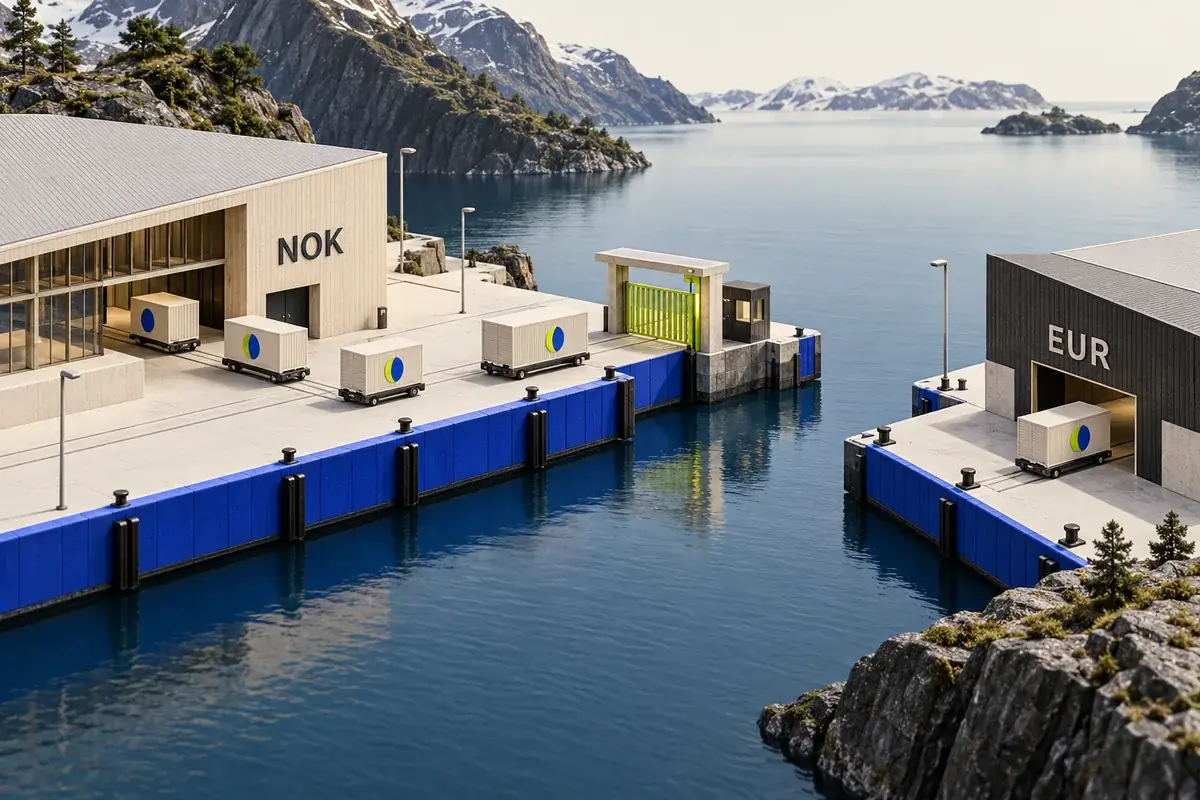
A Norwegian trader starting with a bank balance has two plausible approaches: convert NOK to EUR and use the exchange’s supported bank method, or buy crypto locally and transfer an accepted asset. The second is not automatically cheaper because it starts with a Norwegian company. It introduces another trade and often a network withdrawal.
Kraken and OKX publish EUR deposit instructions for their eligible European customers. Those instructions are the place to obtain the receiving account and payment reference. Norway’s SEPA participation does not turn a NOK payment into a EUR payment; your bank or currency service still has to perform the conversion.
For example, suppose you want to allocate NOK 10,000. Ask how many euros will arrive after the bank’s exchange-rate margin and transfer charge. Compare that credited amount with the quantity of accepted collateral you would receive after a local crypto purchase and withdrawal. You are comparing the balance available for trading, not the attractive “free deposit” wording at the beginning of either route.
When Vipps is convenient but expensive
Firi’s Norwegian tariff lists free bank and Open Banking deposits, 3.9% for Vipps/card-type deposits, and a separate 0.7% trading charge. On a NOK 10,000 credited deposit, the 3.9% deposit fee alone is NOK 390, added to the deposit amount. A NOK 10,000 trade carries NOK 70 at 0.7%. These are different charges, before any onward crypto withdrawal or price spread.
Those numbers do not prove that a particular bank conversion is always cheaper. They show why paying for instant local convenience can outweigh small differences between futures commission rates. Someone funding only occasionally may value that convenience; someone making repeated top-ups has more reason to compare the bank-funded alternative.
| Route | Known starting charge | Additional items to include |
|---|---|---|
| NOK bank deposit at Firi | No Firi deposit fee; trading is separate | Crypto purchase, quoted price and onward withdrawal |
| Vipps-funded Firi deposit | 3.9% deposit fee; trading is separate | Same purchase and transfer costs as above |
| EUR bank deposit at the futures provider | Use the account’s current deposit method | NOK/EUR conversion, bank charge and any receiving fee |
| Existing supported crypto | No new NOK purchase required | Sending-platform charge and the receiving account’s supported network |
Already holding crypto at Firi? Check the destination first
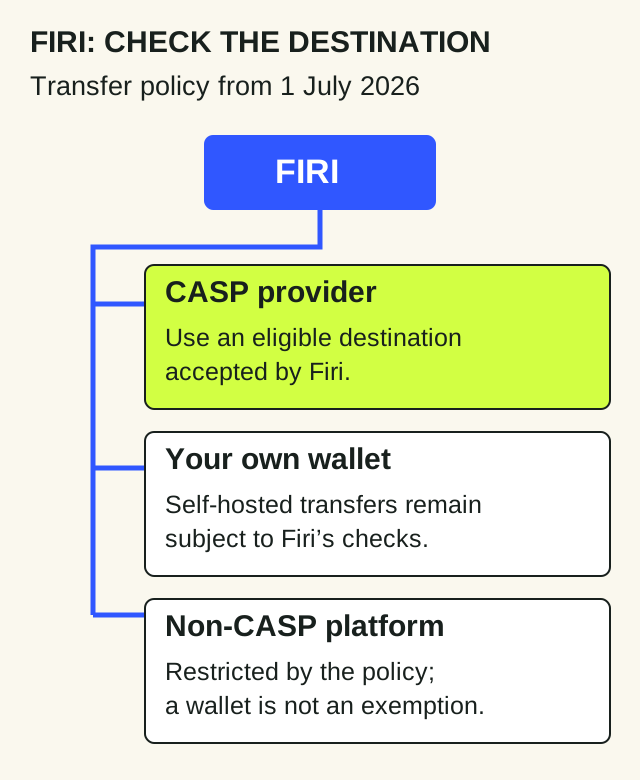
The most consequential change for a Firi user is not its trading commission. Firi says that from 1 July 2026 it will no longer transfer crypto to platforms without CASP status, while transfers to authorised platforms and self-hosted wallets remain possible. CASP is the authorisation for a crypto-asset service provider under MiCA.
That is Firi’s published transfer policy, not a claim that every Norwegian provider handles every destination identically. It nevertheless rules out a common shortcut in exchange reviews: buy locally, send anywhere, and assume the derivatives account will work. The receiving company matters before the purchase.
Kraken and OKX operate European crypto services alongside their separately regulated derivatives businesses. Use the deposit address supplied by the European account that is actually serving you. When the sending platform asks for the beneficiary or recipient provider, identify that account accurately; an exchange group can contain several legal entities.
The asset also has to be accepted
Kraken’s EEA restrictions include USDT deposits and trading. A global tutorial telling you to buy USDT and send it to Kraken is therefore unsuitable for a Norwegian resident. EUR, supported stablecoins and other eligible collateral need to be checked against the European account’s current schedule. A ticker being familiar is not evidence that it is accepted there.
For an existing Firi holding, establish the destination’s asset and network before selling or swapping anything. A conversion can create a Norwegian tax event as well as a trading cost. Moving an asset you already hold may involve fewer trades, but only if the receiving platform supports it and its collateral treatment suits the position you want.
Self-custody remains a separate choice. Firi’s allowance for transfers to your own wallet does not give a DEX Norwegian authorisation or remove that interface’s geographical conditions. We do not promote an unverified DEX as the substitute for a European futures account here.
What does the actual futures trade cost?
At the entry tier, Kraken’s EEA futures schedule lists 0.02% maker and 0.05% taker fees. OKX’s published X-Perps overview lists the same starting rates. On that evidence, there is no honest basis to call one automatically cheaper for a Norwegian customer based only on the first line of the fee table.
A taker order executes against available orders; a maker order rests and supplies liquidity. A limit order that executes immediately can still be a taker. For a trader who regularly enters at market, the taker rate is the relevant starting comparison, even if an advertisement highlights the smaller maker number.
Consider a USD 8,000 position opened and closed at an unchanged value, with both executions charged at 0.05%. Each trade costs USD 4, or USD 8 altogether. That is an illustration of commission only. The amount is based on the position value, not merely the money you deposited as margin, and it does not include funding, spread or conversions.
What matters after the entry fee
The Norwegian customer’s result often includes another currency step. A USD trading profit is not automatically the same percentage gain when measured against the NOK originally committed. If the krone strengthens before the money returns home, the NOK value of the dollar proceeds can fall even though the futures trade made money.
Kraken’s multi-collateral model can also involve conversions or charges when the account needs USD for a loss or fee. OKX publishes periodic X-Perps funding, currently at eight-hour settlement intervals. Neither a fixed funding rate nor a guaranteed monthly cost can be inferred from the trading commission.
Compare your likely behaviour. Frequent market entries make commissions and execution quality important. Holding a position over several funding intervals makes the funding record more significant. Keeping collateral in a different asset introduces its own price movements and conversion terms. These are reasons to inspect the specific European contract, not reasons to chase the exchange with the largest advertised leverage.
What changed under Norwegian crypto regulation?
Norway brought MiCA into its domestic framework through the Crypto-Assets Act. Finanstilsynet’s 2026 notice places the end of the relevant transition at 1 July 2026. An old registration for exchange or custody services is therefore not, by itself, enough evidence of a provider’s current permission to serve Norwegian customers.
For leveraged crypto, the useful distinction is between the company handling the crypto account and the company providing the derivative. Kraken identifies its Cyprus-regulated European investment firm for derivatives. OKX identifies OKX Europe Markets Limited under Malta’s investment-services framework. Their crypto-service permissions address another part of the relationship.
A reader does not need to memorise the company names. Their purpose is to make a check possible: the name in the terms shown during onboarding should match the European service being recommended. If an account is instead assigned to an international entity, the product, protections and permitted customer locations may be different.
BankID helps with local onboarding; it is not a futures licence
Firi uses Norwegian identity tools such as BankID in its registration process. That can simplify opening a local conversion account. Kraken’s EEA derivatives requirements instead include full verification, a tax identification number and an assessment of derivatives knowledge. Having passed a Norwegian bank’s identity checks does not automatically complete those steps at a foreign exchange.
Similarly, a Norwegian passport holder who actually lives outside the EEA should not expect the Norway product simply by choosing Norwegian as the app language. Changing residence can require an account review. The correct product follows the accepted customer circumstances, not a preference for a more attractive leverage figure.
Taking futures profits back to a Norwegian bank
DNB’s March 2026 explanation is more useful than the blanket statement that Norwegian banks “ban crypto”. The bank says customers may buy and sell crypto and use gains, provided the origin of the money can be documented and the required checks can be completed. That does not promise acceptance of every transfer, but it contradicts the idea that a legitimate crypto profit is automatically unusable.
For a futures account, a screenshot of the final balance is a weak explanation. The money may include original deposits, realised trading gains, funding payments and remaining collateral. Keep the exchange’s ledger showing that progression, alongside the originating bank payment and the final withdrawal confirmation.
Direct EUR withdrawal or a local NOK sale?
A direct EUR withdrawal can avoid an extra crypto transfer and sale, although the Norwegian bank’s currency conversion still affects the NOK received. Kraken publishes several cash-withdrawal methods with different eligibility and charges. Use the method actually available to your verified account; do not reuse another customer’s bank details from a tutorial.
Returning through Firi involves receiving supported crypto, selling it and requesting the NOK withdrawal. Its Norwegian tariff lists NOK 69 for a bank withdrawal, in addition to the sale and any incoming route costs. The advantage is a local NOK endpoint. The disadvantage is the additional set of transactions, which should earn its place through convenience or a better final quote.
There is also an important distinction between money belonging to you and collateral still supporting an open position. Only the withdrawable balance can leave the trading account. A profitable open trade is not the same as a completed profit sitting in the cash wallet. Before requesting the bank payout, reconcile the amount released by the exchange with the amount in the withdrawal confirmation.
How Norway taxes crypto futures and collateral
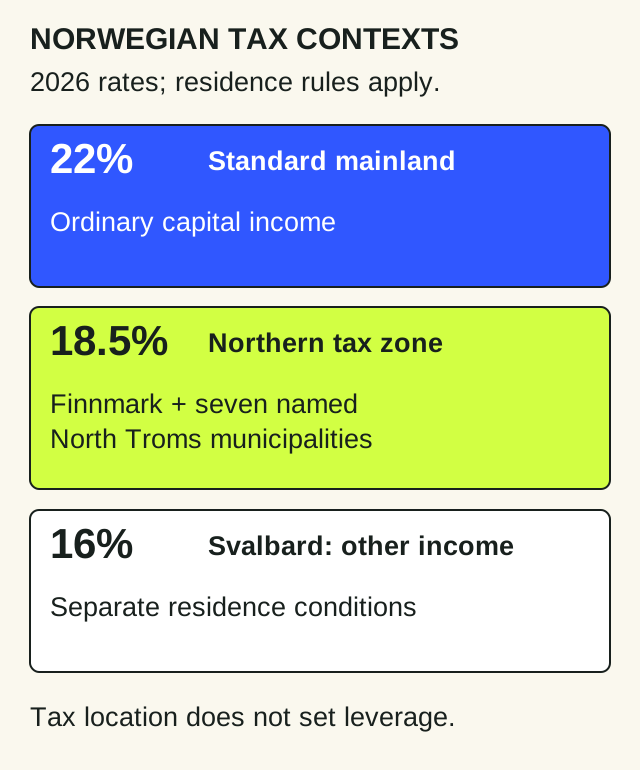
For an individual trading on their own account, the standard mainland starting point is 22% tax on ordinary capital income. Skatteetaten specifically discusses derivatives and options at that rate, with qualifying losses deductible at the same rate. Crypto assets also fall within its capital-income framework, but the contract result and the collateral holding should not be collapsed into one unexplained figure.
A simple example: NOK 12,000 of realised derivative gains and NOK 4,000 of deductible derivative losses leave NOK 8,000 before any other relevant adjustments. At the standard 22% rate, that corresponds to NOK 1,760. This example is not a full tax return: it assumes the same applicable income treatment and excludes special residence rules and personal adjustments.
Why a profitable USD trade needs a NOK record
Suppose your platform settles a gain in USD or a stablecoin. Preserve the value and date of that settlement, the relevant NOK valuation and the later disposal of any asset you retain. Skatteetaten’s guidance treats crypto swaps as disposals; the tax clock does not necessarily wait until the money reaches DNB or another Norwegian bank.
Norges Bank publishes indicative exchange rates that can support a consistent valuation record. They are reference rates, not an offer to convert your withdrawal at that price. A tax calculation using a documented NOK value and a bank receipt using an actual conversion quote can legitimately contain different numbers.
The practical consequence is to export both futures activity and wallet activity. A file containing only coin purchases will miss derivative settlements. A futures P&L total alone may miss a later gain or loss on collateral. The trading and wallet histories should explain each other without counting the same profit twice.
Year-end holdings and the new reporting rules
Norway also includes virtual assets in the wealth-tax calculation at the relevant year-end market value. That is distinct from taxing a realised trading gain. The face value of a leveraged position is not simply a pile of crypto that you own: record the actual assets and applicable contract values rather than multiplying the wallet balance by the leverage setting.
From 2026, Norway’s crypto reporting framework requires covered providers to collect customer and transaction information, with the first provider reporting due in February 2027. This does not mean your personal tax return will automatically contain a correct, complete futures calculation. Foreign accounts, multiple wallets and contract classification can still require reconciliation.
Finnmark, Troms and Svalbard: where the answer changes
Oslo, Bergen and Trondheim do not have separate exchange-leverage limits in the sources reviewed. A real regional difference does arise in tax. Qualifying residents of Finnmark and the designated North Troms municipalities have a lower ordinary-income rate, currently 18.5%, instead of the standard 22%.
The zone is not the whole of northern Norway. The official 2026 list includes Finnmark and Karlsøy, Storfjord, Kåfjord, Skjervøy, Nordreisa, Kvænangen and Lyngen. Tromsø is not included merely because it is a northern city. This affects the tax calculation for an eligible resident; it does not change which crypto future an exchange may offer.
Svalbard needs its own residence assessment
Svalbard’s 2026 tax decision sets a 16% rate for the category of other income, separate from its salary-withholding rates. The often-quoted 8% salary rate is therefore not a sound default answer to “what tax would I pay on crypto futures in Longyearbyen?” The applicable Svalbard residence and income rules must first be satisfied.
Exchange availability is a separate question. The Norway-facing futures sources establish a mainland Norwegian/EEA offering; they do not individually confirm Svalbard onboarding. A resident should provide the actual Svalbard address and obtain the provider’s territorial classification before transferring margin. We have not converted a special tax regime into an unsupported promise of either European or international exchange access.
For most readers, the decision stays simpler: select the documented European futures product, compare the final NOK cost of funding it, and keep a ledger that can explain both trades and withdrawals. The regional exceptions belong here, after those core choices, rather than displacing the practical exchange comparison at the top of the page.