













Which crypto futures exchange should you choose?
Bitget for a controlled first setup
Use its collateral-based exit alongside deliberate margin settings. Rehearse the controls before a live USDT trade.
Read the verdictOKX for frequent market orders
Its published regular-user taker rate is lower in the comparison below. The difference grows with turnover.
Read the verdictFor a bank-funded, dated contract, Interactive Brokers is a separate candidate discussed under local funding. The two choices above concern crypto-funded perpetual accounts; neither promises a direct XAF deposit or an Equatorial Guinea licence.
Equatorial Guinea is not Guinea or Guinea-Bissau
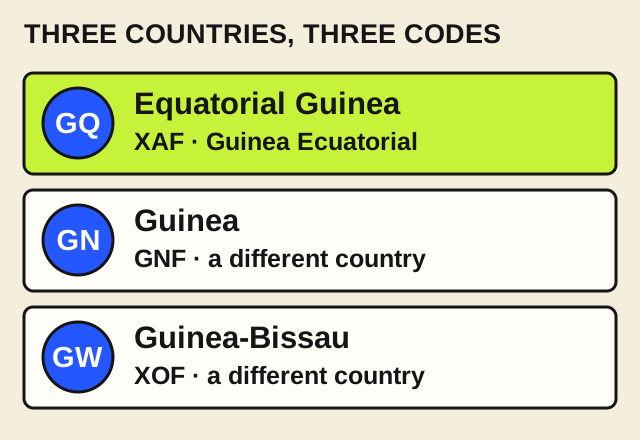
Use Equatorial Guinea, or Guinea Ecuatorial in a Spanish interface. Its country code is GQ and its currency is XAF. Guinea uses GN and the Guinean franc; Guinea-Bissau uses GW and XOF. An application filed under the wrong one can put your identification, address and payment records into three different country profiles.
This is more than a spelling issue. Bitget’s September 15, 2026 prohibited-country list names Guinea-Bissau, but not Equatorial Guinea. Its Futures Services Agreement has additional product restrictions, including Spain. Neither a Spanish-language interface nor a Spanish-language document makes a resident of Malabo a resident of Spain.
Enter citizenship and residence in their respective fields. For example, a foreign national genuinely living in Bata should not assume their passport’s issuing country supplies the answer to the residence question. Conversely, an Equatoguinean citizen living elsewhere needs the rules for that actual location.
If you selected the wrong country before verification, correct the account through the platform’s official process before depositing. Do not create a conflicting second identity to get around the first choice. This avoids discovering the mismatch only when a withdrawal is being reviewed.
Bitget: make the amount at risk visible
The useful starting point is a single USDT-margined position, not copy trading, several bots and a shared margin pool at once. Bitget documents a Futures demo environment. Use it to see which figure is the order’s exposure, which is margin, and which balance remains outside that position. Practice is about recognising those fields, not proving you can make a profit.
The isolated-margin setting is only half the decision
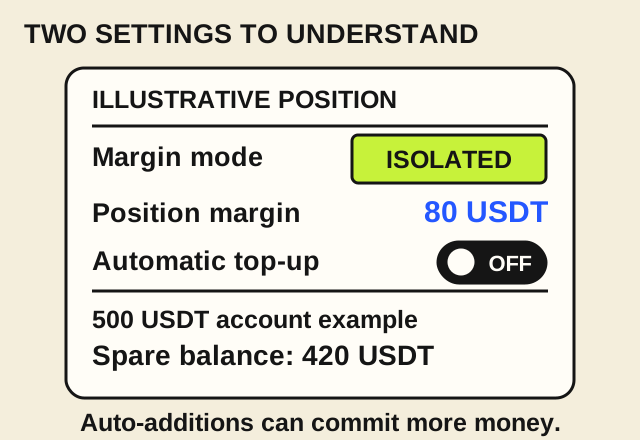
Bitget’s automatic-margin-call feature can transfer available Futures funds into an isolated position when the configured threshold is reached. That may postpone liquidation, but it also commits more money. If you want a deliberately limited allocation, inspect both the margin mode and this separate switch; do not rely on the word “isolated” alone.
For an illustrative account holding 500 USDT, suppose you allocate 80 USDT to one position. With automatic additions disabled, the other 420 USDT is not deliberately authorised by that feature to replenish it. With additions enabled, the position may draw more from the available Futures balance. This is not a promise of a precise maximum loss: fees, account terms and the actual liquidation mechanism still matter.
That choice is relevant when replacing trading funds from an XAF bank account is difficult. Decide the allocation before opening the position. Automatically committing more collateral is a different decision from accepting the original trade, and should not happen merely because the setting sounded protective.
A stop based on collateral, rather than one Bitcoin price
Bitget also offers MMR SL, a stop triggered by the account’s margin-pressure measure. It provides a different exit from a conventional price stop: useful if you want the remaining collateral, rather than a single BTC price, to trigger closure. It executes at market, does not support partial closure and has restrictions on changing margin mode while active.
Do not read an 80% trigger as “keep 80% of my money.” Suppose the required maintenance margin stays at 20 USDT and starting account equity is 100 USDT. At 80% margin pressure, equity is only 25 USDT, because 20 ÷ 25 = 80%. That means 75 USDT has already been lost before execution costs. This deliberately simplified example explains the indicator; it is not a recommended setting or a live liquidation estimate.
Choose Bitget if that additional exit control fits how you intend to manage the account. Choose OKX’s lower standard taker rate if you only need ordinary price-based orders and expect frequent trades. A more elaborate control is useful only when you understand what it will do.
Bitget or OKX: which is cheaper for futures?
At the published regular-user rates used here, Bitget charges 0.02% maker and 0.06% taker, while OKX’s worked fee documentation uses 0.02% maker and 0.05% taker. Both opening and closing executions cost money. The figures below assume the same 2,000 USDT value on each side; changing prices change the closing fee.
| How it fills | Bitget | OKX |
|---|---|---|
| Maker entry + maker exit | 0.80 USDT | 0.80 USDT |
| Maker entry + taker exit | 1.60 USDT | 1.40 USDT |
| Taker entry + taker exit | 2.40 USDT | 2.00 USDT |
OKX wins the taker-cost comparison; neither wins the maker comparison at those rates. Twenty unchanged round trips entered and exited as taker orders cost 48 USDT versus 40 USDT. That is an 8 USDT difference before funding, slippage and transfer costs. For frequent market-order execution, it is a concrete reason to prefer OKX.
A limit order is not automatically a maker order. If its price immediately matches an existing order, it can take liquidity. If you need to exit urgently, assuming a maker fee can understate the cost. Use the execution record, not the name of the order button, to explain a charge.
Do not buy BGB simply because an advert mentions fee discounts: Bitget’s August 2026 FAQ specifically describes its BGB fee-payment switch as a spot discount. Futures tier rates need their own confirmation. The comparison above assumes no special promotion, referral rebate or negotiated rate.
How much can it cost to leave a position open?
A small difference in execution charges can be overtaken by funding. Bitget’s documentation describes the usual eight-hour cycle but explicitly allows different intervals for some contracts or conditions. Read the countdown and rate on the actual market. “Crypto trades all weekend” does not mean a weekend position has no holding cost.
For example, assume a constant 2,000 USDT position and a positive 0.01% funding rate paid by the long at each settlement. One payment is 0.20 USDT; three are 0.60 USDT. If the rate were instead 0.05%, those three payments would total 3 USDT. These are scenarios, not today’s funding rates or a forecast.
When an exchange shows settlements at 00:00, 08:00 and 16:00 UTC, they correspond to 01:00, 09:00 and 17:00 in Malabo and Bata. An app may already display local time, so check the timezone before adding an hour. The contract countdown is more useful than memorising a generic schedule.
If your intended holding period is several days, compare the likely funding exposure as well as maker/taker fees. A dated listed future can avoid a perpetual’s periodic funding transfer, but its price can contain a premium and it has an expiry and broker charges. “No funding” is not the same as “free to hold.”
Can you deposit XAF directly from a local bank?
Do not assume a local bank transfer or card purchase is available just because the exchange accepts your country. COBAC’s May 2022 notice restricts supervised institutions’ crypto dealings, including conversion and settlement of related transactions. This is a banking restriction to account for, not evidence that every exchange globally rejects every Equatorial Guinea applicant.
The distinction changes what to do next. If you already hold assets lawfully and the exchange approves your product, compare the platform itself. If all your funds are in a domestic XAF account, first establish whether the proposed transaction can be carried out for its real purpose. Do not fund a position on the assumption that a bank will approve the next transfer when you need it urgently.
Bitget also distinguishes its exchange services from third-party fiat providers. A payment widget can therefore have its own supported countries, identity review, limits and currency quote. Completing Bitget verification does not automatically complete the payment provider’s checks.
What about a listed Bitcoin future through a broker?
Interactive Brokers includes Equatorial Guinea on its application-country list and publishes access to CME Micro Bitcoin futures. That makes it a candidate for someone who wants a listed contract, subject to account and product approval. The bank still needs to assess the actual outward investment under the BEAC framework. A cash-settled future should be described accurately, rather than hidden behind a generic “personal transfer” purpose.
This route fits someone who specifically values an exchange-listed, dated contract and can satisfy the bank and broker requirements. It is not our automatic replacement for every crypto exchange: contract size, cash collateral and transfer costs may make it unsuitable for a small intended exposure.
What a Malabo bank transfer can cost
A useful published reference is SGBGE’s first-quarter 2026 tariff, available through CNEF Guinea Ecuatorial. For outward EUR transfers outside CEMAC, it lists a 1% commission with a XAF 5,000 pre-tax minimum, a 0.5% BEAC charge and variable correspondent fees. This dated schedule helps you price an authorised transfer; it is not evidence that the bank approves crypto funding.
| Transfer value expressed in XAF | Bank commission | BEAC component | Subtotal before tax and other charges |
|---|---|---|---|
| 100,000 XAF | 5,000 XAF minimum | 500 XAF | 5,500 XAF |
| 1,000,000 XAF | 10,000 XAF | 5,000 XAF | 15,000 XAF |
The smaller example uses 5.5% of the transfer amount on those components alone; the larger uses 1.5%. The bank minimum explains the difference. Sending ten separate transfers of 100,000 XAF would generate 55,000 XAF under these assumptions, versus 15,000 XAF for one transfer of 1 million. That arithmetic is a cost comparison, not a reason to invest more money.
The tariff lists incoming transfers as free of a fixed receipt charge, but separately gives a conversion basis for non-EUR receipts. A zero receipt fee therefore does not establish a zero-cost USD withdrawal. Obtain the final credited XAF quote and identify any conversion and correspondent deductions.
If a proposed small trading account cannot absorb these costs, the answer is not to increase leverage to earn them back. The payment structure may simply be too expensive for the amount involved. Keep that decision separate from which exchange has the lower trading fee.
Will Bitcoin protect you from XAF devaluation?
Not reliably. The CFA franc used in Equatorial Guinea is linked to the euro, while a USDT-margined Bitcoin contract combines a crypto price position with a dollar-linked settlement asset. Those exposures do not match an obligation stated in euros. A profitable Bitcoin call is not guaranteed to preserve a particular amount of XAF purchasing power.
In January 2026, Equatorial Guinea’s government published BEAC’s denial of rumours of an imminent CFA-franc devaluation. Treat it as a dated statement, not an indefinite guarantee. More importantly, a rumour does not tell you the size, direction or timing of a suitable Bitcoin position.
Consider a trader whose upcoming bill is denominated in euros. Even if USDT remains close to USD, the USD/EUR rate can move while Bitcoin falls. Increasing the Bitcoin leverage increases the crypto loss exposure; it does not lock the bill’s exchange rate. A direct, permitted currency arrangement answers a different question from crypto speculation.
Separate the money needed for that bill from money deliberately allocated to a trade. The amount you choose to place in a Futures wallet should be determined by the trade you can afford, not by an urgent need to compensate for uncertain exchange rates.
How do you get the result back out?
Plan the exit destination before opening a position. An exchange can return a crypto asset to a compatible address, but a domestic bank account expects a supported cash transfer. Closing a USDT future leaves a USDT result; it does not by itself create XAF in a bank in Bata.
If another service handles the permitted cash conversion, compare the amount it will actually pay with the token amount it needs. Include its minimum transaction, its withdrawal fee and the receiving bank’s treatment. Do not count an advertised conversion rate as an executable offer until the amount and payment method match your case.
For a dispute, identify who performed the disputed step. A futures execution belongs with the exchange, a missing bank credit with the payment and banking records, and an incorrect currency quote with the service that supplied it. CNEF publishes the regional framework for complaints against supervised financial institutions; that does not make it the supervisor of an offshore crypto exchange.
Keep the order identifier, withdrawal reference and bank credit as separate records. This is useful for one practical reason: you can show whether a shortfall came from trading, a transfer deduction or conversion. Without that separation, a 20 USDT charge can be mistaken for a trading loss and lead you to switch the wrong service.