

















Which exchange fits a São Tomé and Príncipe account?
Kraken: start from an existing EUR balance
Retain EUR collateral while understanding the USD valuation and settlement of the derivative.
Read the verdictBybit: use USDC with session settlement
A different fit for existing stablecoin funds; know why the entry price resets during an open trade.
Read the verdictThis choice depends on money you can lawfully move and an account that enables the intended product. A EUR funding option is not automatically available to every bank or residence. The local foreign-exchange process comes before a transfer, and the exchange’s deposit instructions must match the payment being sent.
Why consider Kraken if your money is already in euros?
The current international Kraken collateral table lists EUR with no collateral haircut and a 0.00% conversion-fee entry. It lists USDC and USDT with a 0.50% collateral haircut. A haircut is a reduction in the value counted towards margin, not a percentage of your coins immediately removed from the wallet.
For an illustration, $1,000 equivalent of collateral subject to a 0.50% haircut contributes $995 before other adjustments. A zero-haircut EUR balance still changes in dollar value as EUR/USD changes. That makes it different from holding dollars even though no haircut applies. The account assesses the derivative in dollars; the local dobra’s euro link does not change that.
What this advantage does, and does not, solve
EUR collateral can avoid an unnecessary purchase of USDT solely to begin an otherwise eligible trade. It does not remove the bank’s outward-transfer cost, the exchange’s trading fees or the currency conversion needed to settle dollar-denominated losses. It also does not guarantee that the EUR funding provider shown in a general support table will accept your particular transfer.
Use the current schedule attached to the account, not an old review quoting a universal conversion percentage. Kraken’s general fee page and collateral table have been updated; older translated support pages can retain historic examples. When rates differ, match the applicable entity and current account display rather than combining the most favourable number from each source.
Our preference for Kraken is therefore specific: it is a sensible first candidate for approved EUR funds when the user wants a derivatives wallet that accepts those funds as collateral. If you only hold a small local STN balance, an expensive international transfer can outweigh that convenience. Do not turn a product advantage into a reason to send more money than you intended.
When is Bybit’s USDC futures account the better fit?
Bybit’s USDC perpetuals quote and settle in USDC. For a trader who already holds that asset on a supported network, they can avoid converting it into USDT merely to choose a contract. Check that the intended market exists in the USDC product and that its order size and liquidity suit the planned position.
Bybit’s unified account may accept other collateral too, but fees still need the relevant settlement asset. Its order-cost guide warns that insufficient settlement funds can create borrowing. Holding an adequate USDC balance for a USDC contract is easier to follow than assuming every asset in the wallet is interchangeable with the coin used to settle charges.
Why the displayed entry price can change without a new trade
USDC perpetuals use session settlement. At the session boundary, unrealised profit or loss is realised into the account balance and the displayed average entry is reset to the mark price. The position can remain open. A changed entry price is therefore not, by itself, proof that the exchange opened another trade or erased earlier profit.
The session follows that contract’s funding interval, which can be one, two, four or eight hours under the current guidance. Do not assume every USDC contract resets on an eight-hour clock. The live contract schedule matters, particularly when comparing a statement from one day with the position currently on screen.
Choose this Bybit product when an existing USDC balance and its settlement convention fit your record-keeping. Choose Kraken first when you want to start from approved EUR funds. Converting euros to USDC solely to imitate the second case adds a step whose cost needs a real benefit in return.
Did the session reset change how much I earned?
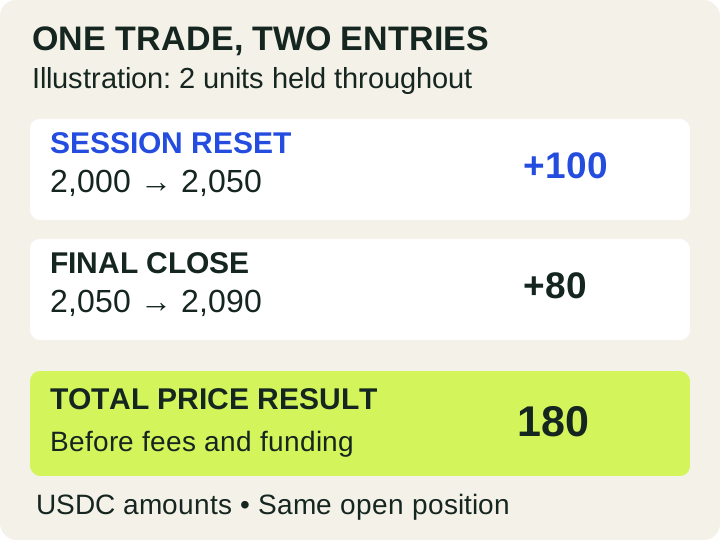
Take a hypothetical two-unit long opened at 2,000 USDC. At a session mark of 2,050, its 100 USDC gain is realised and the reference entry resets to 2,050. If the same two units later close at 2,090, that final segment adds 80 USDC. The whole price result is 180 USDC before fees and funding.
Looking only at the final close would show 80 and understate the full result. Adding the first 100 to a fresh calculation from 2,000 to 2,090 would count that first gain twice. Reconcile the session record with the final close instead of trusting one line labelled “realised P&L”.
A losing first session works the same way: a later green number may only recover part of a loss already booked. Moving an amount from unrealised to realised does not reset your economic starting point. This distinction is especially useful when you later convert the final balance into EUR and then dobras for spending.
Bybit’s profit-and-loss guide also separates leverage from position size. For the same two-unit trade and the same price change, selecting a higher leverage multiple does not create a larger absolute trading gain; it changes the initial margin requirement and risk. The gain becomes larger only if you increase the exposure or the market move changes.
How expensive is sending money from a local bank?
BISTP’s 2026 personal tariff distinguishes an international transfer using the customer’s foreign currency from one using currency supplied by the bank. The listed commission is 1.30%, minimum 315 STN, for the first case; the general bank-currency line is 2.48%, minimum 465 STN. These are commission components, not all-in prices.
| Currency source | Percentage calculation | Minimum that applies |
|---|---|---|
| Your own foreign currency | 1.30% = 95.55 STN | 315 STN |
| Bank-supplied foreign currency | 2.48% = 182.28 STN | 465 STN |
For that illustrative amount, the minimum dominates in both cases. The difference between those two commission components is 150 STN. It would be misleading to call 95.55 STN the total fee just because a calculator multiplied the transfer by 1.30%.
The tariff separately lists administration, telecommunications, applicable taxes and possible correspondent-bank expenses. It also notes a 0.5% stamp duty on the transferred amount. Ask for the complete written payment quote and the net amount expected at the beneficiary. Do not add every line indiscriminately: some depend on the chosen channel, amount or actual handling.
This is a case where keeping an existing foreign-currency balance can matter more than a small difference between two futures execution fees. The saving is not automatic, because the transfer still needs approval and a supported receiving account. If the all-in cost makes a small trading budget uneconomic, leave the transfer unmade rather than increasing the budget to justify the fee.
Will a Dobra 24 card work on an exchange?
A Dobra 24 card working at a local ATM or shop does not establish that it can pay an overseas exchange. BISTP’s tariff describes Dobra 24 domestic ATM, transfer and point-of-sale services. An international online checkout needs its own supported card network, issuer approval and merchant acceptance.
Do not interpret a bank’s separate tariff line for international Visa operations as proof that it issues every customer a Visa card, or that a specific exchange accepts one. A tariff can describe processing an operation without promising all of the products a reader imagines from the name.
Before paying a card-processing charge, check the final recipient and asset delivered. Some purchase flows use a third-party provider with a different identity check, minimum and fee. A successful card purchase may place crypto in a spot wallet while Futures remains unavailable; it is not a substitute for checking product eligibility first.
For this reason, neither featured recommendation relies on a claimed Dobra 24 integration. Kraken is assessed for supported EUR funding and collateral; Bybit for an existing supported USDC balance. A payment method should be named as a working exchange integration only when the actual provider and account confirm it.
Do I need permission for an overseas investment transfer?
São Tomé and Príncipe’s foreign-exchange law separates current transactions from capital transactions. Article 15 subjects the listed capital operations, including securities, financial loans and other capital movements, to prior central-bank authorisation. Article 16 allows foreign-currency accounts, but holding such an account does not itself waive the rules governing an outward investment.
Ask the bank to classify the intended transaction and identify the approval or documentation it requires. An overseas trading deposit should not be described as an ordinary purchase of goods merely to fit an easier payment category. The relevant decision is whether that transfer for that purpose may proceed.
BCSTP’s 2024 operational regulation also addresses foreign-exchange processes and export-receipt handling. It should not be read as a blanket exemption for a private futures deposit. If the bank cites a newer permission or exemption for your case, retain that specific basis with the payment records rather than relying on a general internet statement that all transfers are free.
Is the right exchange rate 24.5 or 24,500 dobras per euro?
For the current dobra, the euro reference is 24.5 STN per EUR. The old 24,500 figure belongs to the pre-redenomination unit: 1,000 old dobras became one new dobra. Mixing the two can make a modest bank charge or trading balance appear a thousand times larger than it is.
At that reference, €300 corresponds to 7,350 STN before fees or any applicable commercial conversion terms. That is the amount used in the bank-commission example above. It is not a quote promising the exchange will credit €300 after all deductions.
The euro link also does not fix the local value of a dollar stablecoin. USDC targets the US dollar, while STN is tied to the euro. A gain measured in USDC can be partly offset by the dollar’s movement against the euro before you convert back into dobras. Keep the currency labels attached to each result rather than comparing bare numbers.
How should you plan the return to a local bank?
Read the available withdrawal methods before choosing the initial deposit method. Kraken publishes currency-specific routes, minimums and regional restrictions, but the options actually shown for the verified account determine what can be requested. A reference to worldwide availability still has conditions; a local bank account is not automatically a SEPA account because its currency is EUR.
For an approved international payment, use the receiving bank’s exact beneficiary instructions and establish who bears intermediary charges. A deposit reference used to fund an exchange is not necessarily the reference needed on a withdrawal. Sending funds with an invented account detail can turn a straightforward transfer into a returned payment with additional expense.
On the Bybit path, first settle the trading account and identify the withdrawable USDC amount. A bank cannot receive a blockchain token by SWIFT. Returning to STN requires a permitted service that accepts the relevant asset and can deliver the local payment. Its supported network and minimum must be checked on both ends; a low network fee is useless if the recipient cannot credit that transfer.
Do not assume a smaller island market has the same local payment coverage as a Portuguese or Brazilian account. Language, an EUR reference and an international website do not establish the same banking product. The useful comparison ends with money arriving through a permitted method you can actually use, rather than with an attractive profit screenshot.