











Which crypto futures exchange makes sense in Switzerland?
Bank Frick’s CHF transfer connection and Kraken’s CHF collateral support can form a complete franc-funded path. The useful comparison is the accepted CHF amount after applicable valuation and charges, rather than an automatic purchase of USDT before opening futures.
This is a different proposition from choosing a Swiss bank to hold Bitcoin. Swiss custody, a Swiss IBAN and leveraged crypto contracts are three separate services. A platform can be excellent at one without supplying the other two. For this guide, access to the derivative comes first; the payment route and tax records then decide how practical it is to use.
Bybit is a second account to consider for someone who already holds transferable crypto and wants its international perpetual markets. Switzerland is not on its current service-exclusion list. That supports consideration, but it is less specific than a Swiss banking connection and does not establish FINMA supervision. The final product offer still belongs to the verified account and its contracting entity.
| Account | Useful Swiss distinction | Main qualification |
|---|---|---|
| Kraken international derivatives | CHF funding and eligible CHF collateral alongside crypto futures | International service; contract and account limits apply |
| Bybit international | Alternative perpetual-market selection for crypto-funded traders | Swiss access inferred from the current exclusion policy; no claim of Swiss licensing |
| Dukascopy Bank | Swiss-bank crypto CFD alternative | Different instrument and margin schedule; not a substitute for a broad perpetual exchange |
Can you trade futures with Swiss francs?
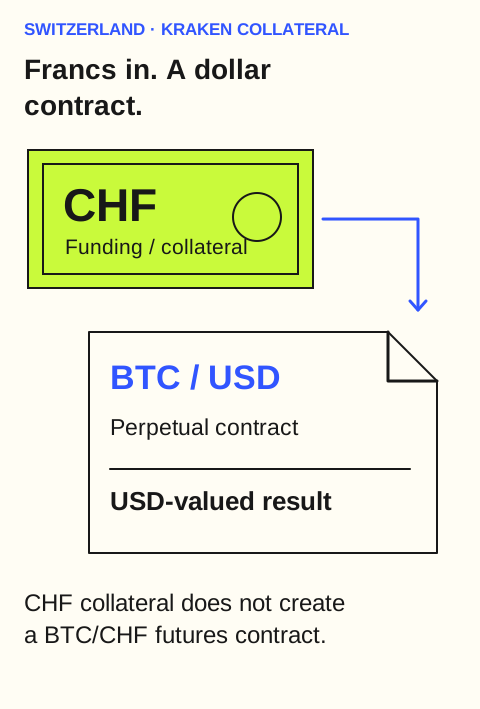
Yes, eligible Kraken multi-collateral accounts list CHF among their accepted collateral currencies. The reviewed table assigns CHF a zero collateral haircut. In plain English, the platform does not apply an extra percentage discount to the dollar value of those francs solely because CHF is the collateral asset.
That does not turn a BTC/USD perpetual into a BTC/CHF contract. The market price, profit calculation and collateral valuation can use different currencies. Someone funding with francs should look at the contract symbol and account statement, rather than assuming that a CHF display on a Swiss landing page describes the settlement currency.
This distinction matters most when you want to keep unused funds in francs. Holding USDT adds a stablecoin exposure; holding BTC adds an asset whose value may fall at the same time as a long position. CHF removes those particular exposures, but its dollar value still moves. It is useful collateral, not a fixed dollar balance.
A result in dollars can feel different in francs
Consider a deliberately simple example, excluding fees. A $500 realised gain is worth CHF 450 at CHF 0.90 per dollar, or CHF 425 at CHF 0.85. The trade made the same dollar amount in both cases; the amount available for Swiss spending is different. These are illustrative exchange rates, not a current FX quote.
For frequent traders, an export containing the original currency and transaction date is therefore more useful than a single dashboard percentage. It lets you reconcile what the derivative earned, what currency conversion changed, and what actually arrived in the Swiss bank account. A deposit history alone cannot reconstruct those three numbers.
Funding from a Swiss bank: use the CHF rail deliberately
Bank Frick’s Kraken instructions distinguish domestic CHF SIC transfers from international SWIFT payments. The SIC route is for qualifying Swiss and Liechtenstein banks. A CHF account held elsewhere is not automatically a domestic Swiss transfer just because the account balance is in francs.
The practical advantage is avoiding an unnecessary round trip through euros or a card purchase. If your exchange account displays a CHF bank-deposit method, compare that method with a crypto purchase using the same starting amount. Include the purchase spread, transfer charge and any conversion required before the balance becomes usable collateral.
What to compare on a CHF 2,000 deposit
A transfer advertised as free can still lose to another route if the currency conversion is expensive. A hypothetical 1% conversion cost on CHF 2,000 is CHF 20; a CHF 5 transfer fee would be cheaper if the currency conversion were otherwise identical. That calculation does not claim either is a live bank tariff. It shows why the total credited balance matters more than the word “free”.
Bank details should come from the account’s deposit screen. A saved beneficiary from an older provider can be wrong after a funding-provider change. In particular, do not send euros to a CHF instruction merely because the recipient bank supports both currencies: the provider describes conversion at its own rate when the incoming currency does not match.
Returning profits to Switzerland
For withdrawals, choose the supported CHF method associated with your own bank account and inspect the displayed fee before confirming. SWIFT may involve an intermediary bank. The number shown by the exchange is therefore not always the complete cost of an international route.
Keep the exchange statement and bank receipt together for a sizeable cash-out. They answer different questions: the exchange record explains the trading result, while the receipt establishes the movement into the bank. Neither the bank accepting a deposit nor a payment provider processing it is an endorsement of the derivative you traded.
How much leverage can a Swiss account actually use?
Switzerland is outside the EU and the European Economic Area. It should not inherit an EEA account’s product limits simply because the customer speaks German, French or Italian. The country selected for verification and the exchange’s contract determine the applicable product service.
Kraken’s Swiss futures-market page currently labels major BTC, ETH and SOL perpetual markets at up to 100x, while other markets show lower limits. Its detailed margin schedule also reduces the available leverage as positions grow. A headline maximum describes a particular market and size tier, not the buying power available on every coin.
The contract specification deserves more weight than a general “50x” or “100x” advertisement. The same provider can offer a simplified app product, a professional trading interface and regional derivatives under different conditions. A screenshot of one should not be used to promise the terms of another.
Why a larger position can receive a lower maximum
The published margin tiers are especially relevant to a trader moving beyond a small test position. A setting that exists for a modest BTC order may not remain available when exposure passes the next size threshold. Splitting that exposure across several orders does not necessarily place the combined position in a lower tier.
This is a reason to choose a provider with a readable position schedule, rather than rank exchanges solely by their largest advertised multiplier. It also helps explain why two Swiss residents can see different available leverage: the market, position size, verification status or product account may differ even when their country is identical.
Compare futures fees without mixing them with spot prices
Kraken’s reviewed entry futures tier lists 0.02% maker and 0.05% taker fees. Those are derivatives fees, not the provider’s separate spot-buying schedule. The tier system can recognise activity or qualifying assets under its published conditions, so an established account may have a different rate from a new one.
For a $10,000 position, a 0.05% execution charge is $5. Opening and closing at that same rate and notional value would total $10 before funding, currency conversion or other charges. The percentage applies to the position, not merely the margin deposited. This example deliberately holds the exit value constant so the arithmetic is transparent.
Kraken versus Bybit at the basic futures tier
Bybit’s reviewed non-VIP derivatives rates are 0.02% maker and 0.055% taker. Against Kraken’s cited tier, the maker rate is the same and Kraken has a small taker advantage. On the unchanged $10,000 example, entering and exiting as a taker costs $11 on Bybit versus $10 on Kraken before holding and other charges.
That one-dollar difference does not justify an expensive currency conversion or transfer on its own. For a Swiss beginner funded in CHF, the direct collateral and banking connection is a stronger reason to start with Kraken. For an existing crypto-funded Bybit account, moving solely to save that amount may not be economical. Larger turnover or a different qualifying tier can change the calculation.
Funding can outweigh a small execution-fee advantage
The useful comparison is the contract you expect to hold. A lower taker fee does not guarantee the lower total cost of a perpetual position if its funding payments are materially higher during your holding period. Funding also changes direction; a historical screenshot cannot promise the amount you will pay or receive tomorrow.
Swiss traders have an additional comparison: whether their chosen collateral creates conversions when fees or losses are booked. Kraken explains that multi-collateral fees and realised results use USD, with non-dollar funds handled according to its collateral and conversion rules. Keeping francs available is convenient, but the account statement must still explain the dollar debits.
| Cost | Compare this | Avoid comparing this instead |
|---|---|---|
| Deposit | CHF spent versus usable balance credited | Transfer fee alone |
| Execution | Same contract size and actual account tier | Spot fee versus futures fee |
| Holding | Funding for the intended contract and period | A single old funding screenshot |
| Withdrawal | CHF received after the supported payout route | Gross exchange balance |
What FINMA status does—and does not—tell you
FINMA’s institution lists separate types of permission and supervision. A bank licence, an anti-money-laundering affiliation and permission to operate an investment service are not interchangeable. When comparing a Swiss-branded business with an international exchange, identify the company named in the account agreement before comparing regulatory labels.
Membership of a recognised self-regulatory organisation is relevant to Swiss anti-money-laundering obligations. It is not a blanket FINMA approval of every token, leverage setting or overseas company using a similar brand. That distinction is more useful than calling every accessible platform “regulated in Switzerland”.
A foreign provider’s ability to accept a Swiss customer also should not be described as Swiss deposit protection. The existence of a Swiss payment route does not move the entire derivatives account inside the Swiss banking system. The bank handling the transfer and the company holding trading collateral may be different counterparties.
What happens to the familiar CHF 100,000 protection figure?
esisuisse describes protection for qualifying deposits at participating Swiss banks and securities firms, with a limit of CHF 100,000 per client per bank. That figure is not insurance against a futures loss. Nor does it establish protection for cryptocurrency or collateral held by a foreign exchange.
This does not make a Swiss bank irrelevant. It explains why a bank-based crypto CFD and an international perpetual should be compared as different products. The bank may be attractive for a consolidated banking relationship; the exchange may better suit a broader crypto derivatives watchlist. Neither advantage should be borrowed to advertise the other service.
When a Swiss bank is useful—and when it misses the point
Swissquote’s crypto materials describe crypto-asset trading and associated services. A customer wanting to hold coins in a Swiss banking relationship can reasonably investigate that offering. It should not automatically take first place in a comparison whose question is where to open a crypto perpetual position.
Dukascopy publishes a separate cryptocurrency CFD margin schedule. That is a relevant leveraged alternative, but the instrument is a CFD and the requirements vary by instrument. A Swiss resident choosing it should compare the specific crypto contract rather than assume a bank platform reproduces the market selection or funding model of a perpetual exchange.
The bank’s published schedule makes the difference tangible: BTC/USD and ETH/USD require 20% margin, equivalent to up to 5x leverage, while several listed altcoin CFDs require 100%. The reviewed maximum exposure is $100,000 equivalent for each of BTC/USD and ETH/USD. These are instrument limits from that service, not a national Swiss leverage ceiling.
A Swiss trader wanting a modest BTC position within an existing banking relationship can therefore compare that specific CFD. Someone whose requirement is a broad altcoin perpetual account should not assume the bank’s crypto list provides leverage on every named asset. The distinction is product fit, rather than an automatic preference for the highest multiplier.
For an existing Bybit user, moving to a Swiss bank simply for the word “Swiss” may remove the derivative that motivated the account. Conversely, keeping an international futures balance solely to make occasional unleveraged purchases can add complexity without helping that use case. The right shortlist follows the intended trade, not the most prestigious address.
Do decentralised perpetuals change the recommendation?
Self-custody is a different operating model, not a substitute for checking a service’s location terms. A wallet connection does not itself establish eligibility or remove the need for Swiss tax records. This guide does not promote a DEX as a way around an exchange restriction or award it Swiss regulatory status.
Are leveraged crypto profits tax-free in Switzerland?
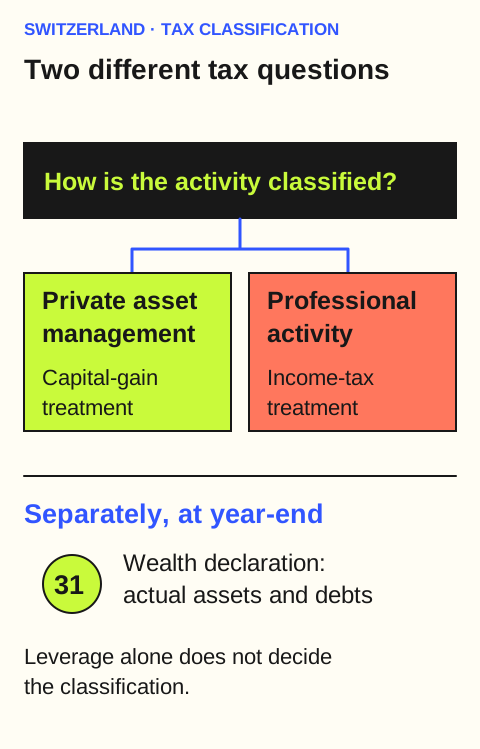
Private capital gains and professional trading income are treated differently. Switzerland’s reputation for favourable private-investment taxation is real, but it does not justify advertising every futures profit as tax-free. The Federal Tax Administration’s crypto guidance points to the nature and extent of the activity, including financing, when distinguishing private asset management from commercial activity.
The relevant question for an active leveraged trader is therefore not simply “Did I withdraw the money?” It is how the activity is classified and how the particular product is treated. A large account withdrawal can include your original capital, realised trading results and currency changes. Those components should not be confused.
Why leverage deserves an early tax conversation
Circular 36 provides a cumulative safe-harbour framework for private securities investing. Its criteria include holding periods, turnover, dependence on gains, financing and the use of derivatives for hedging. Short-term speculative derivatives may fall outside that safe harbour. Failing a condition does not, by itself, automatically make the person a professional trader; the overall circumstances must be assessed.
That is a narrower and more useful conclusion than either “all Swiss crypto gains are exempt” or “using leverage makes all gains taxable”. Someone relying on frequent perpetual profits to cover living costs has a different factual position from someone occasionally hedging a long-held portfolio. Obtain the classification before building a budget around an assumed exemption.
Year-end wealth is a separate issue
Zurich’s published guidance requires crypto holdings to be included in taxable wealth, using the relevant year-end valuation approach. It also distinguishes private gains from commercial activity. An income-tax exemption for a private gain does not imply that the remaining assets disappear from the wealth declaration.
For a futures account, preserve an equity statement showing cash, collateral assets, open positions and liabilities. Do not substitute the total leveraged position size for what you own. Equally, do not report only the original deposit if the account value has changed. The appropriate return treatment depends on the holdings and obligations actually present at year-end.
Zurich, Geneva, Ticino and Zug: what changes locally?
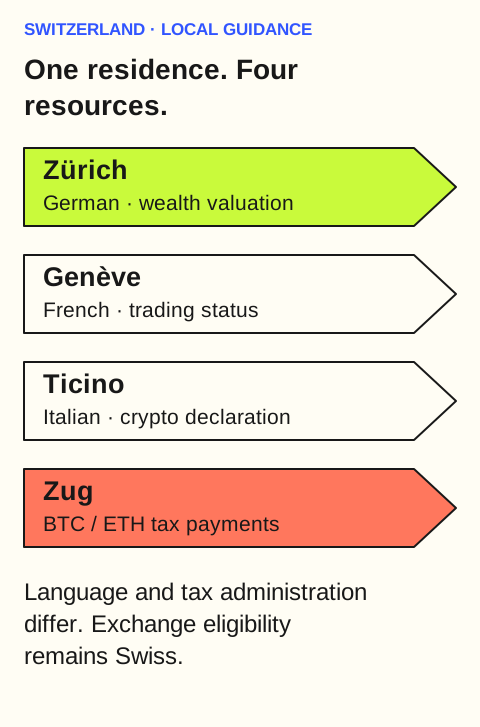
There is no reason to manufacture four exchange rankings for Switzerland’s language regions. The reviewed international access policies are country-based; they do not give a German-speaking resident a larger crypto leverage allowance than a French- or Italian-speaking neighbour. Regional differences become useful when they change tax administration, documentation or how a reader can obtain an answer.
Zurich and German-language tax guidance
Zurich provides a dedicated crypto entry in its tax guidance, including valuation and the distinction between private and commercial activity. A Zurich resident can use that material to prepare a return discussion with the actual canton responsible for the assessment. It is more relevant than a generic international blog claiming Switzerland has one flat crypto tax rate.
Geneva and the French-speaking reader
Geneva explicitly addresses private wealth management versus trading in cryptocurrencies and refers to the federal framework. The practical point is the assessment of the activity, rather than the interface language chosen on an exchange. An account in French still needs records that distinguish contributions, disposals, expenses and remaining assets.
Ticino and Italian-language records
Ticino has published its own instructions for declaring cryptocurrency holdings. The language and return process are local; they do not establish a separate Italian-style exchange regime within Switzerland. Someone living in Lugano should use the Swiss residence on the account, not select Italy because the application or customer support is in Italian.
Zug’s crypto reputation has limits
Zug accepts eligible tax payments in Bitcoin and Ether through its payment arrangement. This is a method of settling a tax invoice, not an exemption for derivatives profits and not a preferential futures account. It is useful if you already hold those assets, but it should not drive the exchange ranking.
Foreign residents, cross-border workers and Swiss citizens abroad
A Swiss passport and a Swiss residential address answer different onboarding questions. A Swiss citizen living in France normally encounters the provider’s French or EEA service. A French citizen genuinely resident in Switzerland should enter the Swiss residence and the real identity document. Language, nationality and residence should not be collapsed into one country selector.
Cross-border workers need particular care because earning CHF does not establish Swiss residence. Someone commuting from France or Germany may have a Swiss salary and bank relationship while remaining resident abroad. The availability of a CHF deposit rail cannot determine which derivatives contract the exchange is allowed to offer that person.
For new arrivals, keep the residence permit, current address evidence and bank details consistent. A relocation can change the account’s contracting entity or product menu, so an old futures approval should not be assumed to transfer unchanged. Updating the address is more important than retaining the old country’s marketing link.
Source tax does not answer every investment question
Zug’s resident guidance distinguishes ordinary assessment and tax deducted at source, including differences associated with residence status. Payroll withholding is not proof that a separate trading activity or assets need no declaration. A person with substantial exchange holdings needs to consider those items separately from the employer’s salary deductions.
The most useful preparation is a compact annual record: account owner and entity, actual residence dates, deposits and withdrawals, realised contract results, fees and year-end balances. That record follows the person when they move and makes it possible to explain why an account changed regional services partway through the year.