
AlphaX zero trading fees: what is included?
The official policy applies zero maker and taker commission automatically to eligible products and users in supported regions. It describes this as a long-term strategy and supplies no expiry date.
BTC-SWAP-USDT also returned zero maker/taker fees on 6 October. The user agreement permits future pricing changes with notice; the calculation below uses the current policy.
Which charges remain?
The same zero-fee page excludes funding, spreads, withdrawal fees, payment-provider charges, blockchain costs and other service fees from the zero-commission claim. A position held for several funding events can therefore have a meaningful holding cost even when every entry and exit has zero maker/taker commission.
Suppose you compare 20 entries and 20 exits, each executing 2,500 USDT. Total filled turnover is 100,000 USDT. At an illustrative competing commission of 0.05%, that turnover would incur 50 USDT of trading fees; zero commission removes that particular charge. The 0.05% is a scenario input, not a claim about every rival or a hidden AlphaX fallback rate.
An average execution disadvantage of 0.05% across the same turnover would also amount to 50 USDT. This is why the fee saving should be compared with executable prices at the intended order size. The fee page alone does not prove which platform gives the better final result.
BTC, ETH and SOL have different AlphaX contract settings
The live public symbol response contained 1,000 entries across the platform's wider product catalogue. We do not describe that as 1,000 crypto perpetuals: the response includes multiple asset categories, and an entry can carry its own display and trading flags. This review uses the named crypto records rather than inflating a count from the whole response.
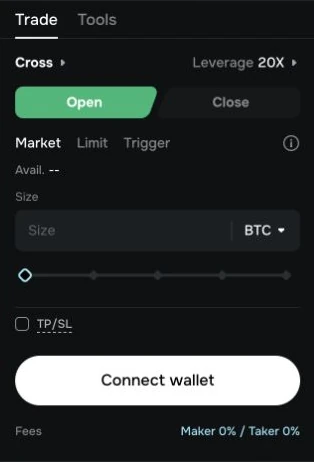
The BTC, ETH and SOL records were marked tradable and used USDT as the quote and settlement-side currency in the configuration. Their maximum leverage values were 150x, 150x and 300x respectively. A generic 200x banner therefore understates one sampled ceiling and overstates the other two.
| Contract | Published maximum | Collateral reference |
|---|---|---|
| BTC-SWAP-USDT | 150x | USDT |
| ETH-SWAP-USDT | 150x | USDT |
| SOL-SWAP-USDT | 300x | USDT |
Contract quantity needs a unit, not just a number
The same records provide quantity precision, a contract multiplier and raw risk-limit arrays. BTC's multiplier was 0.001, ETH's 0.01 and SOL's 1. Those fields must be interpreted together before turning raw contract counts into coin exposure or dollar position limits.
The unsigned ticket's unit selector is particularly important here. An amount shown in USDT is not automatically the raw count used by a contract API. Nor does a small minimum quantity establish that a deposit of that same number of dollars is enough to open a trade. Use the accepted order summary for the selected unit rather than transplanting a raw API value into a different field.
The risk arrays also carry side-specific entries. We have not converted them into one universal dollar ladder or assumed identical long and short limits without adequate documentation. The useful conclusion is narrower but sound: leverage and size controls vary by contract and tier, so a market's headline maximum is not the amount of exposure an account can open.
Funding remains contract-specific
The funding response publishes both a rate and a period for each record. BTC, ETH and SOL were examples with eight-hour periods; other entries in the response used four hours. Zero trading commission does not flatten those differences or make a small-cap contract share BTC's funding schedule.
If two contracts provide similar directional exposure, compare their actual holding charge and settlement period before choosing on commission alone. For a short trade that never crosses a settlement event, that cost may not be incurred; for a position carried over several days it can become the larger component.
The AlphaX setting that can enlarge an isolated position’s loss budget
The help centre describes both cross and isolated margin for USDT perpetuals. Cross margin shares the available settlement-asset balance across positions. Isolated margin assigns backing to a particular position. That familiar distinction is only the start of the relevant AlphaX decision because the platform also provides auto-add margin for isolated positions.
When enabled, auto-add can draw further funds from the available futures balance as the position approaches its maintenance requirement. Its guide warns that, if the remaining balance is smaller than the configured addition, the system can use that remaining balance. Under extreme conditions, all available futures assets can consequently be consumed.
An isolated label is not a fixed spending cap with auto-add enabled
Isolated, with extra balance allowed in
400 USDT remains available in this illustrative futures account.
Available funds can be added when the documented trigger applies.
Consider an illustrative account with 600 USDT assigned to a position and another 400 USDT available. Enabling an automatic 200 USDT addition permits the position to consume more than the original 600 if the documented conditions are met. The exact sequence depends on the position and remaining balance, but the original allocation is no longer the complete planned loss budget.
This does not make auto-add inherently unsuitable. A trader may deliberately reserve additional backing for a position instead of closing on the first adverse move. The important point is to decide that amount consciously rather than select isolated mode and assume every other USDT in the futures account is inaccessible to that feature.
The guide says auto-add resets after the position is fully closed and must be enabled again for a new position. A previous trade's configuration therefore should not be assumed for the next one. This matters whether you want the feature active or specifically want it off.
Read the margin ratio in the correct direction
AlphaX's liquidation guide expresses risk with a maintenance-to-equity ratio, with liquidation triggered at 100% or above. A rising ratio in that framework indicates less room, not improving account health. The estimated liquidation price can change with funding, position changes, fees and transfers.
Some generic guides use a different ratio convention. Copying their interpretation can invert the meaning of the percentage shown here. For the current AlphaX workflow, the account's maintenance ratio and active auto-add setting are more actionable than memorising a liquidation formula based only on entry price and leverage.
Closing an AlphaX position, reversing it and moving the result
The published web guide puts position management under the Positions tab and describes market, limit and flash-close controls. It separately describes Reverse as opening exposure in the other direction. A trader who wants to leave the market should distinguish that action from a simple closure.
The article's description of flash close is not proof of guaranteed instantaneous execution at the displayed price. A market-style exit still depends on available liquidity and product operation. A limit close controls the acceptable price but may remain unfilled while the original position continues to move.
Why the transfer step appears in the guide
The web tutorial funds futures through an internal USDT transfer from the spot account. The connected-wallet guide instead describes an external deposit credited to the trading account.
If the deposit appears in spot but the futures ticket has no usable balance, the missing step may be that internal transfer. Sending another external deposit would not fix the compartment mismatch.
After a close, use the realised result and remaining account commitments to assess what can be moved. Profit on an open position, total futures equity and the amount accepted by a withdrawal form are not three interchangeable figures. The UI workflow should show the permitted transfer rather than requiring you to infer it from the position's PNL colour.
Liquidation is not an exit order under your control
The account’s normal closing controls need to be used before the liquidation condition disables them. The guide describes insurance and auto-deleveraging as deficit-handling mechanisms, not protection for an ordinary stop.
AlphaX withdrawals: the published waiting periods matter
AlphaX's withdrawal guide states a 24-hour restriction after new sign-up and another 24-hour restriction after changing specified verification settings, including email, phone or Google Authenticator. A trader planning to deposit, trade and immediately remove the balance from a new account should factor that published rule into the decision.
The guide also says a withdrawal can trigger account review, with manual review if risk is detected. Its separate timing article says a transaction ID is typically generated within 30–60 minutes. That is the operator's processing expectation, not a maximum withdrawal time we measured or a guarantee that the destination has received the funds.
Three stages that should not be conflated
Submission means the withdrawal request has been entered. A generated transaction hash indicates the transfer has been sent to the blockchain according to the timing guide. Arrival at another exchange or wallet additionally depends on that network and the receiving service's requirements.
A waiting status before a transaction hash exists is therefore a different situation from a confirmed transfer that has not yet been credited by the destination. Keep the request record and, once available, the transaction hash; those identify which stage needs investigation without pretending all delays are network congestion.
The wallet guide likewise asks users with enabled email, phone or authenticator verification to complete the required checks. A connected wallet does not, on its own, prove those steps vanish. The practical conclusion is to understand the withdrawal path associated with your chosen access method before using AlphaX as a short-term transit account.
AlphaX custody: what the vault and forced-exit design actually say
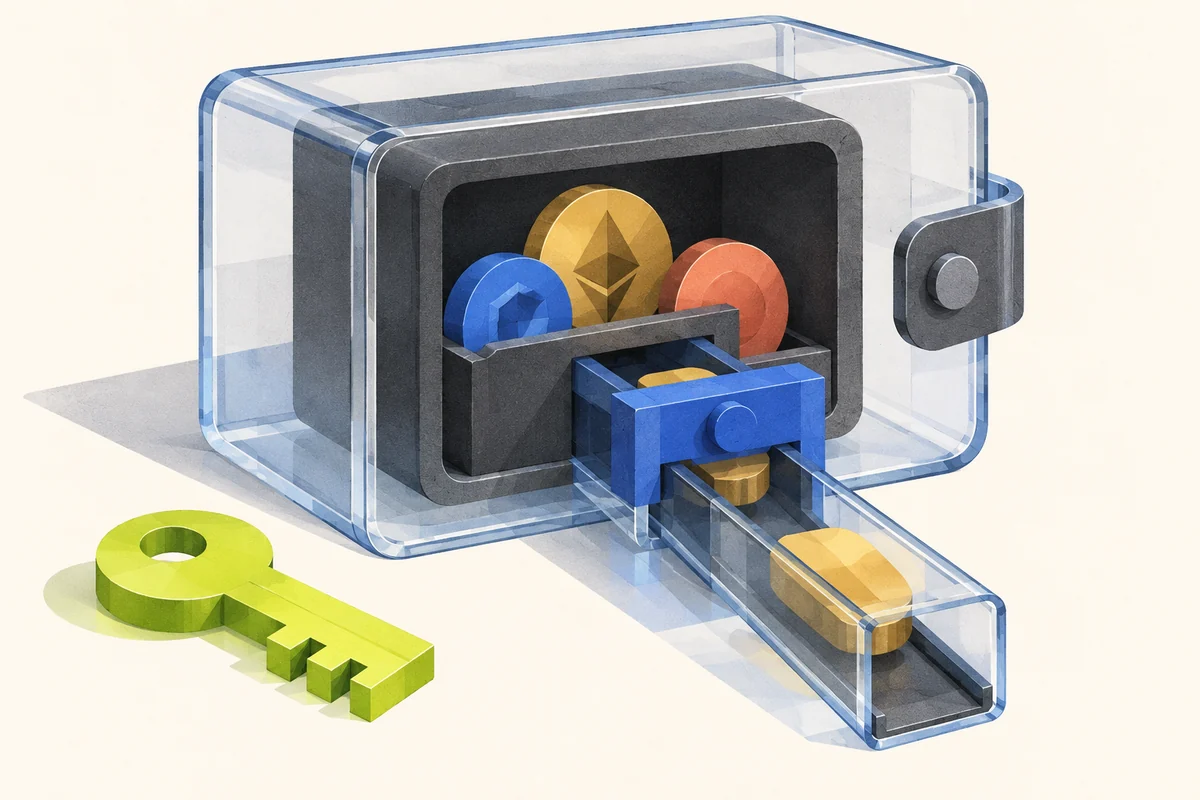
AlphaX’s current agreement describes non-custodial services. Its technical whitepaper, reviewed on 6 October, adds a more specific design: trading is matched off-chain, collateral sits in an upgradeable DexVault contract, and normal withdrawals use multiple signing authorizers. Holding a wallet key and controlling every movement from that vault are separate questions.
| Part | Published design | Practical distinction |
|---|---|---|
| Wallet key | External wallet or an embedded wallet with key export | Key ownership concerns the wallet, not every vault permission |
| Normal withdrawal | Account checks, risk review and signing authorization | The ordinary payout can depend on platform processing |
| Forced withdrawal | Direct contract request after timeout, using a proof of the recorded balance | An alternative exit is described; this review has not verified it against a funded account |
The forced-withdrawal section describes recovery if the normal service stops responding. The unanswered implementation question is whether a user can obtain the required balance proof and exercise that exit against the currently deployed contract. We did not establish that end-to-end path. The documentation is therefore more informative than a wallet-connect badge, but independent recovery remains unresolved in our assessment.
For a reader comparing trading costs, the zero-commission offer can still be evaluated. For a reader switching specifically to gain a verified independent exit, AlphaX does not yet clear that evidentiary requirement here.
Account checks and regional exclusions still exist
The agreement's general exclusion list covers both residents and citizens of named jurisdictions, including the United States, mainland China, Iran, Belarus and others. It separately prohibits derivatives for Australian residents while describing possible spot access. An Australian entity name or an AUSTRAC claim does not establish permission for an Australian retail futures account.
The current terms and guides also allow information requests and access restrictions. The retrieved material does not establish mandatory identity-document onboarding for every AlphaX user. Equally, this is not evidence that a user can never be asked for information or that every jurisdiction is supported.
AlphaX alternatives for different account requirements
If the decision is driven by independently documented on-chain trading infrastructure, compare the evidence in our Hyperliquid review rather than assuming two DEX labels describe the same custody and exit model. If privacy and collateral behaviour are the main concern, the Paradex dossier examines those product-specific trade-offs.
A conventional exchange can also be the clearer choice for a trader who values familiar account support and a well-defined verification route over a decentralization claim. Our Bybit review offers that comparison, subject to residence and product eligibility. The purpose is to resolve the account requirement, not to imply that changing venue removes leverage risk.
AlphaX futures: your questions
Is AlphaX zero-fee trading only a temporary promotion?
The current official page describes it as a long-term strategy and states no end date. Eligible trading commission was zero in the sampled BTC response. Funding and other excluded costs remain, and future policy changes are possible.
Does AlphaX offer 200x on BTC?
The reviewed BTC-SWAP-USDT configuration specified 150x, as did ETH. SOL specified 300x. Use the exact contract and its size limits instead of applying a generic brand-level leverage banner.
Can AlphaX isolated margin use the rest of my futures balance?
If auto-add margin is enabled, the documented feature can move available futures funds into that isolated position. Its guide warns that the remaining balance can be consumed under extreme conditions. Isolated mode with auto-add is not a fixed initial allocation.
Why might an AlphaX withdrawal be unavailable for 24 hours?
The withdrawal guide lists a restriction after new sign-up and after changes to specified verification settings. Account review can add a separate processing step; the guide’s timing estimate is not a guaranteed deadline.
Can Australian residents trade AlphaX perpetuals?
The current agreement specifically prohibits Australian residents from derivatives, including perpetuals and margin trading. Its possible spot permission should not be presented as futures eligibility.
Evidence behind this reviewSources and research
Sources and research
Official documents, including the technical whitepaper, public contract responses and the unsigned trading interface were reviewed on 6 October 2026. No funded trades or withdrawals were performed. The whitepaper describes an independent exit; deployment-to-account recovery and its required balance proof were not verified.
- Current zero-fee policy and exclusions
- BTC effective fee response
- Contract catalogue and market-specific limits
- Per-contract funding rates and periods
- Current user agreement via official help centre
- Futures account transfers and closing controls
- Cross and isolated margin
- Auto-add conditions and reset
- Liquidation and maintenance ratio
- Withdrawal restrictions and reviews
- Published withdrawal processing estimate
- Connected-wallet transfer workflow
- Protocol technical whitepaper: vault and forced withdrawal, pages 6–8