
Where Paradex makes a persuasive case for perpetuals
A trader who dislikes having every position associated with a publicly searchable wallet has a specific reason to examine Paradex. The exchange publishes market activity while limiting public access to individual account information. That is more useful than another vague promise of a fast decentralized exchange: it addresses who can inspect your positions while you are trading.
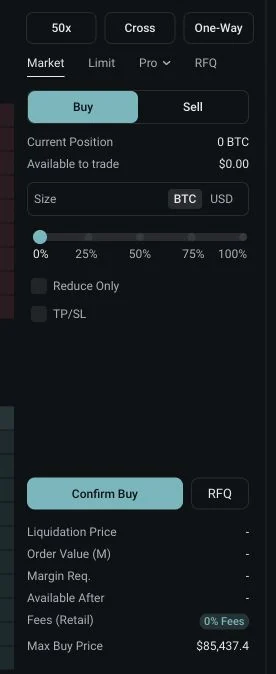
The second attraction is retail pricing. The published fee policy sets retail trading fees at zero, including perpetual orders. We also saw a “Fees (Retail)” field displaying 0% in the public BTC order builder. Those observations support the commission claim; they do not establish that a filled trade has no spread, market impact or funding expense.
Paradex becomes less straightforward when you move from a few deliberate orders to automated trading. It classifies orders by their submission method, applies different timing and rate limits, and offers some liquidity only to retail flow. Comparing a bot's experience with a browser trader's experience without accounting for that distinction can produce the wrong conclusion about both prices and costs.

Which Paradex perpetual markets and leverage limits are available?
The public market catalog returned 66 perpetual instruments in our 6 October 2026 collection. It also contained thousands of options contracts and two spot records. That total is not a count of thousands of crypto futures markets. The perpetual category itself includes non-crypto exposure, so a trader shopping for altcoin leverage should search for the exact coin instead of relying on the overall instrument total.
BTC-USD-PERP was quoted in USD and settled in USDC. Its catalog entry showed a 2% base initial margin requirement, corresponding to a 50x starting allowance, and a maintenance factor of 0.5 applied to initial margin. The public BTC interface also displayed 50x. This is evidence for that market and configuration, rather than a promise of the same allowance for every asset or account size.
Minimum order versus practical trade size
The BTC specification listed a $10 minimum notional and a quantity step of 0.00001 BTC. It also listed a maximum order size of 100 BTC and a position limit of 300 BTC. A small order minimum makes a controlled first execution possible; the large upper limits do not prove that the order book can absorb anything close to those amounts at the displayed price.
For an altcoin, the useful comparison is the cost of entering and exiting your intended quantity. A tiny top-of-book spread says little about a much larger sale. Paradex's book displays cumulative quantity, letting you see how many levels a proposed trade would consume. Read that alongside the order builder's maximum buy or minimum sell price, not as a replacement for it.
We did not execute a funded order or measure sustained depth through volatile sessions. The catalog proves published market configuration; the unsigned interface demonstrates available controls and quotes at inspection. Neither supports a blanket claim that Paradex has the best liquidity for all of its listed markets.
Retail versus Pro: the difference that changes Paradex fees
Retail is an order classification, not a lifetime label attached to an individual trader. Orders submitted through the web interface qualify, and the documentation also allows interactive API orders to qualify. Standard API submissions use Pro behavior by default. It would therefore be inaccurate to say that every API user pays Pro fees or that everyone opening an account automatically receives the same execution conditions.
Retail submission and cancellation each have a documented 300-millisecond delay. Retail orders also face limits of three per second, 30 per minute, 300 per hour and 1,000 per 24 hours. Those limits suit deliberate trading much better than rapidly updating quotations. A cancellation is not exempt from the timing distinction simply because it is intended to remove risk.
The documentation states that exceeding retail rate limits switches the account to Pro order behavior and removes access to retail price-improvement liquidity. That matters if an apparently manual workflow uses scripts or other tools in the background. A trader should not extrapolate the conditions seen on an occasional browser order to a high-frequency account without checking the actual order classification.
| Feature | Retail order | Pro order |
|---|---|---|
| Standard trading commission | 0% | 0.003% maker; 0.045% entry-level taker |
| Submission / cancellation delay | 300 ms / 300 ms | No retail speed bump |
| RPI access | Eligible | Not eligible |
| Typical submission | Web or interactive API | Standard API |
What zero commission saves on a normal round trip
Under the published retail policy, a $15,000 opening fill and a $15,000 closing fill incur $0 in ordinary trading commission. Under the published entry-level Pro taker rate of 0.045%, the same two fills cost $13.50 before discounts. That comparison isolates commission only: execution prices and funding can easily change the final outcome.
The Pro schedule lists a 0.003% maker rate and taker tiers that decline with 14-day volume. Maker status requires adding liquidity; pressing a limit-order button does not establish it. The policy also describes staking, fee-token and FastFills discounts, but these depend on eligibility and matching conditions. We do not subtract a hoped-for discount or reward from the baseline cost.
There is a material source conflict. The public market API still returned a different Pro fee configuration from the published fee policy during this review. We use the explicit policy for the qualified examples here and flag the disagreement in our research record. The applied rate on the account's order preview and fill receipt needs to resolve that discrepancy before committing to a fee-sensitive strategy.
Finally, the policy lists a 0.015% settlement fee for delisted perpetual markets. A zero trading-fee headline should not be expanded into a claim that every account event is free. Delisting treatment, funding and the chosen withdrawal route remain separate costs.
Why the Paradex order book can look different for retail traders
Retail Price Improvement, or RPI, allows selected liquidity providers to post quotations that can match retail orders but cannot match ordinary Pro flow. The potential benefit is a more competitive execution price for a browser trader. The existence of RPI does not guarantee that the full size of your order will receive a better price.
This separation also explains an otherwise puzzling display. An order book can appear crossed because an RPI quote and an incompatible Pro quote are not allowed to trade against each other. Treating that screen as an obvious arbitrage opportunity ignores the matching rules. Public standard API books also exclude RPI, so they may not reproduce the exact depth available to retail orders in the interface.
Retail orders also receive documented queue priority at a given price. That benefit is distinct from RPI access: one concerns the order of execution among competing orders, while the other concerns which quotations can match. Neither lets a retail order jump ahead of a better-priced order simply because it belongs to the retail class.
At inspection, the BTC book's accessible labels included an RPI-marked bid. This demonstrates that the interface can distinguish that liquidity. It does not prove that our own order would have qualified, that a quote would have remained available, or that the bid was executable for any arbitrary quantity.
For comparison shopping, use equivalent execution paths. Compare the Paradex interactive order preview with the competing venue's actual preview for the same side and quantity. Comparing a standard API snapshot on one venue with an enhanced retail display on another creates an uneven benchmark. This is also why our general public-book measurements are not presented as a complete test of the retail advantage.
What other traders can see—and what remains visible to Paradex
Paradex's privacy feature limits public inspection of account positions and related private state. Public market information, such as prices and aggregated order-book liquidity, remains available. You can study BTC trading conditions without receiving a public directory of every user's leveraged exposure.
The boundary is important. The documentation states that Paradex Cloud services still require full visibility to operate trading and risk management. Privacy from other market participants is not invisibility to the exchange's operators. Its privacy policy also describes collection of information such as wallet addresses, transactions and IP addresses.
Privacy is not the same as an untraceable funding route
A bridge still has to know where funds are going. The privacy documentation describes selective information sharing needed for bridge transactions. Deposits and withdrawals on an external public chain may reveal activity even when the trading account's internal position details are concealed. It is therefore misleading to describe every stage of a Paradex trade as anonymous.
There is a further recovery trade-off. Encrypted state is posted to the settlement layer, with decryption responsibilities described for a privacy council involving the Paradex Foundation, Paradex and Karnot. The documentation allows state publication during emergency recovery. That arrangement supports a recovery design, but it means that ordinary privacy expectations must not be marketed as an unconditional promise for every failure scenario.
The practical value is narrower and still meaningful: another trader should not be able to browse your account's positions in the same way as on a fully transparent trading ledger. If that is your concern, Paradex has a relevant feature. If the requirement is that no operator or external payment route ever sees account information, its documentation does not support that claim.
USDC collateral: why a token balance may not increase buying power
The margin documentation identifies USDC as the collateral used for futures. Other assets may appear in the account, but the non-USDC balance guide says that those holdings are not currently counted as free collateral. A total account-value figure can therefore look healthy while the amount available for a new perpetual order is much smaller.
For example, consider an account containing $1,200 in USDC and a separate spot holding worth $800. The displayed value can reflect both, yet the non-USDC holding does not turn the futures budget into $2,000. The actual order allowance still depends on eligible USDC, open positions, reserved orders and other requirements. A generic “all assets share margin” explanation would be wrong for this setup.
Two positions can compete for the same USDC
Cross margin evaluates the requirements of the positions together. If BTC and ETH trades share a USDC pool, a loss on one can reduce the room available to the other. The documentation also includes open orders in its exposure calculation, along with fee and open-loss provisions. A resting order may consume capacity before it produces a filled position.
A trader with 1,200 USDC, 350 USDC of BTC losses and substantial ETH requirements should inspect the account's remaining available amount before increasing either trade. Cancelling an unused order can remove a reservation; it cannot reverse a realized or unrealized trading loss. The useful diagnosis is to identify which component consumed the capacity, rather than treating a disabled buy button as a deposit failure.
Paradex documents cross, isolated and portfolio-margin approaches, with portfolio margin labeled beta. These are not interchangeable assurances of lower margin. Isolated trading can help separate a position budget; portfolio margin evaluates a combined account under its own eligibility and risk rules. Do not build an options-plus-perps strategy around an assumed offset before the actual account confirms that treatment.
Order protection: price limits, partial fills and trade reversals
The current futures ticket separates order size, leverage, margin mode and closing controls. It offers Reduce Only and TP/SL controls alongside the order preview. Those fields are more useful than a single leverage slider because they address different questions: how much exposure to request, which balance supports it and what an exit instruction may do.
Paradex documents two protections for market execution: a terminal price limit and an average-price slippage constraint. The first prevents any fill beyond a specified boundary. The second considers the average execution of the order. A buy request for two units filled at $100 and $102 averages $101, but it still includes a $102 fill. A $101 hard ceiling would not allow that second execution merely because the average could fit another tolerance.
This can lead to partial execution rather than a complete fill. That is a purposeful consequence of a price boundary, not necessarily a broken market order. After an incomplete entry, the account contains the filled quantity, not the originally requested quantity. The unfilled remainder should not be included when sizing a closing instruction.
TP/SL and settlement are separate steps
The documented TP/SL arrangement uses linked triggers: when one is triggered, the other is cancelled. Triggered protection uses a market order rather than a guaranteed execution price. A rapidly moving book can therefore produce a different exit from the trigger level. The linked-order behavior does not make a leveraged trade immune to liquidation before a desired exit is completed.
A less familiar issue is a trade bust. Paradex describes situations where an order is matched by its cloud service but later fails onchain validation, for example because of counterparty risk checks or a changed reduce-only state. The platform can then resynchronize the account. A fleeting fill notification is not the same thing as a permanently settled change in exposure.
If an apparent fill disappears, compare the final position quantity and trade history before replacing the order. Re-entering the whole intended position based only on the first notification can duplicate exposure if part of the trade survived. This observation comes from documented behavior; we did not create or reproduce a trade bust in a funded account.
Paradex funding accrues continuously despite the eight-hour display
Paradex presents a funding rate normalized to eight hours, while its documentation describes continuous accrual. The display interval is therefore not an invitation to assume that holding for seven hours avoids funding entirely. Exposure and the time it remains open determine the payment accumulated under the mechanism.
For a simple illustration, a $20,000 position exposed to an unchanged positive 0.01% eight-hour rate for two hours would imply roughly $0.50 paid by the long side. This holds the notional and rate constant to explain the time scale. A real account can experience changing rates, changing prices and partial position reductions, so its recorded funding should replace the estimate.
The rate construction also uses reference information from multiple trading venues rather than only the most recent Paradex fill. A temporary local price gap does not by itself tell you the next funding charge. For a multi-day position, the funding history is more informative than multiplying one attractive momentary rate by a month.
The trading-fee advantage is most directly observable on entry and exit. Funding can become the larger expense when holding for longer. A trader comparing Paradex with another exchange should keep those two parts separate: a zero commission quote does not settle which venue is cheaper for the planned holding period.
Deposits, withdrawals and access to your wallet
Paradex supports more than one account-entry route. Its wallet guide describes Ethereum-wallet access, Starknet access through the relevant bridge flow, and email or social access using an embedded wallet. These choices affect where the signing authority lives and how you regain access; they are not cosmetic login preferences.
USDC is the relevant trading collateral. The documentation describes the native Ethereum bridge as well as Layerswap routes. A source exchange's withdrawal page and the receiving route must refer to the same supported asset and network. A token named USDC on another network is not automatically delivered to the intended Paradex balance merely because the ticker matches.
The native withdrawal is not an instant transfer
The Ethereum-wallet instructions describe a native withdrawal passing through a Pending L2 state that can last up to eight hours before funds become available on L1. A trader planning to move collateral to another venue in minutes should not assume that the native route meets that deadline. Bridge alternatives have their own quotations, network support and operating dependencies.
Available withdrawal balance is also constrained by account commitments. Money backing existing positions or orders is not necessarily free to leave. When the requested amount exceeds availability, the remedy may be to reduce commitments rather than change bridge provider. The amount you can withdraw and the time a chosen bridge takes are different problems.
Recovery depends on how the account was created
For a conventional connected wallet, access follows that wallet's own recovery arrangement. For an email or social account, the documentation provides an embedded-wallet export option through the wallet menu. That should be understood before depending on a single social login. No support conversation should require publishing a recovery secret.
Guardian-key documentation describes additional signing and recovery tools, but it is not evidence of a universal one-click rescue process for every account or service outage. We have not tested account recovery, guardian signing or a bridge withdrawal. The defensible conclusion is that there are documented paths to control and recover access, with responsibilities that differ between wallet types.
The login method determines the recovery responsibility
Preserve access to that wallet
Its signing and recovery arrangement controls the account identity.
Understand the embedded wallet
The documented wallet menu provides an export option; recovery is not just a password-reset assumption.
Country restrictions still apply to a private trading account
The terms exclude US persons, Canadian persons and people covered by the specified sanctions restrictions. They also prohibit using a VPN to circumvent access limitations. A wallet connection does not override those conditions, and privacy features do not make an otherwise restricted account eligible.
The country rules matter before transferring collateral. They apply to the service and its interfaces, not simply to whether a page happens to load from a particular connection. For someone who changes residence, citizenship alone may not answer the access question; the terms' definitions and the current supported location both matter.
This review concentrates on the global product. It does not imply local authorization for leveraged derivatives in every country not explicitly named in this short summary. Our country guides address the local choices separately, including places where the appropriate conclusion is to use another product or avoid a commercial recommendation.
Paradex, Hyperliquid or dYdX: choose the difference you need
Hyperliquid is a useful alternative to compare if the priority is a particular perpetual market and a different account workflow. That comparison should include the visibility of trading activity and the actual available book for the intended quantity. A platform's larger community is not a substitute for checking the market you will use.
dYdX deserves a separate look if its active markets and chain-based account controls better match the strategy. Its market-margin rules can behave differently as total market exposure changes. This is a reason to compare the account mechanics, not to assume that all onchain order books offer the same risk budget.
Paradex futures: your questions
Can another trader look up my Paradex positions?
The privacy design limits public access to individual account positions while keeping aggregated market activity available. Operators still need private state for trading and risk management, and external deposits can remain visible. It is a protection against public account browsing, not complete anonymity.
Can I use an API and still receive Paradex retail fees?
Yes, the documentation permits orders using interactive API authentication to receive retail classification. Ordinary API orders default to Pro. The applicable timing and frequency limits still matter; exceeding retail limits changes behavior and removes RPI access.
Why does the Paradex book differ from my market-data feed?
RPI liquidity is available to retail orders and is excluded from standard API books. A public feed can therefore omit quotes visible to the interactive trader. Use equivalent order paths when comparing execution prices.
Does a spot token in my Paradex account support a futures position?
The current non-USDC balance guide says those assets are not counted as free futures collateral. They can contribute to displayed account value without increasing the USDC available to support a new perpetual order.
Can I withdraw through the native Ethereum bridge immediately?
The documented Pending L2 stage can take up to eight hours. That is separate from how much collateral the account can release. Alternative bridge routes need their own supported-network and cost check.
Does the eight-hour funding display mean funding is charged only once every eight hours?
No. Paradex documents continuous accrual using an eight-hour normalized rate. The time you hold exposure matters, even if the position is closed before a full eight-hour period has elapsed.
Why did a Paradex fill disappear from my position?
The documented trade-bust process can reverse a cloud match that fails subsequent onchain validation. Check the final position and trade records before submitting a replacement. A transient fill indication alone is not enough to calculate the remaining exposure.
Evidence behind this reviewSources and research
Sources and research
Official documentation, dated public market data and the unsigned trading interface were reviewed on 6 October 2026. No funded trades, wallet signatures or withdrawals were performed. Market conditions and account-specific permissions can change.
- Retail and Pro order classification
- Published trading fees and delisting fees
- Public market configuration
- Retail Price Improvement matching
- Trading privacy and emergency disclosure
- Privacy policy
- Margin systems
- Cross margin requirements
- Non-USDC balances
- TP/SL order behavior
- Market-order price protection
- Trade busts
- Funding mechanism
- Wallet and bridge overview
- Ethereum wallet deposits and withdrawals
- Embedded-wallet access
- Guardian keys
- Terms and restricted persons