
Where edgeX makes sense for a perpetual trader
edgeX combines a conventional trading layout with a wallet-based account. In the unsigned interface we inspected, the BTC-USDC screen placed the order book, cross-margin ticket, position mode and order controls together. A trader moving from a centralized futures exchange should recognize the main decisions without having to learn a pool-pricing interface first.
The main reservation is cost for a patient limit-order trader. At the regular tier, maker and taker fees differ by only 0.005 percentage points. Posting every entry is therefore a smaller fee advantage than on a venue with zero maker fees. Waiting for a fill can still improve the entry price, but the fee schedule alone does not make edgeX an obvious home for passive quoting.
Make the V2 comparison, not the old-product comparison
There are two important sources of stale information. Older material describes a USDT account and different fee rates. The current public contract metadata identifies BTC-USDC, while the live VIP page quotes 0.040% maker and 0.045% taker. We use those current figures throughout this review. Mixing an old fee table with the current order screen makes the product appear cheaper than it is.

Likewise, a search result describing the old StarkEx-based V1 design should not be treated as a complete account of V2. The current documentation has a separate V2 architecture and custody section. The useful question for a trader is what supports the account now and which recovery or transfer route applies, rather than whether an older review awarded a particular technology label.
edgeX crypto markets: BTC, SOL and the missing TON contract
The 6 October V2 catalog contained 183 enabled contract records, but it was a mixed-asset catalog. Removing the stock, FX and eight commodity contracts left 74 crypto perpetuals in our classification. That number is a dated count of configured contracts, not a claim that every market has equally deep liquidity or is permitted for every reader.
BTC’s first risk tier allowed up to 100x leverage for position value up to $1 million. Its maintenance fraction was 0.5%. The following tiers reduced maximum leverage to 75x and then 50x as position size grew. SOL started at 75x with a $500,000 first-tier position ceiling and a 0.67% maintenance fraction. A BTC ceiling therefore cannot be copied into a SOL plan.
The minimum BTC order was 0.001 BTC. SOL’s minimum was 0.5 SOL, with a 0.1 SOL quantity increment. Minimum order and quantity increment are different rules: an increment tells you how to increase an already valid size, not necessarily the smallest position that can be opened. This is particularly relevant to a small account comparing multiple altcoin contracts.
TON is not in the captured current V2 list
The old V1 catalog contained TON, but the current V2 contract list we checked did not. We therefore do not recommend edgeX for TON on the strength of the old record, nor assign TON the exchange’s advertised maximum leverage. A token appearing in an asset list is also not proof of an enabled perpetual market.
This is a useful filter for the broader catalog. Establish that the exact perpetual exists, then inspect its order minimum, risk tier and live book. If a strategy revolves around a token absent from the current list, there is little reason to move collateral into edgeX merely because other crypto markets are supported.
| Rule | BTC-USDC | SOL-USDC |
|---|---|---|
| First-tier maximum | 100x | 75x |
| First-tier size ceiling | $1,000,000 | $500,000 |
| Maintenance fraction | 0.5% | 0.67% |
| Minimum order | 0.001 BTC | 0.5 SOL |
edgeX fees: what a complete trade actually costs
The regular perpetual rate is 0.040% maker and 0.045% taker. A $20,000 entry costs $8 if it receives maker treatment or $9 if it takes liquidity. If the exit has the same notional, a maker entry followed by a taker close costs $17. Two taker executions cost $18. These examples isolate trading fees; the final result also depends on the entry and exit prices and any funding.
That $1 difference on the entry helps put post-only in perspective. It can prevent an unintended taker execution, but it does not justify missing a desired trade solely to save a large fee differential that is not present at this tier. Conversely, repeated turnover can accumulate meaningful charges even when each individual trade seems inexpensive.
The VIP threshold is a 14-day volume measure
The live VIP schedule starts its first discount at $10 million of 14-day trading volume, with 0.038% maker and 0.043% taker. At $25 million, rates become 0.035%/0.040%; at $100 million, 0.030%/0.035%. These are sizeable qualification thresholds for a personal account. Treating the best published rate as the normal retail rate would substantially understate cost.
The page also publishes spot rates, which differ from perpetual rates. For example, the regular spot taker rate shown during inspection was 0.070%, not the 0.045% perpetual rate. A fee comparison should identify the product column before concluding that a particular transaction was charged incorrectly.
A referral code may identify the registration route, but it does not establish a permanent fee discount or VIP entitlement. The account’s effective rate and the fee attached to each filled order remain the evidence for what the trader actually paid. Unfilled orders are not a completed volume history, and reward points should not be deducted from costs as though they were cash.
Funding currently uses a four-hour period
The V2 contract data and live trading screen showed a four-hour funding period. Some older explanatory material uses other intervals; an interval from that material should not be combined with the new account’s displayed rate. If the rate is 0.01% for one four-hour period, a $20,000 position owes or receives $2 for that period, depending on direction and sign.
A twelve-hour holding example at an unchanged 0.01% across three periods would total $6. Real rates can move and actual payment eligibility follows the position and settlement rules. This is an illustration of units, not a forecast. The selected market’s current cap matters too: BTC’s captured limits were not a universal cap for every contract.
Funding edgeX with USDC: which networks are enabled?
The current V2 metadata enabled USDC transfers on Edge, Ethereum, Arbitrum, Base, Optimism and Polygon. The listed deposit minimum was 10 USDC. For the Ethereum and other supported external routes, the metadata identified CCTP-based transfers; the Edge route had its own native transfer type. This is more specific than simply saying “edgeX supports stablecoin deposits.”
The practical choice is often the network where the funds already sit. Moving USDC to another chain first adds a transfer and potentially another fee. However, the sending token must match the asset and network specified in the current deposit flow. The same ticker on a different bridge or a different chain does not guarantee the same supported route.
Do not use an old USDT instruction as a V2 deposit address guide
Older edgeX articles and support pages describe different collateral and chains. They remain useful historical context but are not a reason to send USDT to a route currently requesting USDC. The transfer screen for the intended account supplies the actual destination and supported asset; the current public list is a way to assess the product before committing funds.
A wallet signature or a source-chain transfer confirmation is not itself a credited trading balance. Cross-chain movement has more than one stage. Once the balance reaches the account, the available-margin display determines what can support an order. Existing positions and pending exposure can make that amount smaller than the total account value.
For a trader who already holds native USDC on one of the supported networks, this setup can avoid a preliminary stablecoin conversion. For someone funded entirely in USDT, that conversion cost belongs in the comparison with a USDT-settled venue such as ApeX Omni. The better route depends on the assets actually held, not on a generic preference for the largest number of network logos.
Current edgeX transfer configuration
USDC · minimum 10
Edge, Ethereum, Arbitrum, Base, Optimism and Polygon.
USDC · minimum 2
The same six routes were enabled, with a 1 USDC minimum fee in metadata.
Stop-limit and stop-market orders on edgeX
The current stop-limit ticket exposes both a trigger price and a separate limit price. It also allows the trigger reference to be selected; Last and Index were visible in our inspection. Older text stating that every stop can only use the last traded price does not fully describe this current menu.
A sell stop-limit illustrates the distinction. The trigger tells edgeX when to activate the order; the sell limit sets the lowest acceptable execution price. If the market falls through that limit before sufficient buyers are available, the order can remain unfilled. The configured price restraint is working, but the intended exit may not have occurred.
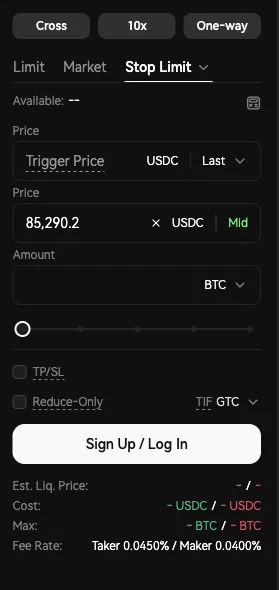
A stop-market instruction prioritizes execution after activation and accepts uncertainty about the eventual price. The choice is particularly important outside BTC: a smaller contract can have much less resting liquidity near the trigger. A visually tidy stop line on a chart cannot demonstrate how much quantity will be available when the line is crossed.
Reduce-only and attached TP/SL answer different questions
Reduce-only prevents an instruction from increasing exposure when it is intended to close a trade. Attached TP/SL describes exit conditions associated with the position or entry. The current ticket showed both controls. We do not repeat the older blanket statement that edgeX only permits TP/SL after an entry has already filled.
After a partial manual close, the relevant check is whether the remaining conditional quantity and direction still match the remaining position. If a resting order has been cancelled or rejected, the earlier form values do not make it active. The order list and subsequent filled-order record provide different parts of that answer.
A post-only entry is useful when adding liquidity is essential. A scaled order distributes a larger instruction across levels, while TWAP distributes execution over time. Neither establishes the average price in advance. For an ordinary reader choosing edgeX, the presence of these controls is useful flexibility; their existence is not evidence that a complex execution strategy will beat a simple limit order.
What changes after adding or reducing an edgeX position?
The public BTC ticket opened in Cross and One-way mode. Those labels matter when interpreting the account: the visible cross balance supports combined exposure, and the displayed position mode determines how opposite-side instructions are handled. We did not change an authenticated account’s margin mode, so we do not promise that switching mode with open positions is permitted.
For BTC’s first tier, a $10,000 position requires $100 of initial margin at the 100x maximum. Cutting the notional to $5,000 reduces that simplified initial requirement to $50, assuming the same tier and no other changes. It does not mean exactly $50 becomes withdrawable. Fees, realized loss, other positions and orders can alter the amount that is actually free.
The maintenance calculation is separate. At the captured 0.5% BTC fraction, $10,000 of exposure corresponds to $50 of maintenance before other adjustments. This is not a claim that a trader may safely remove every dollar above that number: initial requirements, open-order checks and the remaining account buffer have different roles.
A smaller position does not automatically make the account independent
In cross margin, reducing one trade can improve the overall buffer while leaving the remaining trades linked through the same collateral. A BTC reduction does not isolate a SOL position. If the intention is to manage separate strategies independently, the documented subaccount structure is more relevant than assigning each strategy a different chart tab.
Pending orders also deserve attention when freeing money. A resting entry can reserve capacity or become new exposure after an apparently successful position reduction. Cancelling an unwanted entry and confirming its status makes the resulting available balance easier to interpret. A conditional instruction can still fail later if the account no longer meets the requirements when it activates.
Reducing an edgeX position changes its margin requirement, but the withdrawable balance also depends on other positions, orders and account equity. The example calculates the requirement change, not a guaranteed cash release.
Half the BTC exposure changes the requirement
Using the captured 1% first-tier rate.
Same tier, before fees, results and other account exposure.
Withdrawing from edgeX after a trade
The same six USDC routes were enabled for withdrawals in the captured V2 configuration. Each showed a 2 USDC minimum withdrawal, a 1 USDC minimum fee and a zero proportional withdrawal-fee rate. That supports a much more precise comparison than the older general claim of a 0.1% charge with a minimum fee, which belongs to different documentation.
Those settings do not prove that every payout costs exactly one dollar from start to finish. Source or destination gas, the displayed route quote and operational conditions can add another cost or change availability. The confirmation shown for the selected route is the final place to inspect the amount expected to arrive. We did not submit a withdrawal to measure actual delivery time.
Use available funds, not the size of the last closed position
Closing $20,000 of exposure is not a $20,000 withdrawal. The returned amount comes from collateral and the trade’s result after charges. In an account with other open trades, part of that balance may continue to support them. The withdrawable amount can consequently differ from both the notional just closed and the displayed total equity.
Choosing the same network used for entry is possible in the captured configuration, but not compulsory. If the next destination accepts USDC on a different supported chain, the withdrawal route may reduce an additional transfer. The receiving service must support that precise asset/network combination; a deposit address for another network should not be substituted merely because it looks similar.
The route should also be assessed when deciding how much to leave on the trading account. A trader who regularly moves capital between venues benefits more from predictable transfer support than from an exchange’s largest advertised leverage. For edgeX, the enabled USDC routes are a practical advantage, while the absence of a funded timing test remains a limitation of this review.
Who can use edgeX, and what does self-custody mean here?
The current website terms identify geographic restrictions covering the United States, Ontario in Canada and sanctioned jurisdictions. Their definition includes relevant residency, citizenship or location conditions; it is not simply a question of whether the homepage loads. The terms also prohibit misrepresenting location to evade restrictions. We do not treat a wallet-based login as permission to ignore those conditions.
This current policy is more specific than the older GitBook terms that still circulate. It is also separate from local derivatives law. A country not named in that short list is not automatically a jurisdiction where every leveraged product is lawful or where the account will be accepted.
V2’s custody documentation describes user-controlled funds and a separate settlement architecture. That is useful context, but a website statement about self-custody cannot establish uninterrupted withdrawal access. Trading depends on the matching, risk, oracle and transfer systems functioning together. A signed instruction can be accepted at one stage while later processing or settlement remains incomplete.
A wallet credential does not establish that every trading or recovery step can be completed independently. The public documentation and controls were inspected; emergency recovery, insured balances and uptime were not tested.
edgeX versus Lighter, Hyperliquid and a USDT account
A trader placing many passive orders should compare edgeX’s regular maker charge directly with the applicable Lighter or Hyperliquid account tier. A difference that looks small on one trade becomes material across repeated turnover. The comparison should use the same product and execution style, not a promotional rate on one side and a base rate on the other.
ApeX Omni is a different comparison if the reader already holds USDT or wants supported crypto collateral. Moving into edgeX’s current USDC account may require a conversion that is unnecessary in Omni. On the other hand, someone whose funds already sit as USDC on Base or Arbitrum may find edgeX’s supported transfer structure convenient.
edgeX futures: your questions
Are edgeX perpetual fees still 0.012% maker and 0.038% taker?
Those rates appear in older data. The V2 metadata and live VIP page checked on 6 October 2026 show 0.040% maker and 0.045% taker for the regular perpetual tier. Account-specific discounts or a qualifying VIP tier must be checked separately.
Does edgeX currently support TON perpetuals?
TON was absent from the captured V2 contract list. An older V1 record is not sufficient evidence of a currently openable TON market. We therefore do not apply edgeX’s BTC maximum to TON or recommend funding the account specifically for that contract.
Can I deposit USDT into the current edgeX USDC route?
Do not substitute USDT for the USDC asset requested by the current route. Older instructions describe a different account setup. Select the token and network provided by the deposit flow for the actual account being funded.
Which chains can receive an edgeX withdrawal?
The captured V2 configuration enabled Edge, Ethereum, Arbitrum, Base, Optimism and Polygon USDC withdrawals. It showed a 2 USDC minimum and 1 USDC minimum fee. Confirm the route quote and receiving-network support because enabled metadata is not a guaranteed transfer time.
Can edgeX stop orders use an index trigger?
The current stop-limit ticket displayed both Last and Index references. The trigger price activates the instruction; the separate limit price controls the acceptable fill. A triggered stop-limit can still remain unfilled.
Can I switch cross and isolated mode with an open trade?
We observed Cross in the unsigned current ticket but did not test an authenticated mode change. Do not assume it is supported while positions or orders exist. A mode-change rule needs the current account control; closing or reopening exposure is a separate decision.
Does edgeX charge funding every hour?
The V2 contract data and current trading screen showed a four-hour period. Use the period attached to the selected contract’s rate rather than combining a current rate with an older hourly explanation.
Evidence behind this reviewSources and research
Sources and research
Official documentation, dated public market data and the unsigned trading interface were reviewed on 6 October 2026. No funded trades, wallet signatures or withdrawals were performed. Market conditions and account-specific permissions can change.
- V2 contracts, risk tiers and transfer routes
- V2 architecture
- V2 self-custody
- Current order handling
- Current funding fields
- Account margin and subaccounts
- Current VIP fee schedule
- Current website terms
- Unsigned perpetual trading interface