
What can you actually do on Orvex?
Orvex describes itself as a MetaDEX: a place to swap supported assets and supply liquidity, with routing between different pool types. Its documentation specifies classic full-range pools and concentrated-liquidity pools. That is a different service from an exchange where a trader opens a BTC perpetual with margin, a liquidation price and an ongoing funding payment.
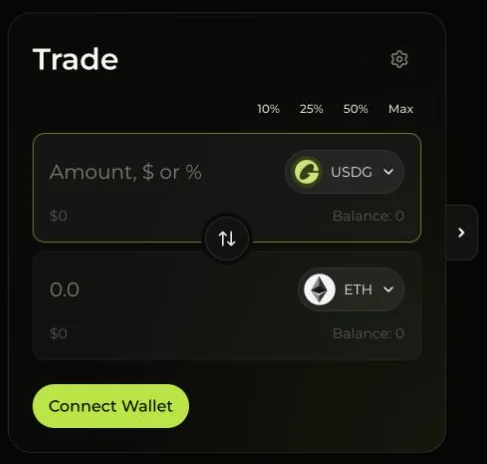
The inspected Orvex screen showed a USDG-to-ETH swap and a wallet-connect button, with no long/short ticket or leverage selector. That matches the documented spot-swap product; it is not evidence of futures trading.
Live messaging and the roadmap do not agree
The homepage announces Genesis as live and uses mainnet messaging. The roadmap still describes the Robinhood Chain deployment as pre-launch and places swaps, liquidity and routing in an upcoming protocol phase. Meanwhile, the Genesis guide describes an active campaign. These are conflicting official descriptions of launch stage, not evidence of a hidden futures product.
We can confirm the visible interface and what each document says. We cannot use those pages to certify a completed rollout of every token, reward programme or market. For a leverage comparison, this leaves a clear outcome: Orvex should not receive a futures score merely because a trading interface exists.
Why “10x capital efficiency” does not mean 10x leverage
Concentrated liquidity lets an LP place assets within a selected price band rather than spread them over the entire possible price range. More of the supplied capital can then be active around the market’s current price. Orvex’s claim of up to ten times the efficiency refers to this use of liquidity, not to lending a trader ten times their deposit.

The trade-off is the band itself. When price moves beyond it, that concentrated position is no longer supplying active liquidity at the current market price. The assets held by the position also change as swaps take place. A narrow band therefore asks the LP to make and maintain a price-range choice; it does not create a fixed-return substitute for a leveraged trade.
Orvex also documents impermanent loss: the LP’s resulting asset mix can be worth less than simply holding the starting assets as their relative prices move. Fees might offset that difference, or they might not. That is the relevant exposure for an LP decision here, rather than a made-up futures liquidation threshold.
What changes the cost of an Orvex swap?
The routing guide says the system compares classic and concentrated pools and, where enabled, approved external liquidity. It describes choosing output after accounting for pool fees, price impact and estimated gas. The practical comparison is the amount expected to arrive in the output asset, not just a fee percentage displayed somewhere else on the site.
The same guide says Orvex does not add an extra router markup on top of the quoted execution route. That does not make the swap free: the pool can charge a fee, the trade can move the execution price, and the blockchain transaction has a network cost. Nor does it establish that an external venue will be available for every pair.
The documentation specifies ETH for gas on Robinhood Chain. A USDG balance intended for a swap is consequently not, by itself, proof that the wallet can pay the transaction’s network fee. This is a concrete funding distinction for this product; it should not be translated into a USDT futures-margin requirement.
Slippage tolerance governs how much deterioration a submitted swap may accept. It is not leverage, and increasing it does not increase a position’s borrowed exposure. During our unsigned inspection, no amount had been submitted and no executable quote was tested, so this review does not publish a supposedly measured spread or an all-in rate for a funded trade.
Genesis multipliers are campaign weights, not position multipliers
The Genesis guide lists eight campaign markets and gives different weights to qualifying liquidity activity. Its 3x and 2.25x examples describe how the campaign counts contributions. They are not a BTC position’s leverage setting and do not mean a deposit automatically becomes three times as valuable.
The guide also says points are provisional, that no reward claim takes place during the campaign, and that finalisation follows review. A points balance should therefore not be presented as a withdrawable token amount or a known dollar payout. The roadmap separately places the full ORVX token economy, emissions and vote-escrow functions in later launch stages.
A homepage can display more markets than a campaign’s eligible list because the two lists answer different questions. The eight Genesis markets in the document are not eight perpetual contracts. Likewise, a prominent APR figure or reward weight is not a substitute for a documented contract specification.
For our site, the Genesis programme explains some of the numbers a reader might mistake for leverage. A long account of voting incentives and token locks would distract from the actual question, which the available product evidence already answers.
| Displayed concept | What it measures |
|---|---|
| Up to 10x efficiency | LP capital concentrated around a chosen price range. |
| Genesis 3x or 2.25x weight | Campaign accounting for eligible liquidity contributions. |
| A futures leverage limit | Borrowed or margined position exposure; no Orvex specification verified. |
Where should someone looking for crypto perps go instead?
Start with the type of position you want to manage. The Jupiter Perps dossier covers a Solana pool-based product with a defined perpetual-market set. It is relevant if your interest was a wallet-based BTC, ETH or SOL position, rather than earning fees by supplying a spot pool.
For a different onchain execution model, the Hyperliquid review examines an order-book perpetual venue, including account and margin distinctions. The GMX review addresses pool-backed trading and how its specific price-impact and borrowing costs change a position’s economics. These are researched comparisons of actual derivatives products; none is a claim that every reader’s location is supported.
Our perpetual-DEX ranking brings those choices together. Orvex remains outside that ranking until primary evidence identifies a real leveraged product with usable terms. A referral relationship or an efficiency slogan is not a reason to insert it into the list.
Orvex: leverage, swaps and Genesis questions
Can I short BTC on Orvex with the documented swap product?
We found no documented BTC perpetual or margin-borrowing facility in the reviewed product. Swapping one owned asset for another does not establish a margined short. Use a venue with a published derivative contract if that is the position you are comparing.
Does “no extra router markup” mean zero trading fees?
No. The routing guide separates its own markup from pool fees and network gas. Execution can also involve price impact. Compare the output of the actual proposed route rather than treating that phrase as an all-in zero-fee offer.
Do Genesis points entitle me to an immediate ORVX withdrawal?
The reviewed campaign guide describes provisional points and no claim during the campaign. It does not establish a fixed conversion into tokens or money. Later token-economy milestones in the roadmap should not be presented as an already available withdrawal.
Why is Orvex covered here if it is not in the leverage ranking?
Its capital-efficiency language can be confused with a trader’s leverage multiple. A short product-scope review resolves that confusion and links to documented perpetual products, without manufacturing a futures rating or a promotional deposit recommendation.
Evidence behind this reviewSources and research
Sources and research
Orvex documentation and the unsigned swap interface were inspected on 6 October 2026. No wallet was connected and no swap or liquidity deposit was executed. The roadmap still describes pre-launch stages despite live-product messaging elsewhere; this discrepancy is retained rather than treated as resolved.
- About Orvex: MetaDEX product scope
- Concentrated liquidity and capital efficiency
- Smart routing and execution costs
- Swap documentation
- Roadmap and stated launch stages
- Genesis markets, weights and points
- Concentrated-liquidity impermanent loss
- Current public homepage