Best Litecoin Futures Exchanges for LTC Trading
Litecoin offers a practical account decision: a better quote must save enough to justify moving the balance that funds the trade.
Short answer
Binance is a useful USDT choice for Litecoin futures, while Hyperliquid’s USDC result was competitive through 50,000 in the October 10 collection. WEEX deserves a separate quote for a much larger order. An occasional trader already using Bybit may save little by transferring funds solely for a lower headline fee.
Visit BinanceLTC options by trade size and account setup
Options for eligible accounts. Country availability is separate from contract availability.

A cost-effective starting point for a new USDT account
For a new USDT trading balance, with 0.001-LTC steps. Its twenty-USDT order-value floor is larger than some traders expect from the small coin increment.
LTCUSDT · USDT settlementVisit Binance
Worth quoting for the larger LTC trade
A larger-order execution alternative. Its more competitive result at 50,000 does not justify moving a small occasional trade from an already funded account.
LTCUSDT · USDT settlementVisit WEEX
Smaller orders from USDC already on the venue
For USDC already available in the wallet account. The largest book comparison remains unpriced because the returned response was incomplete.
LTC · USDC settlementVisit HyperliquidShould you move your Litecoin futures account?
For a trader already funded on Bybit, the new LTC measurements support a more modest conclusion than “switch to the cheapest exchange.” At 10,000 per side, Binance saved between 1.15 and 2.02 USDT relative to Bybit when each collection round was compared separately. That can matter to repeated trading, but it is a small saving for a one-off position if transferring capital costs several units.
A fresh USDT account has a clearer starting point: Binance LTCUSDT combined low modeled cost across the researched sizes with a fine 0.001-LTC quantity increment. Hyperliquid was competitive for smaller USDC-funded orders, while WEEX became more interesting at the largest measured size. Their strengths apply to different uses, not to a single permanent Litecoin ranking.
How WEEX compares when the observation periods match
All finalists were collected within each of three short research rounds, so a favorable later WEEX price is not compared against a much earlier competitor observation. Requests were close together rather than simultaneous executions, and the original responses are available below. The broader result is more useful: WEEX looks strong at 50,000 per side, but its regular fee makes it less compelling at 10,000 or 25,000.
For 50,000 each way, WEEX’s estimate was 87.37–87.39 USDT. Binance ranged from 86.89 to 94.65, and Bybit from 93.60 to 98.55. WEEX and Binance overlap, so the evidence does not establish one as consistently cheaper even in this narrow window. An existing WEEX balance is a reason to obtain a current quote, not a reason to ignore Binance or automatically relocate funds.
| Contract | Estimated combined cost |
|---|---|
| BinanceLTCUSDTUSDT settlement | 12.37–13.22 USDT10.00 commission includedPublished fee basis: 0.05% per side |
| WEEXLTCUSDTUSDT settlement | 17.56 USDT16.00 commission includedPublished fee basis: 0.08% per side |
| HyperliquidLTCUSDC settlement | 11.88–12.47 USDC9.00 commission includedPublished fee basis: 0.045% per side |
Compare 8 other measured contracts
| Contract | Estimated combined cost |
|---|---|
| BinanceLTCUSDCUSDC settlement | 15.27–18.62 USDC8.00 commission includedPublished fee basis: 0.04% per side |
| BybitLTCPERPUSDC settlement | 73.61–77.53 USDC11.00 commission includedPublished fee basis: 0.055% per side |
| BybitLTCUSDTUSDT settlement | 14.77–15.38 USDT11.00 commission includedPublished fee basis: 0.055% per side |
| OKXLTC-USDT-SWAPUSDT settlement | 14.27–14.89 USDT10.00 commission includedPublished fee basis: 0.05% per side |
| MEXCLTC_USDCUSDC settlement | Above ordinary order limitObserved ceiling: ≈ 5,620 USDC. No executable one-order estimate.API fee basis: 0.08% per side |
| MEXCLTC_USDTUSDT settlement | 19.13–19.76 USDT16.00 commission includedAPI fee basis: 0.08% per side |
| GateLTC_USDTUSDT settlement | 22.31–23.47 USDT15.00 commission includedPublished fee basis: 0.075% per side |
| AsterLTCUSDTUSDT settlement | 17.17–18.70 USDT8.00 commission includedPublished fee basis: 0.04% per side |
Use your own trading fee
Enter your account’s taker fee. Only commission changes; the books remain dated. The fee source beside each input identifies its trading channel.
Inputs and calculation details
Total = buy and sell price impact from the midpoint + both trading fees. Orders above a known limit are excluded. Missing limits remain unknown; partial books do not establish a full-order cost.
Dated inputs and fee sources ↗ · Raw books ↗LTC spread versus depth: what changes when the order gets bigger?
At 25,000 per side, WEEX’s combined modeled price impact was only about 3.69 USDT before commission. Binance’s impact component was approximately 12.33–14.72. Judged only by the returned book, WEEX looked better. Add the stated taker fees, however, and Binance’s total became 37.33–39.72 against WEEX’s approximately 43.69.
The reason is the fee contribution: two 25,000 orders at WEEX’s 0.08% reference cost 40 in commission, compared with 25 at Binance’s 0.05%. The better book does not fully compensate for the extra 15 at this size. At 50,000, WEEX’s relatively small modeled impact matters more, allowing its total to overlap Binance’s.
A displayed spread cannot stand in for the entire LTC order
The price nearest the midpoint covers only the quantity offered at that level. A larger market order consumes subsequent levels. Our estimates add those quantities until the full researched notional is reached; they do not multiply the first spread by every coin as though unlimited volume were sitting at the best price.
Hyperliquid illustrates a different limitation. Its 25,000-per-side estimate was 33.78–36.54 USDC, lower than the highlighted centralized references. At 50,000, at least one returned book lacked sufficient quoted depth for a complete model. The full-size range is therefore withheld rather than extended from the smaller order. This does not demonstrate that no additional liquidity existed beyond what the endpoint returned.
For an LTC order that needs immediate execution, the relevant comparison is the complete size in the chosen direction. For a patient limit order, the tradeoff changes: it may cost less if filled, but waiting for a maker fill is not equivalent to receiving the taker execution modeled here. A low maker rate does not supply evidence of fill probability.
When does a lower LTC fee pay for switching exchanges?
Use the actual account-moving cost as an upfront expense. In an illustrative case where withdrawal and any conversion together cost six units, the observed 10,000-per-side Binance saving over Bybit would require approximately three to six comparable completed trades to recover that move. That range uses the unrounded differences from the three matched rounds.
This is a practical distinction between an active trader and someone opening one position. One trade does not recover the assumed six-unit move in any of those observations. Ten comparable trades could, if the advantage persists and the transfer cost is genuinely six. Neither condition is guaranteed by today’s order books.
When the illustrative transfer cost breaks even
What must a 6-dollar account move recover?
Illustrative relocation cost, with a 10,000-per-side LTC trade.
Count how often you expect to use the balance
The transfer cost belongs to the funded account, not automatically to every order. If you fund once and make several trades without withdrawing between them, spreading that setup cost across those trades is reasonable. If you move money back after every position, the repeated withdrawal charges can absorb the saving again and again.
A change in account fee tier also changes the decision. The comparison uses publicly stated regular rates; it does not require giving up a personal fee discount you already have. Use the rate that applies to your actual LTC contract and execution channel. The best new-account comparison may differ from the best action for an established account.
There is also an operational distinction between moving unused capital and migrating an open position. Transferring a balance does not transfer an LTC future. Closing one contract and opening another creates additional fills and a timing gap. The six-unit relocation example assumes available capital, not a cost-free transfer of an existing leveraged position.
LTCUSDT, LTCUSDC or LTCPERP for a multi-day trade?
Binance LTCUSDC has a lower displayed promotional taker rate, 0.04%, than the regular 0.05% USDT reference. Yet its captured 10,000-per-side cost was 20.18–22.00 USDC, compared with 13.02–13.67 for LTCUSDT. The extra book impact outweighed the fee reduction. At 25,000 each way the difference widened further.
Bybit LTCPERP was more expensive still at the measured 10,000 size: 61.66–64.00 USDC versus 14.50–15.07 USDT for LTCUSDT. Having USDC in the account does not make those two books equally attractive. For a small existing USDC balance, Hyperliquid supplied the more competitive measured alternative, subject to its leverage and access conditions.
The actual funding history also differed
During October 4–6 UTC, a constant 10,000-USDT/USDC notional position accumulated funding of about 4.69 on Bybit LTCUSDT, 5.49 on Binance LTCUSDT, 3.94 on Binance LTCUSDC and 9.00 on Bybit LTCPERP. Hyperliquid’s corresponding total was 9.23. These totals were positive: longs paid them and shorts received them.
For these Litecoin products, the recent funding savings on Binance LTCUSDC were only about 1.55 per 10,000 over the three-day window relative to LTCUSDT. That is smaller than its additional measured execution cost of roughly 6.51–8.98. Switching settlement currency solely for that recent funding difference would therefore have increased the modeled cost of a comparable long, even before conversion.
The holding period still matters, but the next three days need not resemble these three. The totals add the actual events for each contract rather than assuming identical intervals. This comparison prices a recent difference between Litecoin products; it does not supply a fixed future holding charge.
Funding LTC futures when your money is already in Litecoin
Sending LTC from a wallet to an exchange can provide an asset balance, but it does not automatically create USDT margin for LTCUSDT. A stablecoin-funded future may require selling part of that LTC, using an eligible collateral mode, or supplying stablecoins separately. These choices affect how much Litecoin exposure remains outside the future.
If the goal is to replace a spot holding with leveraged LTC exposure, selling the coins to fund margin is part of that strategy and incurs a spot fill. If the goal is to retain the coins while opening a short, selling all of them first would remove the holding the short was meant to offset. Decide which exposure should survive before estimating the transfer cost.
Binance’s MWEB restriction is a Litecoin-specific funding issue
Binance’s published MWEB notice says it does not support Litecoin deposits or withdrawals using MimbleWimble Extension Blocks. The notice warns that those deposits cannot be received or returned. A generic statement that an exchange “supports LTC” is therefore insufficient for someone sending from an MWEB-enabled wallet.
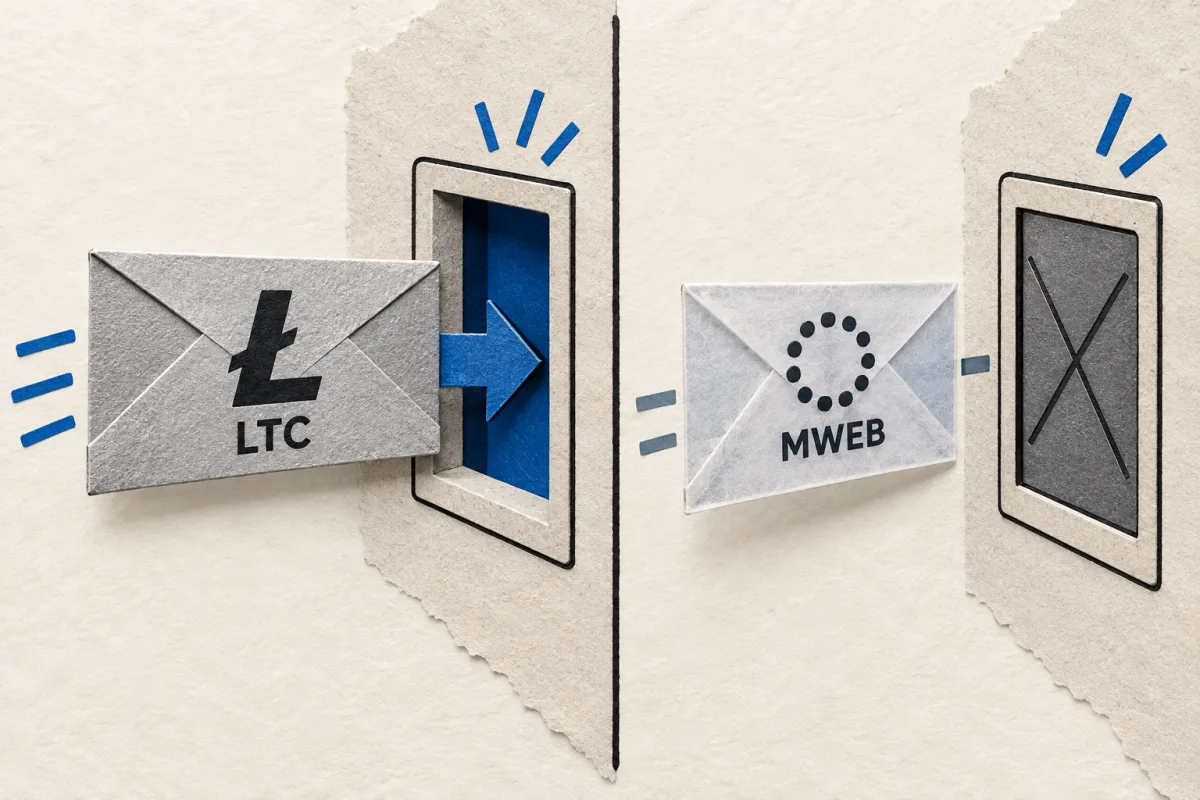
The practical implication is narrow: use the recipient’s supported Litecoin transfer method, not an MWEB transfer assumed to work because the token name matches. This restriction does not mean Binance LTCUSDT has been delisted, nor does it prevent a customer with eligible stablecoin margin from trading the future. Deposit compatibility and the active derivative listing are different checks.
We have not tested a wallet withdrawal or authenticated a deposit address. For that reason, there is no invented network charge or guaranteed arrival time in the cost table. The article supplies the documented incompatibility that can change the funding plan, while the live sender and recipient supply the transaction-specific quote.
What LTC leverage and minimum order can the account use?
Bybit LTCUSDT’s first reported risk band allows up to 75× through 10,000 USDT of position value. The next band permits 70× through 15,000. LTCPERP instead begins at 50× through 100,000 USDC. The larger first USDC band does not overcome the higher execution cost shown earlier, but it matters when assessing the margin required for a particular position.
Its one-market-order ceiling is much smaller than that band: 280 LTC for LTCPERP, approximately 18,950 USDC at the captured price. LTCUSDT allows 3,000 LTC, approximately 203,055 USDT. A 25,000 LTCPERP depth estimate therefore exceeds the observed single-market-order allowance even though the position value fits the first leverage band.
Binance’s two Litecoin contracts have different minimum values
Both Binance LTCUSDT and LTCUSDC use a 0.001-LTC quantity increment, but the captured minimum notional was twenty USDT for LTCUSDT and five USDC for LTCUSDC. At an illustrative LTC price of 60, a new USDT order needs at least 0.334 LTC to reach 20.04; 0.333 LTC is worth only 19.98. The corresponding five-unit USDC threshold is reached by 0.084 LTC, worth 5.04.
Bybit uses a coarser 0.1-LTC increment and a five-unit minimum notional. At the same illustrative price, one increment is already worth six. For a small trader, the finest coin step does not necessarily give the smallest permissible position: the contract’s value threshold must be satisfied too.
MEXC’s linear LTC contracts use 0.01 LTC per contract. The reported instrument maxima were 200× for LTC_USDT and 125× for LTC_USDC. OKX LTC-USDT-SWAP uses one LTC per full contract, with a 0.1-contract step. These are different quantity conventions; a number copied from one order ticket cannot be transferred blindly into another.
Are coin-settled Litecoin futures better for an LTC holder?
The directory also records inverse products, including OKX LTC-USD-SWAP. Its contract value is ten USD, unlike the one-LTC unit of the USDT swap. The inverse product’s margin and profit calculation require their own quote; the linear cost table does not measure it.
An inverse contract may be relevant to a trader intentionally holding collateral and results in LTC. It does not remove Litecoin price exposure from the collateral itself. For someone whose spending or risk budget is in stablecoins, that distinction may make the simpler stablecoin contract more useful even when coins are already available in a wallet.
There is no benefit in transferring LTC to a venue only to discover the intended account mode does not accept it as usable futures collateral. The exact margin setup should be chosen before pricing a withdrawal. Our measurements establish the named linear contracts’ book costs, not blanket approval of every coin balance under every account mode.
More Litecoin futures venues to compare
The additional Litecoin comparisons include Aster, Gate and MEXC under their stated fee channels.
Aster’s lower reference fee did not produce the cheapest LTC total in these samples; its 50,000-per-side range was 101.98–118.44. Gate’s public contract-fee reference gave 162.91–168.27, while MEXC’s API model came to 118.40–119.16. A verified account discount can change commission, but it cannot retroactively change the depth observed in those books.
For regional eligibility, the country pages explain access separately from this instrument comparison. A venue offering Litecoin spot in a location is not automatically offering the globally listed perpetual. The useful final choice combines the LTC size, holding direction and account already available to the trader.
22 contract records across 15 venues. Each instrument has its own record; a listing does not establish country eligibility. Quantity, increment and minimum value requirements apply together; an omitted value is not a zero minimum.
Aster1 contracts
LTCUSDT
- Settlement / P&L
- USDT
- Published ceiling
- Not supplied
- Minimum quantity
- 0.001 LTC
- Quantity increment
- 0.001 LTC
- Minimum order value
- 5 USDT
- Funding interval
- See product schedule
Binance2 contracts
LTCUSDC
- Settlement / P&L
- USDC
- Published ceiling
- Not supplied
- Minimum quantity
- 0.001 LTC
- Quantity increment
- 0.001 LTC
- Minimum order value
- 5 USDC
- Funding interval
- See product schedule
LTCUSDT
- Settlement / P&L
- USDT
- Published ceiling
- Not supplied
- Minimum quantity
- 0.001 LTC
- Quantity increment
- 0.001 LTC
- Minimum order value
- 20 USDT
- Funding interval
- See product schedule
Bitget1 contracts
LTCUSDT
- Settlement / P&L
- USDT
- Published ceiling
- 75×
- Minimum quantity
- 0.1 LTC
- Quantity increment
- Not supplied
- Minimum order value
- 5 USDT
- Funding interval
- 8 hours
Bybit2 contracts
LTCPERP
- Settlement / P&L
- USDC
- Published ceiling
- 50×
- Minimum quantity
- 0.1 LTC
- Quantity increment
- 0.1 LTC
- Minimum order value
- 5 USDC
- Funding interval
- 4 hours
LTCUSDT
- Settlement / P&L
- USDT
- Published ceiling
- 75×
- Minimum quantity
- 0.1 LTC
- Quantity increment
- 0.1 LTC
- Minimum order value
- 5 USDT
- Funding interval
- 8 hours
dYdX1 contracts
LTC-USD
- Settlement / P&L
- USDC
- Published ceiling
- 10×base initial margin; size adjustment can lower it
- Minimum quantity
- 0.1 LTC
- Quantity increment
- 0.1 LTC
- Minimum order value
- Not supplied
- Funding interval
- See product schedule
edgeX1 contracts
LTCUSDC
- Settlement / P&L
- USDC
- Published ceiling
- 20×
- Minimum quantity
- 1 LTC
- Quantity increment
- Not supplied
- Minimum order value
- Not supplied
- Funding interval
- 4 hours
Gate1 contracts
LTC_USDT
- Settlement / P&L
- USDT
- Published ceiling
- 75×
- Minimum quantity
- 1 contracts1 contract = 0.1 LTC
- Quantity increment
- 1 contracts
- Minimum order value
- Not supplied
- Funding interval
- 8 hours
Hyperliquid1 contracts
LTC
- Settlement / P&L
- USDC
- Published ceiling
- 10×
- Minimum quantity
- Not supplied
- Quantity increment
- Not supplied
- Minimum order value
- Not supplied
- Funding interval
- See product schedule
Kraken2 contracts
PF_LTCUSD
- Settlement / P&L
- USDUSD P&L; selectable profit currency can incur conversion fees
- Published ceiling
- Not supplied
- Minimum quantity
- Not supplied1 contract = 1 LTC
- Quantity increment
- Not supplied
- Minimum order value
- Not supplied
- Funding interval
- See product schedule
PI_LTCUSD
- Settlement / P&L
- LTC
- Published ceiling
- Not supplied
- Minimum quantity
- Not supplied1 contract = 1 USD
- Quantity increment
- Not supplied
- Minimum order value
- Not supplied
- Funding interval
- See product schedule
KuCoin1 contracts
LTCUSDTM
- Settlement / P&L
- USDT
- Published ceiling
- 75×
- Minimum quantity
- 1 contracts1 contract = 0.1 LTC
- Quantity increment
- 1 contracts
- Minimum order value
- Not supplied
- Funding interval
- 8 hours
MEXC4 contracts
LTC_USD
- Settlement / P&L
- LTC
- Published ceiling
- 100×
- Minimum quantity
- 1 contracts1 contract = 10 USD
- Quantity increment
- 1 contracts
- Minimum order value
- Not supplied
- Funding interval
- See product schedule
LTC_USD1
- Settlement / P&L
- USD1
- Published ceiling
- 50×
- Minimum quantity
- 1 contracts1 contract = 0.01 LTC
- Quantity increment
- 1 contracts
- Minimum order value
- Not supplied
- Funding interval
- See product schedule
LTC_USDC
- Settlement / P&L
- USDC
- Published ceiling
- 125×
- Minimum quantity
- 1 contracts1 contract = 0.01 LTC
- Quantity increment
- 1 contracts
- Minimum order value
- Not supplied
- Funding interval
- See product schedule
LTC_USDT
- Settlement / P&L
- USDT
- Published ceiling
- 200×
- Minimum quantity
- 1 contracts1 contract = 0.01 LTC
- Quantity increment
- 1 contracts
- Minimum order value
- Not supplied
- Funding interval
- See product schedule
OKX2 contracts
LTC-USD-SWAP
- Settlement / P&L
- LTC
- Published ceiling
- 50×
- Minimum quantity
- 1 contracts1 contract = 10 USD
- Quantity increment
- 1 contracts
- Minimum order value
- Not supplied
- Funding interval
- See product schedule
LTC-USDT-SWAP
- Settlement / P&L
- USDT
- Published ceiling
- 50×
- Minimum quantity
- 0.1 contracts1 contract = 1 LTC
- Quantity increment
- 0.1 contracts
- Minimum order value
- Not supplied
- Funding interval
- See product schedule
Paradex1 contracts
LTC-USD-PERP
- Settlement / P&L
- USDC
- Published ceiling
- 20×base initial margin; size adjustment can lower it
- Minimum quantity
- Not supplied
- Quantity increment
- 0.001 LTC
- Minimum order value
- 10 USDC
- Funding interval
- 8 hours
Phemex1 contracts
LTCUSDT
- Settlement / P&L
- USDT
- Published ceiling
- 50×
- Minimum quantity
- Not supplied
- Quantity increment
- 0.01 LTC
- Minimum order value
- 1 USDT
- Funding interval
- 8 hours
WEEX1 contracts
LTCUSDT
- Settlement / P&L
- USDT
- Published ceiling
- 200×
- Minimum quantity
- 0.1 LTC1 contract = 0.1 LTC
- Quantity increment
- Not supplied
- Minimum order value
- Not supplied
- Funding interval
- 8 hours
LTC futures questions
How much can an existing Bybit LTC trader save by moving to Binance?
At 10,000 each way, matched collection rounds showed an estimated saving of 1.15–2.02 USDT before relocation costs and funding. A hypothetical six-unit move would take around three to six comparable completed trades to recover. The saving is not guaranteed to persist.
Why is WEEX more competitive for the larger Litecoin example?
Its price-impact component stayed comparatively small as the researched order grew. At 25,000 each way, higher regular commission outweighed that book advantage; at 50,000, the combined total overlapped Binance’s. That is a size-dependent result, not a universal WEEX cost lead.
Can I deposit Litecoin from MWEB to Binance to fund the trade?
Binance’s published notice says it does not support MWEB deposits or withdrawals and warns of loss for unsupported deposits. That restriction is about sending the coins. It does not establish a ban on trading an eligible LTCUSDT contract using stablecoin margin.
Why is the Binance LTCUSDT minimum larger than LTCUSDC?
The captured contract filters set twenty USDT for LTCUSDT and five USDC for LTCUSDC. Both use 0.001-LTC increments. These are product-specific rules; the smaller USDC minimum does not imply its larger-order execution will also be cheaper.
Is LTCPERP the same contract as Bybit LTCUSDT?
No. LTCPERP settles in USDC, has four-hour funding, a 50× initial risk band and a 280-LTC market-order ceiling in the captured specification. LTCUSDT has separate USDT settlement, eight-hour funding, leverage bands and a larger single-order limit.
Will closing a stablecoin Litecoin future send LTC to my wallet?
Closing the researched linear contracts settles the trading result in the specified account currency; it does not deliver native Litecoin. If you need LTC afterward, acquiring and withdrawing it is a separate transaction with its own price, fee and supported transfer method.
Sources and research
Comparisons use the public records linked below, not funded account tests. How we research · Report a correction.
Books were collected in three separately initiated rounds between 03:03:09 and 03:04:59 UTC on October 7, 2026. The 93 responses cover 31 contracts. Requests within a round were not simultaneous; these observations do not establish a daily average or stress-period execution.
Equal quote notionals of 1,000, 10,000, 25,000 and 50,000 were swept independently against asks and bids. Gate, OKX and MEXC contract quantities were normalized to coin quantities. A published full-size range requires complete returned depth on both sides in all three samples. A truncated book is not evidence that further liquidity does not exist.
Estimated cost combines midpoint price impact and the cited taker reference on both orders, before quantity rounding, funding, conversion and transfers. This is a venue-selection model, not realized trading P&L. MEXC API fees differ from manual-account promotions. Binance USDC uses the promotional column visible in its fee table; ordinary USDT uses the regular column. Stablecoins are compared at par.
Funding totals add actual events from October 4 through October 6 UTC using an unchanged reference position value. Adding that history to October 7 execution observations creates a sensitivity scenario, not a trade made over those dates. Negative totals favor longs and charge shorts; future rates can reverse.
Instrument specifications and risk bands were fetched with this research. Checked Bybit and MEXC order caps are valued at the observed midpoints. The additional directory retains its own record dates and may contain products outside the measured shortlist.
No orders, deposits, withdrawals or authenticated account checks were performed. Deposit guides document supported routes, not live account-specific acceptance. The individual funding examples and fixed relocation costs are explicitly labeled when hypothetical.
- Litecoin books, limits and funding records ↗
Three comparable collection rounds and exact instrument filters, including separate minimum notionals.
- Binance MWEB notice ↗
Published restriction on Litecoin transfers using MWEB; no wallet transaction performed.
- Binance USDⓈ-M fee table ↗
Regular USDT 0.05% taker; displayed USDC promotional 0.04% taker, no BNB discount. Checked October 7, 2026.
- Bybit derivatives trading fees ↗
Regular 0.055% taker reference.
- MEXC API futures fee update ↗
June 1, 2026 effective schedule: 0.06% maker, 0.08% taker for API orders. Manual promotions are not inferred.
- WEEX fee schedule ↗
VIP 0 reference used in the cost comparison.
- Aster fee categories ↗
Crypto General regular tier, without token discount.