Best Arbitrum Futures Exchanges for ARB Leverage
An ARB unlock attracts attention. The better futures decision depends on the order you can actually place, the cost of keeping it open and the evidence behind the event.
Short answer
WEEX stands out for an ARB order around 50,000 USDT; Binance and Hyperliquid are more competitive around 10,000. A MEXC manual-account promotion can change that choice only if it appears in your account; API users do not receive it. An unlock short also needs enough margin to survive a rally before the event.
Visit WEEXThree ways to narrow the ARB futures choice
Options for eligible accounts. Country availability is separate from contract availability.
Larger immediate orders
A larger immediate USDT order at the recorded regular fees. Eligible MEXC zero-fee manual accounts have a cheaper modeled alternative below; that campaign excludes API orders.
ARBUSDT · USDT settlementVisit WEEX
A USDT alternative with a different holding bill
For a USDT trade whose holding bill matters. Its historical negative funding favored longs and charged shorts during the checked window.
ARB-USDT-SWAP · USDT settlementVisit OKX
Smaller USDC positions up to 10×
For smaller native-USDC positions up to 10×. This is an order-book route; GMX’s separate ARB pool is examined later.
ARB · USDC settlementVisit HyperliquidTrading ARB around an unlock: contract access before the thesis
An Arbitrum unlock does not hand tokens to an ARB futures position. The trade remains a long or short on ARB’s price, with a holding bill that can differ in sign between venues. A scheduled release is therefore a reason to examine supply evidence, not a substitute for choosing the correct contract and funding direction.
WEEX showed the stronger large-order result in a brief recorded window around 25,000–50,000 USDT. That is a useful candidate for a fresh quote, not a day-long liquidity ranking. OKX and native Hyperliquid were competitive at smaller size; GMX provides a separately verified pool market on ARB.
At 10,000, there is no overwhelming execution winner
Hyperliquid's 14.63–16.57, OKX's 15.97–17.24, Bybit's 16.30–17.39, Binance ARBUSDT's 16.89–17.80 and WEEX's 17.08–17.61 are close. Funding, settlement currency and the actual fee tier can reverse that ordering.
These amounts include taker commission and measured price impact for an equal-value purchase and sale. They are not the cost of buying 10,000 tokens. Nor are they a forecast for opening today and closing after an unlock: future exit prices and liquidity are unknown.
| Contract | Estimated combined cost |
|---|---|
| OKXARB-USDT-SWAPUSDT settlement | 19.12–20.07 USDT10.00 commission includedPublished fee basis: 0.05% per side |
| WEEXARBUSDTUSDT settlement | 17.06–18.88 USDT16.00 commission includedPublished fee basis: 0.08% per side |
| HyperliquidARBUSDC settlement | 14.63–16.28 USDC9.00 commission includedPublished fee basis: 0.045% per side |
Compare 8 other measured contracts
| Contract | Estimated combined cost |
|---|---|
| BinanceARBUSDCUSDC settlement | 22.50–24.60 USDC8.00 commission includedPublished fee basis: 0.04% per side |
| BinanceARBUSDTUSDT settlement | 14.38–16.19 USDT10.00 commission includedPublished fee basis: 0.05% per side |
| BybitARBPERPUSDC settlement | 95.84–106.84 USDC11.00 commission includedPublished fee basis: 0.055% per side |
| BybitARBUSDTUSDT settlement | 17.52–19.18 USDT11.00 commission includedPublished fee basis: 0.055% per side |
| MEXCARB_USDCUSDC settlement | Above ordinary order limitObserved ceiling: ≈ 4,130 USDC. No executable one-order estimate.API fee basis: 0.08% per side |
| MEXCARB_USDTUSDT settlement | 18.16–19.08 USDT16.00 commission includedAPI fee basis: 0.08% per side |
| GateARB_USDTUSDT settlement | 35.54–38.50 USDT15.00 commission includedPublished fee basis: 0.075% per side |
| AsterARBUSDTUSDT settlement | Above ordinary order limitObserved ceiling: ≈ 3,776 USDT. No executable one-order estimate.Published fee basis: 0.04% per side |
Use your own trading fee
Enter your account’s taker fee. Only commission changes; the books remain dated. The fee source beside each input identifies its trading channel.
Inputs and calculation details
Total = buy and sell price impact from the midpoint + both trading fees. Orders above a known limit are excluded. Missing limits remain unknown; partial books do not establish a full-order cost.
Dated inputs and fee sources ↗ · Raw books ↗Why a low ARB fee does not settle the comparison
Binance's USDC reference charges 0.04% taker rather than the 0.05% used for its USDT contract. Yet its ARBUSDC execution estimate at 10,000 each way was 28.75–32.70 USDC, above ARBUSDT's 16.89–17.80 USDT. The lower commission did not compensate for the worse returned prices.
WEEX was modeled at its contract’s 0.08% taker field; MEXC used its published 0.08% API reference. For an eligible manual account, MEXC’s ARB campaign changes the conclusion: it offers 0% maker and taker on ARBUSDT and ARBUSDC for MENA users from 1 October 2026, 12:00 UTC, with no end date announced. API trading and liquidation charges are excluded.
For ARB_USDT at 50,000 USDT per side, removing eighty USDT of API commission from the recorded model gives approximately 40.49–49.87 USDT, versus WEEX’s 92.96–98.35. MEXC is the lower modeled execution-cost choice for that eligible zero-fee manual scenario. This is a recalculation of the saved book, not a new fill or an all-in holding-cost ranking.
Do not extend that 50,000-USDT result to ARB_USDC: its captured ordinary-order ceiling was only about 4,037 USDC. Nor does MENA residence alone prove derivatives eligibility. The account must actually receive the campaign rate; funding and price impact still apply.
Is shorting an Arbitrum unlock a sensible reason to choose an exchange?
An unlock can justify researching a short, but it cannot establish the trade's direction by itself. The key difference is between tokens becoming transferable and recipients actually selling them. A futures price may already reflect expected supply before any tokens move, while buyers can absorb selling after the event.
For an ARB trader, this creates two separate questions. What exactly becomes available, and how much must the price move before the trade covers its costs? A platform that is inexpensive for a quick entry can be less attractive if the position waits several days for an uncertain event.
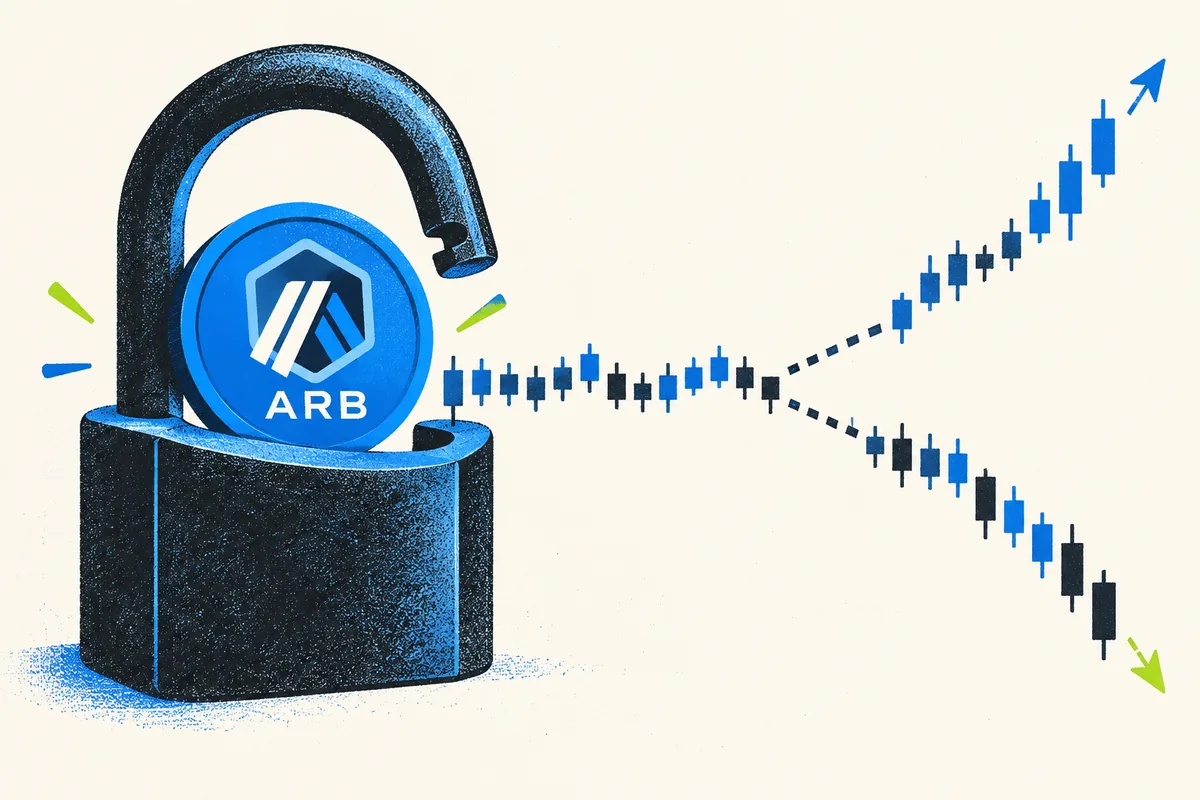
Separate the investor schedule, Foundation vesting and treasury holdings
The Foundation distribution documentation describes investor and team allocations with an initial one-year lock followed by monthly releases across the remaining three years. It gives March 16, 2023 as the token-generation anchor. The public airdrop date of March 23 is a different event and should not be substituted into that schedule.
Foundation vesting follows a separate four-year linear schedule beginning April 17, 2023. These allocations should not be added into a supposed single monthly cliff without checking which category is being counted. A market calendar can combine releases that have different recipients and mechanics.
Three ARB supply claims that mean different things
Vested
A recipient is allowed to transfer an allocation.
Does not prove a saleIn the DAO treasury
Tokens belong to the treasury and may require allocation decisions.
Not automatically exchange floatSent to an exchange
A transfer reaches a trading venue; the recipient may sell or retain it.
Still not an executed sell orderThe Foundation's first-half 2026 update reported 9.23 billion ARB as either unlocked or held by the DAO treasury, with 0.77 billion remaining under the original schedule through March 2027. Its wording does not say that 9.23 billion tokens are freely circulating on exchanges.
That distinction changes the trading argument. Treasury inventory, newly vested allocations and tokens deposited to a trading venue are different kinds of evidence. A large supply headline alone does not tell a short seller how much immediate selling pressure will reach the ARB order book.
Avoid paying for an event the source does not actually confirm
The cited schedules do not establish the exact number of tokens that will reach an exchange on a future date. A calendar entry that combines team vesting, Foundation transfers and treasury balances overstates what can be concluded about imminent selling.
Price can also move before the announced release. Waiting until a widely watched date does not guarantee a fresh opportunity, and opening early increases the time exposed to funding. The exchange comparison below makes that waiting cost visible without pretending to predict how ARB will react.
ARB funding: a short can pay on one venue and receive on another
Across October 4–6 UTC, a constant 10,000 exposure on OKX ARB-USDT-SWAP would have received about 1.33 in net funding as a long, or paid that amount as a short. Hyperliquid's corresponding net total charged longs about 8.03 and credited shorts. Bybit ARBUSDT charged longs about 0.35, while its USDC ARBPERP charged about 7.47.
These are sums of actual historical events. They are not annualized yields or a promise that the next unlock period will have the same sign. Bybit and OKX each had nine captured settlements; Hyperliquid had seventy-two. Comparing the last displayed rate alone would miss the different intervals.
| Contract | Long result | Short result | Settlements |
|---|---|---|---|
| bybit · ARBPERP | Pays 7.47 | Receives 7.47 | 9 |
| bybit · ARBUSDT | Pays 0.35 | Receives 0.35 | 9 |
| hyperliquid · ARB | Pays 8.03 | Receives 8.03 | 72 |
| okx · ARB-USDT-SWAP | Receives 1.33 | Pays 1.33 | 9 |
How much price movement would cover an illustrative short's costs?
Combine the 10,000 execution estimates with that historical funding window solely as a sensitivity exercise. An OKX short would cost about 17.30–18.57 USDT after adding the 1.33 funding payment. A Hyperliquid short would cost about 6.60–8.54 USDC after subtracting its 8.03 funding receipt.
Relative to 10,000 exposure, those amounts are approximately 0.173%–0.186% and 0.066%–0.085%. They show why a small forecast price move needs a cost budget. They do not describe an executed three-day trade: the execution observations were collected later, on October 7, and a real position's value changes with ARB's price.
If funding reverses, the advantage can disappear. Also, adding leverage does not make the underlying ARB price move more likely; it changes the margin supporting the exposure. A good event thesis still needs room for an adverse move before the expected catalyst.
WEEX's larger-order execution lead remains useful, but its funding history was not included here. The recommendation is therefore strongest for the measured entry/exit comparison. It is not a completed claim that WEEX was cheapest to hold through this three-day period.
Can you place the ARB order shown in the cost table?
Aster ARBUSDT had an observed market-order ceiling worth approximately 3,689 USDT. MEXC ARB_USDC was about 4,037 USDC. Both books returned enough quoted depth to calculate some larger sizes, but those sizes exceeded the captured order limits. A cheap 10,000 depth estimate is not permission to submit one 10,000 market order.
Bybit ARBPERP's captured ceiling was approximately 13,177 USDC, making 10,000 the largest of the tested sizes below it. Its 15,000 and larger table entries describe book depth beyond a single permitted market submission. Splitting an order would require fresh execution prices for the later pieces.
ARB's low unit price makes token limits easy to misread
The USDT alternatives had much higher captured value ceilings: roughly 127,267 on OKX, 553,395 on MEXC, 793,243 on Bybit and over 2.2 million on WEEX. These conversions use the lowest observed midpoint and are approximate, because the exchange's limit is expressed in quantity rather than a permanently fixed dollar amount.
OKX's ARB contract multiplier was ten tokens, but its minimum increment was 0.1 contract. The resulting tradable increment is one ARB, not ten. A separate display showing whole contract units can otherwise make a small ARB position look ten times larger or smaller than intended.
For someone placing a limit order rather than a market order, the relevant limit and fee may differ. The present calculations do not assume that posting a maker order guarantees a fill, particularly around an event when the price may move away from the order.
What leverage can ARB futures actually use?
The public product records included headline maxima of 200× for WEEX and MEXC ARB_USDT. Bybit ARBUSDT's first published band allowed 50× through 200,000 of position value, reducing to about 33.33× in the next band. Hyperliquid's native ARB market had a 10× maximum.
Those are materially different choices for capital allocation. At a 10,000 exposure, theoretical initial margin is 1,000 at 10×, 200 at 50× and 50 at 200×. Additional requirements and fees still apply. The 50 figure is not a claim that a specific account can safely open or retain that position with only fifty units in its wallet.
The leverage band and the maximum order are different limits
On Bybit's USDC ARBPERP, the first 50× band ended at 40,000 of position value, compared with 200,000 for ARBUSDT. Its single market-order ceiling was lower still, around 13,177 at the observed price. Neither number can substitute for the other.
OKX's first cross-margin tier covered 15,000 contracts. At ten ARB per contract that is 150,000 ARB, worth around 27,700 at the observed price, with a 50× tier maximum. A larger ARB position therefore needs its own tier check even when the order fits the separate market-order ceiling.
The practical comparison is the exact contract, intended position value and eligible account. A 200× catalog maximum is not enough evidence to promise that leverage for a large position, a restricted jurisdiction or a different settlement product.
Is there a real ARB perpetual on GMX?
Yes. The Arbitrum GMX API returned a listed ARB/USD market with an ARB–USDC pool, and the public interface displayed that exact pair. The review also found a separate ARB–ARB pool. These are additional pool-based contracts, not two more independent exchanges.
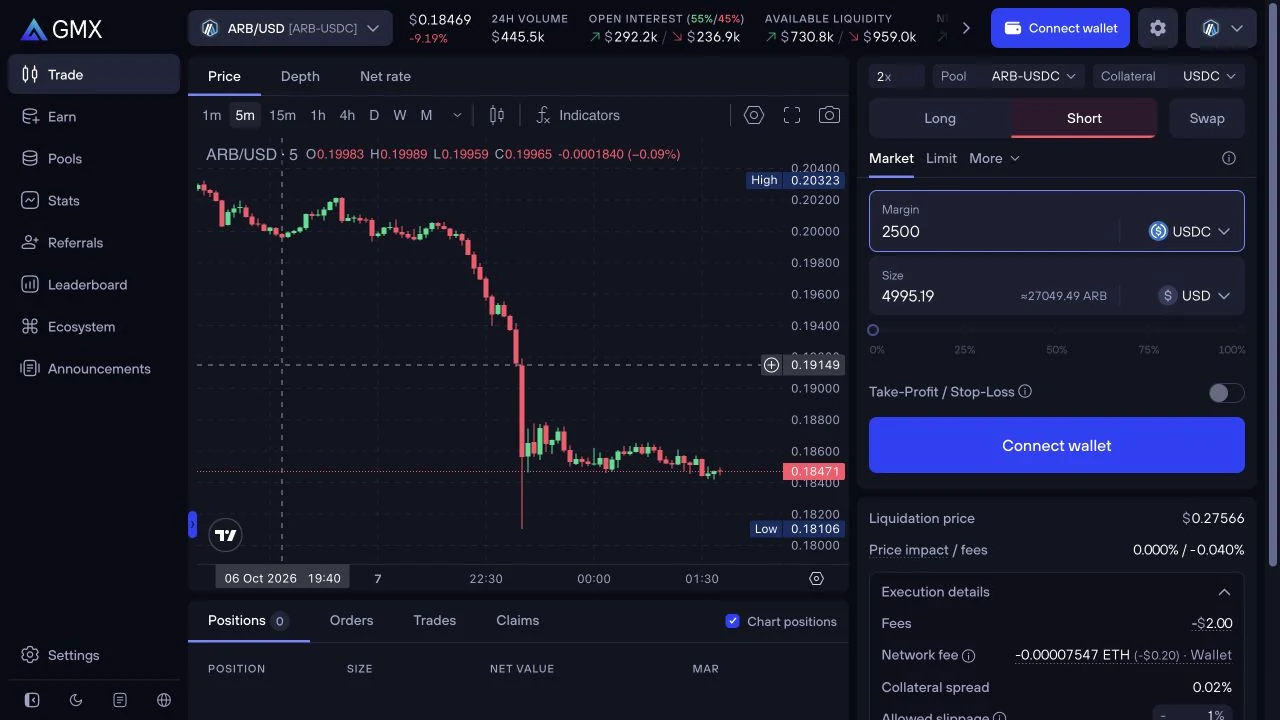
The screenshot shows the ARB–USDC market with USDC collateral and Short selected. Entering 2,500 USDC of margin at the displayed 2× setting produced a quoted exposure just under 5,000 USD after charges. It displayed about two dollars in trading fees, a separate network charge and a collateral spread.
Compare the final quote, not only the headline commission
The network fee in that capture was quoted in ETH, while the margin field used USDC. A funded USDC wallet without the required ETH gas is therefore not equivalent to having everything necessary for this particular route. ARB tokens do not replace the ETH balance shown for that network charge.
GMX's ongoing funding and borrowing can add to the opening cost. A quoted fee for entering the position is not a complete budget for retaining it until a token release. The GMX quote and centralized order-book results were collected separately; they are not simultaneous prices for the same order.
At the API capture, the ARB–USDC pool showed approximately 729,139 USD available on the long side and 960,085 on the short side. The ARB–ARB pool was much smaller, about 18,864 and 19,594. Those are separate pool capacities, not total platform liquidity or a promise of a particular executable price.
This makes the actual pool name important when opening ARB on GMX. An ARB–ARB quote should not inherit the larger stablecoin pool's capacity merely because the index token matches. The GMX evidence file retains the exact pool addresses and original integer values used for the USD conversions.
Which USDC route is more useful for Arbitrum futures?
Hyperliquid was substantially more competitive than Bybit ARBPERP at the measured 10,000 size: 14.63–16.57 versus 84.07–92.54 USDC before funding. Binance ARBUSDC, at 28.75–32.70, sat between them. That is enough separation to make the exact USDC instrument worth choosing deliberately.
The native Hyperliquid book was incomplete for a 50,000 model in at least one round. This limits the large-order conclusion, not the verified existence of the ARB market. Its 10× cap also rules it out when the account specifically requires a higher available leverage setting.
Already holding USDC on Arbitrum can reduce the setup friction
Hyperliquid's onboarding guide supports a direct USDC deposit from Arbitrum, requiring ETH on that network for gas. Other supported funding routes exist, but an existing Arbitrum USDC balance gives the reader a concrete starting point without first acquiring ARB tokens.
The guide lists a one-USDC withdrawal fee for that direct route. For a small trade, that fixed cost can outweigh tiny differences in execution: a 0.15-USDC modeled advantage is not a saving if achieving it requires an otherwise unnecessary one-USDC withdrawal plus deposit gas.
ARB exposure, the deposit network and the asset used as margin therefore need to match the intended workflow. They do not all have to be ARB. Someone arriving with ARB tokens must account for the conversion or collateral terms actually offered, instead of assuming every Arbitrum-related venue accepts those tokens directly as trading balance.
Other ARB listings and where to go next
The directory contains seventeen perpetual records across fourteen venues. Eleven stablecoin contracts across eight venues were measured in the execution comparison. The two GMX pools were verified separately in this article and are not silently added to the directory's count.
Gate ARB_USDT was among the measured alternatives, at 34.40–39.75 USDT for 10,000 each way. MEXC ARB_USDT was closer to the leading group at 18.22–19.64 using API pricing. The broader directory also contains products without a like-for-like execution measurement; they should not receive an invented position in the cost ranking.
For a trader who already has one of those accounts, the useful next step is to compare its actual eligible fee and exact contract with the measured alternatives. For regional eligibility, use the country guides. For platform custody, account and withdrawal details, the linked exchange reviews provide the broader assessment without duplicating it throughout this ARB article.
17 contract records across 14 venues. Each instrument has its own record; a listing does not establish country eligibility. Quantity, increment and minimum value requirements apply together; an omitted value is not a zero minimum.
Aster1 contracts
ARBUSDT
- Settlement / P&L
- USDT
- Published ceiling
- Not supplied
- Minimum quantity
- 0.1 ARB
- Quantity increment
- 0.1 ARB
- Minimum order value
- 5 USDT
- Funding interval
- See product schedule
Binance2 contracts
ARBUSDC
- Settlement / P&L
- USDC
- Published ceiling
- Not supplied
- Minimum quantity
- 0.1 ARB
- Quantity increment
- 0.1 ARB
- Minimum order value
- 5 USDC
- Funding interval
- See product schedule
ARBUSDT
- Settlement / P&L
- USDT
- Published ceiling
- Not supplied
- Minimum quantity
- 0.1 ARB
- Quantity increment
- 0.1 ARB
- Minimum order value
- 5 USDT
- Funding interval
- See product schedule
Bitget1 contracts
ARBUSDT
- Settlement / P&L
- USDT
- Published ceiling
- 50×
- Minimum quantity
- 0.01 ARB
- Quantity increment
- Not supplied
- Minimum order value
- 5 USDT
- Funding interval
- 8 hours
Bybit2 contracts
ARBPERP
- Settlement / P&L
- USDC
- Published ceiling
- 50×
- Minimum quantity
- 0.1 ARB
- Quantity increment
- 0.1 ARB
- Minimum order value
- 5 USDC
- Funding interval
- 8 hours
ARBUSDT
- Settlement / P&L
- USDT
- Published ceiling
- 50×
- Minimum quantity
- 0.1 ARB
- Quantity increment
- 0.1 ARB
- Minimum order value
- 5 USDT
- Funding interval
- 8 hours
dYdX1 contracts
ARB-USD
- Settlement / P&L
- USDC
- Published ceiling
- 10×base initial margin; size adjustment can lower it
- Minimum quantity
- 1 ARB
- Quantity increment
- 1 ARB
- Minimum order value
- Not supplied
- Funding interval
- See product schedule
edgeX1 contracts
ARBUSDC
- Settlement / P&L
- USDC
- Published ceiling
- 20×
- Minimum quantity
- 400 ARB
- Quantity increment
- Not supplied
- Minimum order value
- Not supplied
- Funding interval
- 4 hours
Gate1 contracts
ARB_USDT
- Settlement / P&L
- USDT
- Published ceiling
- 50×
- Minimum quantity
- 1 contracts1 contract = 1 ARB
- Quantity increment
- 1 contracts
- Minimum order value
- Not supplied
- Funding interval
- 8 hours
Hyperliquid1 contracts
ARB
- Settlement / P&L
- USDC
- Published ceiling
- 10×
- Minimum quantity
- Not supplied
- Quantity increment
- Not supplied
- Minimum order value
- Not supplied
- Funding interval
- See product schedule
Kraken1 contracts
PF_ARBUSD
- Settlement / P&L
- USDUSD P&L; selectable profit currency can incur conversion fees
- Published ceiling
- Not supplied
- Minimum quantity
- Not supplied1 contract = 1 ARB
- Quantity increment
- Not supplied
- Minimum order value
- Not supplied
- Funding interval
- See product schedule
KuCoin1 contracts
ARBUSDTM
- Settlement / P&L
- USDT
- Published ceiling
- 75×
- Minimum quantity
- 1 contracts1 contract = 1 ARB
- Quantity increment
- 1 contracts
- Minimum order value
- Not supplied
- Funding interval
- 8 hours
MEXC2 contracts
ARB_USDC
- Settlement / P&L
- USDC
- Published ceiling
- 125×
- Minimum quantity
- 1 contracts1 contract = 1 ARB
- Quantity increment
- 1 contracts
- Minimum order value
- Not supplied
- Funding interval
- See product schedule
ARB_USDT
- Settlement / P&L
- USDT
- Published ceiling
- 200×
- Minimum quantity
- 1 contracts1 contract = 1 ARB
- Quantity increment
- 1 contracts
- Minimum order value
- Not supplied
- Funding interval
- See product schedule
OKX1 contracts
ARB-USDT-SWAP
- Settlement / P&L
- USDT
- Published ceiling
- 50×
- Minimum quantity
- 0.1 contracts1 contract = 10 ARB
- Quantity increment
- 0.1 contracts
- Minimum order value
- Not supplied
- Funding interval
- See product schedule
Phemex1 contracts
ARBUSDT
- Settlement / P&L
- USDT
- Published ceiling
- 50×
- Minimum quantity
- Not supplied
- Quantity increment
- 1 ARB
- Minimum order value
- 1 USDT
- Funding interval
- 8 hours
WEEX1 contracts
ARBUSDT
- Settlement / P&L
- USDT
- Published ceiling
- 200×
- Minimum quantity
- 1 ARB1 contract = 1 ARB
- Quantity increment
- Not supplied
- Minimum order value
- Not supplied
- Funding interval
- 8 hours
ARB futures questions
Does an ARB futures position receive newly unlocked tokens?
No. A price derivative does not allocate vested tokens to its holders. Unlock recipients and their schedules are separate from the accounts trading ARB perpetuals.
Is ARBPERP another name for Bybit ARBUSDT?
They are different settlement products. ARBPERP uses USDC; ARBUSDT uses USDT. Their measured books, funding totals, position tiers and market-order limits differed substantially.
Can I use an Arbitrum USDC balance to fund Hyperliquid ARB futures?
The documented direct bridge accepts USDC from Arbitrum and requires ETH for deposit gas. After funding the account, choose the native ARB market. Owning ARB tokens is not a prerequisite for that USDC route.
Does GMX offer ARB shorts, or only trading on the Arbitrum network?
The checked public interface offered Short on the exact ARB/USD [ARB-USDC] market. A separate ARB–ARB pool was also listed. This confirms an ARB price product rather than inferring one from the network name.
Why are some ARB cost estimates marked above the order limit?
Returned book depth can exceed the quantity allowed in one market order. The markings prevent a theoretical sweep from being mistaken for one executable submission. Aster ARBUSDT and MEXC ARB_USDC were notable examples.
Does an ARB unlock tell me how many tokens will be sold?
No. Vesting releases, circulating supply and actual sales measure different things. A token can be unlocked without being sold, and treasury balances do not all enter the market at once. Use the documented schedule to understand supply permissions, not as a guaranteed short signal.
Which ARB futures venue is best for holding through an unlock?
The evidence does not establish a permanent winner for that future period. The measured funding signs differed by contract, and WEEX funding was not collected. Choose using the expected holding period, current eligible quote and complete costs, rather than extending the entry-cost ranking into an unsupported holding-cost claim.
Sources and research
Comparisons use the public records linked below, not funded account tests. How we research · Report a correction.
Collected 33 public books for eleven exact ARB contracts in three nearby rounds, from 04:42:35 to 04:43:26 UTC on October 7, 2026. This is a roughly 51-second observation, not a daily or stressed-market benchmark. Requests within each round were not simultaneous.
Each side was swept for equal settlement values of 1,000, 5,000, 10,000, 15,000, 25,000 and 50,000. Costs combine midpoint price impact and cited taker commission before quantity rounding, transfers and funding. USDT and USDC are valued at par. Full-size ranges require complete returned depth on both sides in all rounds.
Gate, MEXC and OKX quantities use the captured contract multipliers. Single-order ceilings are shown separately from book depth and position risk tiers. Missing returned depth is not equated with absence of further market liquidity.
Funding totals use actual October 4–6 UTC events at constant reference exposure. Combining them with later execution measurements is a sensitivity model, not a backtest of a completed position. Uncollected funding is not zero.
GMX API pool capacity uses 30-decimal USD values. The public interface was inspected without connecting a wallet or submitting a transaction. Its quote and the earlier API capacity are separate observations. No live fills, authenticated account fees or regional account approvals were tested.
- ARB books, specifications and funding ↗
Three rounds, eleven contracts; public fee references and actual October 4–6 funding events.
- GMX ARB pool records ↗
Two exact listed markets. USD amounts use 30-decimal scaling; independent public UI capture.
- Arbitrum distribution documentation ↗
Distinct investor/team and Foundation vesting schedules; not a sell-pressure forecast.
- Arbitrum Foundation first-half 2026 report ↗
Unlock and DAO treasury total; wording preserved in the article.
- Hyperliquid funding your account ↗
Direct Arbitrum USDC route, ETH gas and withdrawal fee.
- GMX trading fees ↗
Trading, borrowing, funding and network costs are separate.
- Bybit regular derivatives fees ↗
0.055% regular taker reference.
- MEXC API schedule ↗
0.08% taker API rate, distinct from manual-account promotions.
- Aster fee groups ↗
ARB uses the General category, 0.04% taker reference.
- Hyperliquid trading fees ↗
0.045% regular native perpetual taker reference.
- Binance futures fees ↗
USDT 0.05%; USDC 0.04% promotional reference, without BNB discounts.
- OKX fee rules ↗
0.05% regular derivatives taker reference.
- WEEX contract information ↗
ARB returned 0.08% taker; opening-order limit is a base-token quantity.
- MEXC ARB 0-Fee Fest — MENA manual accounts ↗
Starts 1 October 2026, 12:00 UTC; no announced end. ARBUSDT/ARBUSDC; excludes API trading and liquidation charges.