Best Avalanche Futures Exchanges for AVAX Leverage
AVAX has credible exchange and wallet markets. The network holding your money can matter as much as the fee on the trade.
Short answer
Binance and Hyperliquid were closely matched around 10,000 in the October 10 AVAX check. Binance suits a USDT account; Hyperliquid suits USDC and up to 10×. For an AVAX balance already on Avalanche, GMX can avoid moving the funds to another exchange, with its own quoted trading and holding costs.
Visit BinanceAVAX contracts for different account setups
Options for eligible accounts. Country availability is separate from contract availability.

A stronger measured result at 50,000 USDT
For larger USDT orders on an exchange book. No Avalanche network transfer is required merely to hold this futures contract.
AVAXUSDT · USDT settlementVisit Binance
Competitive execution from an existing USDC account
For AVAX price exposure from an existing USDC derivatives account. Native 10× and its funding history differ from the centralized alternatives.
AVAX · USDC settlementVisit Hyperliquid
Higher leverage with a clearly bounded first band
A clearly documented 75× first band through 10,000 USDT. Its larger order-quantity allowance does not enlarge that high-leverage band.
AVAXUSDT · USDT settlementVisit BybitShould you trade AVAX on an exchange or directly on Avalanche?
For a trader starting with USDT on an exchange, moving to Avalanche adds a transfer and wallet operation before the first position. Binance AVAXUSDT offers a direct comparison point: a 10,000-USDT buy plus an equal-value sell cost an estimated 12.63–13.28 USDT across the researched books. There is no need to acquire AVAX for network fees merely to trade that contract.
A reader who already keeps USDC on Avalanche faces a different choice. GMX can use that environment without first depositing at a centralized exchange. Its AVAX/USD market was verified by both its public market records and its trading interface. The useful advantage is where the trading funds already sit, rather than a claim that a wallet market must always be cheaper.
Hyperliquid offers a third arrangement: a native AVAX perpetual backed by a USDC trading balance, with a captured 10× maximum. It is relevant to a person already trading there, although an Avalanche wallet balance is not automatically a Hyperliquid margin balance. The deposit route and its final denomination still matter.
What the measured exchange costs actually favor
At 50,000 of quote value on each side, Binance AVAXUSDT estimated 82.77–90.27 USDT, Bybit 99.06–111.86 and OKX 95.53–125.92. At 10,000, OKX varied from 11.60 to 16.15, overlapping both Binance and Bybit. A single cheapest snapshot would obscure how much the OKX result changed between captures.
MEXC AVAX_USDT reached 99.34–103.50 at 50,000 using its documented API fee. That is close to Bybit but higher than Binance in these observations. Its book had lower price impact than several competitors; the API commission changed the final comparison. A verified manual-account promotion should be calculated separately rather than silently substituted into this table.
| Contract | Estimated combined cost |
|---|---|
| BinanceAVAXUSDTUSDT settlement | 11.26–13.57 USDT10.00 commission includedPublished fee basis: 0.05% per side |
| BybitAVAXUSDTUSDT settlement | 12.89–15.17 USDT11.00 commission includedPublished fee basis: 0.055% per side |
| HyperliquidAVAXUSDC settlement | 11.42–13.43 USDC9.00 commission includedPublished fee basis: 0.045% per side |
Compare 7 other measured contracts
| Contract | Estimated combined cost |
|---|---|
| BinanceAVAXUSDCUSDC settlement | 15.33–18.03 USDC8.00 commission includedPublished fee basis: 0.04% per side |
| OKXAVAX-USDT-SWAPUSDT settlement | 13.97–15.86 USDT10.00 commission includedPublished fee basis: 0.05% per side |
| MEXCAVAX_USDCUSDC settlement | 22.35–23.22 USDC16.00 commission includedAPI fee basis: 0.08% per side |
| MEXCAVAX_USDTUSDT settlement | 16.96–17.77 USDT16.00 commission includedAPI fee basis: 0.08% per side |
| WEEXAVAXUSDTUSDT settlement | 17.59–17.84 USDT16.00 commission includedPublished fee basis: 0.08% per side |
| GateAVAX_USDTUSDT settlement | 22.80–24.94 USDT15.00 commission includedPublished fee basis: 0.075% per side |
| AsterAVAXUSDTUSDT settlement | 13.09–14.39 USDT8.00 commission includedPublished fee basis: 0.04% per side |
Use your own trading fee
Enter your account’s taker fee. Only commission changes; the books remain dated. The fee source beside each input identifies its trading channel.
Inputs and calculation details
Total = buy and sell price impact from the midpoint + both trading fees. Orders above a known limit are excluded. Missing limits remain unknown; partial books do not establish a full-order cost.
Dated inputs and fee sources ↗ · Raw books ↗At 10,000 each way the later quote favored Binance, about 11.74 USDT, over Hyperliquid’s 13.57 USDC. This narrows the reason to choose the wallet route to an existing onchain balance or its account model. It is not a dependable small-order fee advantage over the centralized alternative.
Which GMX pool actually trades AVAX?
GMX lists AVAX/USD on both Avalanche and Arbitrum. They are separate verified pools, each with its own collateral and available capacity. Matching the asset name does not let a position use the other network’s liquidity.
In the captured Avalanche records, the AVAX index token and long-side pool token are wrapped AVAX, while the short-side pool token is native USDC. The public interface labels that pool WAVAX-USDC. This is a concrete AVAX instrument, not an inference from finding an exchange deployed on the Avalanche network.
Avalanche had substantially more available capacity
The Avalanche AVAX market returned approximately 1.87 million dollars of available long capacity and 1.76 million of short capacity. The Arbitrum AVAX market returned about 65,817 and 10,526 dollars respectively. These are dated pool availability fields, not exchange bids and asks or a guaranteed amount obtainable at a particular price.
For an illustrative 25,000-dollar short, that distinction is decisive: the captured Arbitrum short capacity was below the proposed size, while Avalanche's was above it. A trader already on Arbitrum cannot borrow the Avalanche pool's much larger number to justify the order. Capacity may change before a transaction is submitted.
Can the pool accommodate a 25,000-USD short?
Above the proposed position
Long capacity: 1,868,259 USDBelow the proposed position
Long capacity: 65,817 USDWhat about the smaller AVAX-only pool?
The same Avalanche response also contained AVAX/USD [AVAX-AVAX]. Its captured available capacity was approximately 47,808 USD for longs and 46,901 for shorts. This is a third choice, not another name for the much larger AVAX-USDC pool above. At a proposed 50,000-dollar position, neither side of this smaller pool had enough recorded capacity; at 25,000, both were above the requested value.
GMX’s single-token pool guide explains that collateral and payouts in these pools use the same underlying token. Internal token swaps are therefore unnecessary for position operations. That can appeal to someone intending to remain in AVAX, but it does not establish zero trading commission or zero position impact. The documentation’s zero-position-impact examples name specific BTC and ETH pools, not every single-token market.
For the reader starting with USDC, the larger AVAX-USDC market remains the more relevant native comparison. Choosing AVAX-only backing merely to avoid an internal swap would change the currency exposure of the account and, in this capture, substantially reduce usable capacity. For an AVAX holder, the smaller pool deserves its own ticket rather than the USDC quote shown below.
A pool token is also a different purchase from an AVAX long. Buying a GM liquidity token supplies capital to a pool; opening an AVAX/USD position trades the token’s price. A pool’s yield display should never be used as the expected return of the leveraged position.
Pool size does not tell you the full trading cost
GMX's position charge depends on how the operation changes the balance between long and short exposure. The published ordinary rates are 0.04% or 0.06% of the position value. Funding, borrowing, network charges and any collateral conversion are separate components. A large liquidity number therefore does not establish a zero-cost fill.
The current fee documentation also distinguishes allowed price movement from the market's separate impact adjustment. A one-percent slippage setting should not be read as a one-percent cap on every cost of the position. That distinction is particularly useful when comparing a GMX quote with an exchange's spread and commission.
A real AVAX quote: what 1,000 USDC supported on GMX
We entered an illustrative 1,000-USDC margin amount in the public Avalanche interface with its 2× setting. The displayed position was about 1,998 dollars, with an opening charge of approximately 0.80 dollars. The network estimate was around 0.65 dollars and changed while the page refreshed. No wallet was connected and no order was submitted.
The position was slightly below a neat 2,000 dollars because the preview accounts for opening costs. This is why multiplying the deposit by the leverage selector can differ from the amount shown on the actual ticket. The quote's USDC collateral, Avalanche network and AVAX/USD product were all visible, rather than reconstructed in a mock interface.
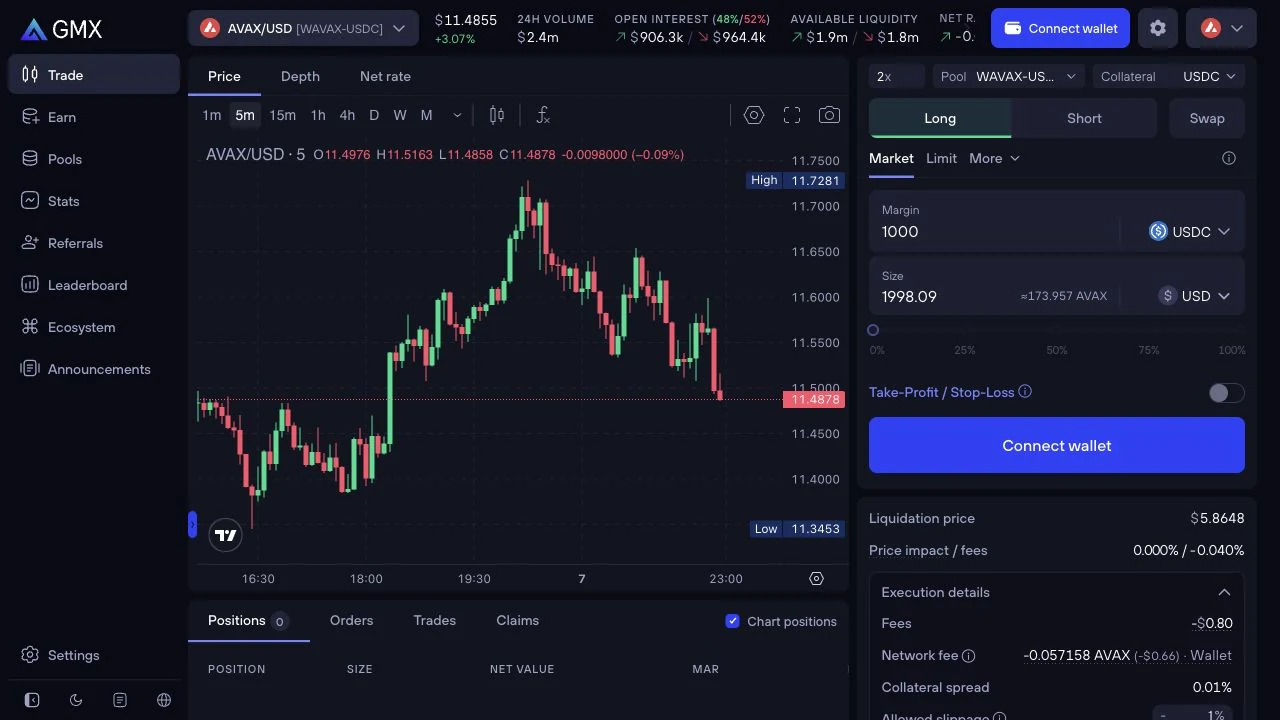
- Collateral
- 1,000 USDC
- Position preview
- ≈1,998 USD
- Opening charge
- ≈0.80 USD
- Network estimate
- ≈0.65 USD
What the opening preview leaves for later
A trader comparing that quote with Binance should still allow for the eventual close and the cost of holding the position. GMX's current documentation describes net price impact being applied when decreasing or closing, so an opening display of zero impact does not establish a cost-free exit. The value of a quote is knowing which parts it already includes.
For a short intraday position, the network estimate can be meaningful relative to a small margin deposit. For a position kept several days, changing funding and borrowing can become more important. For the saved position of roughly 1,998 USD, a separate 0.04% closing charge alone would add about 0.80 USD if its size and applicable rate stayed unchanged. That is before the other exit costs.
USDC and USDC.e are separate balances
The checked Avalanche market uses native USDC. GMX’s token records identify bridged USDC.e separately, with a different contract address. A wallet showing a dollar-denominated token is not enough to establish that no swap will be required.
The trade interface should show the chosen input and resulting collateral before submission. If it proposes a conversion, that cost belongs in the comparison with an exchange deposit. Native AVAX is also needed for ordinary Avalanche wallet transaction costs; committing the entire wallet balance as collateral can leave no practical room for a later on-chain action.
Can a GMX Account balance access the Avalanche AVAX pool?
GMX’s current network guide distinguishes wallet funds from its separate GMX Account balance. The latter executes on Arbitrum. Direct Avalanche trading instead uses wallet funds; the GMX Account feature is not available for that deployment.
This matters to someone who sees both balances under the same wallet identity. A funded GMX Account does not establish usable margin in the Avalanche AVAX-USDC pool. Likewise, the larger Avalanche short-capacity figure is not the capacity of an AVAX position opened through the Arbitrum account flow.
Does every Avalanche trade require a separate AVAX gas balance?
Classic wallet-signed trading uses AVAX for Avalanche gas. Express mode can pay through a supported gas-payment token, including USDC, USDT or WAVAX on Avalanche. The enabled mode and the balance named in the fee row therefore matter before a reader acquires extra AVAX solely for gas.
For a person already holding 1,000 USDC on Avalanche, this creates a practical account question before any bridge decision: can the selected mode use those wallet funds and reserve enough for its fees? That is different from funding the Arbitrum GMX Account. The public quote in this article establishes the Avalanche product and the proposed margin, but no connected-wallet approval flow was tested.
How much AVAX leverage can you actually use?
Bybit AVAXUSDT published a 75× first band through 10,000 USDT. The next band, through 15,000, was 70×. This makes a 12,000-USDT position a different margin decision from a 9,000-USDT one even though both use the same market and interface.
The captured initial-margin rates were 1.33% and 1.43% respectively. Applied to those example positions, the simple requirements are 119.70 and 171.60 USDT before fees and account adjustments. The platform's actual ticket remains responsible for rounding and its other controls; the example shows why the headline maximum alone is insufficient.
MEXC's 200× does not settle the venue choice
MEXC AVAX_USDT displayed a maximum of 200×, while its AVAX_USDC instrument showed 125×. The inverse AVAX_USD product showed 100×. Those are three separate contracts, not three settings of the same balance. The linear USDC book also cost more than the USDT book at each measured size.
A request for 100× therefore narrows the eligible product set, but it does not prove that the highest-leverage venue has the best execution. The intended position must satisfy that instrument's size-dependent risk controls. Its margin budget also has to absorb trading costs; the published leverage field is not a quote for a particular account.
A position band and an order limit answer different questions
Bybit allowed 22,000 AVAX in one ordinary market order. MEXC AVAX_USDC allowed 10,500 contracts at 0.1 AVAX each, or only 1,050 AVAX. At an illustrative 25 dollars per coin, the latter is 26,250 USDC. A 50,000-USDC book calculation would therefore not describe one permitted ordinary order at that example price.
At the captured AVAX price near 11.53, that MEXC USDC ceiling was only about 12,100 USDC. Both the 25,000 and 50,000 book models exceed one permitted order at the observed price; the table flags them. Larger positions can involve multiple orders, but the cost of a sequence cannot be derived by reusing an unchanged book after every fill.
AVAXUSDT or AVAXUSDC: does the lower fee win?
On Binance, the USDC promotional taker reference used here was 0.04%, compared with the regular 0.05% USDT reference. At 10,000 each way, that saves two units in commission. Yet AVAXUSDC's combined execution result was 18.29–21.76, compared with AVAXUSDT's 12.63–13.28.
The reason is the separate order book. Additional price impact outweighed the lower advertised commission. At 50,000, the USDC result widened to 146.50–161.56, a much larger difference than the ten-unit commission saving. Holding USDC can still make that product convenient, but it does not make its executions equivalent to the USDT market.
A longer holding period can partly change that comparison
During October 4–6 UTC, a constant 10,000-value long paid about 4.00 USDC in funding on Binance AVAXUSDC and 6.32 USDT on AVAXUSDT. The USDC contract saved roughly 2.33 over those three days. That saving was smaller than its observed execution disadvantage at the same position size.
This compares a historical funding window with later books, rather than recreating a completed trade. Its useful conclusion is conditional: lower funding alone did not cover the additional modeled trading cost in this scenario. A much longer holding period or a different future rate could change the arithmetic.
Hyperliquid's corresponding funding total was about 8.93 USDC, while Bybit's was 6.60 USDT and OKX's 6.31. Hyperliquid was competitive for immediate 10,000-value execution, but the researched holding cost weakens the case for selecting it solely on that small execution advantage.
Should an AVAX holder use coin collateral or stablecoin collateral?
Someone keeping AVAX as a long-term holding may want a separate short without selling the coins. A stablecoin-margined contract makes the short's collateral easier to budget in dollars. If AVAX rises sharply, the short can require attention even while the holding becomes more valuable elsewhere; the two balances are not automatically combined.
Using AVAX-linked collateral produces a different exposure. Its dollar value changes alongside the coin price. On a leveraged long, falling AVAX can hurt both the position and the collateral supporting it. That is an additional consequence of choosing coin collateral, not a reason to call every AVAX contract interchangeable.
The inverse contract uses a different size unit
MEXC AVAX_USD was documented with ten USD of face value per contract and settlement in AVAX. By contrast, AVAX_USDT uses 0.1 AVAX per contract and settles in USDT. Copying a contract count from one into the other creates an entirely different trade size.
For example, 1,000 inverse contracts represent 10,000 USD of face value. One thousand linear USDT contracts represent 100 AVAX; at an illustrative 25 dollars, that is 2,500 USDT. The distinction matters when relocating an existing hedge, not just when comparing leverage labels.
Further AVAX futures contracts
GMX’s chain-specific AVAX pools are compared above; the directory below covers exchange contracts.
18 contract records across 14 venues. Each instrument has its own record; a listing does not establish country eligibility. Quantity, increment and minimum value requirements apply together; an omitted value is not a zero minimum.
Aster1 contracts
AVAXUSDT
- Settlement / P&L
- USDT
- Published ceiling
- Not supplied
- Minimum quantity
- 1 AVAX
- Quantity increment
- 1 AVAX
- Minimum order value
- 5 USDT
- Funding interval
- See product schedule
Binance2 contracts
AVAXUSDC
- Settlement / P&L
- USDC
- Published ceiling
- Not supplied
- Minimum quantity
- 0.01 AVAX
- Quantity increment
- 0.01 AVAX
- Minimum order value
- 5 USDC
- Funding interval
- See product schedule
AVAXUSDT
- Settlement / P&L
- USDT
- Published ceiling
- Not supplied
- Minimum quantity
- 1 AVAX
- Quantity increment
- 1 AVAX
- Minimum order value
- 5 USDT
- Funding interval
- See product schedule
Bitget1 contracts
AVAXUSDT
- Settlement / P&L
- USDT
- Published ceiling
- 75×
- Minimum quantity
- 0.1 AVAX
- Quantity increment
- Not supplied
- Minimum order value
- 5 USDT
- Funding interval
- 8 hours
Bybit1 contracts
AVAXUSDT
- Settlement / P&L
- USDT
- Published ceiling
- 75×
- Minimum quantity
- 0.1 AVAX
- Quantity increment
- 0.1 AVAX
- Minimum order value
- 5 USDT
- Funding interval
- 8 hours
dYdX1 contracts
AVAX-USD
- Settlement / P&L
- USDC
- Published ceiling
- 10×base initial margin; size adjustment can lower it
- Minimum quantity
- 0.1 AVAX
- Quantity increment
- 0.1 AVAX
- Minimum order value
- Not supplied
- Funding interval
- See product schedule
Gate1 contracts
AVAX_USDT
- Settlement / P&L
- USDT
- Published ceiling
- 75×
- Minimum quantity
- 1 contracts1 contract = 1 AVAX
- Quantity increment
- 1 contracts
- Minimum order value
- Not supplied
- Funding interval
- 8 hours
Hyperliquid1 contracts
AVAX
- Settlement / P&L
- USDC
- Published ceiling
- 10×
- Minimum quantity
- Not supplied
- Quantity increment
- Not supplied
- Minimum order value
- Not supplied
- Funding interval
- See product schedule
Kraken1 contracts
PF_AVAXUSD
- Settlement / P&L
- USDUSD P&L; selectable profit currency can incur conversion fees
- Published ceiling
- Not supplied
- Minimum quantity
- Not supplied1 contract = 1 AVAX
- Quantity increment
- Not supplied
- Minimum order value
- Not supplied
- Funding interval
- See product schedule
KuCoin1 contracts
AVAXUSDTM
- Settlement / P&L
- USDT
- Published ceiling
- 75×
- Minimum quantity
- 1 contracts1 contract = 0.1 AVAX
- Quantity increment
- 1 contracts
- Minimum order value
- Not supplied
- Funding interval
- 8 hours
MEXC3 contracts
AVAX_USD
- Settlement / P&L
- AVAX
- Published ceiling
- 100×
- Minimum quantity
- 1 contracts1 contract = 10 USD
- Quantity increment
- 1 contracts
- Minimum order value
- Not supplied
- Funding interval
- See product schedule
AVAX_USDC
- Settlement / P&L
- USDC
- Published ceiling
- 125×
- Minimum quantity
- 1 contracts1 contract = 0.1 AVAX
- Quantity increment
- 1 contracts
- Minimum order value
- Not supplied
- Funding interval
- See product schedule
AVAX_USDT
- Settlement / P&L
- USDT
- Published ceiling
- 200×
- Minimum quantity
- 1 contracts1 contract = 0.1 AVAX
- Quantity increment
- 1 contracts
- Minimum order value
- Not supplied
- Funding interval
- See product schedule
OKX1 contracts
AVAX-USDT-SWAP
- Settlement / P&L
- USDT
- Published ceiling
- 50×
- Minimum quantity
- 0.1 contracts1 contract = 1 AVAX
- Quantity increment
- 0.1 contracts
- Minimum order value
- Not supplied
- Funding interval
- See product schedule
Paradex1 contracts
AVAX-USD-PERP
- Settlement / P&L
- USDC
- Published ceiling
- 20×base initial margin; size adjustment can lower it
- Minimum quantity
- Not supplied
- Quantity increment
- 0.01 AVAX
- Minimum order value
- 10 USDC
- Funding interval
- 8 hours
Phemex2 contracts
AVAXUSDC
- Settlement / P&L
- USDC
- Published ceiling
- 50×
- Minimum quantity
- Not supplied
- Quantity increment
- 0.1 AVAX
- Minimum order value
- 1 USDC
- Funding interval
- 8 hours
AVAXUSDT
- Settlement / P&L
- USDT
- Published ceiling
- 50×
- Minimum quantity
- Not supplied
- Quantity increment
- 0.1 AVAX
- Minimum order value
- 1 USDT
- Funding interval
- 8 hours
WEEX1 contracts
AVAXUSDT
- Settlement / P&L
- USDT
- Published ceiling
- 200×
- Minimum quantity
- 1 AVAX1 contract = 1 AVAX
- Quantity increment
- Not supplied
- Minimum order value
- Not supplied
- Funding interval
- 8 hours
AVAX futures questions
Is GMX AVAX available only on Avalanche?
No. Both Avalanche and Arbitrum listed AVAX/USD, but their pools had different capacity. The captured Arbitrum short availability was about 10,526 USD, far below Avalanche’s 1.76 million.
Can a 12,000-USDT Bybit AVAX position use the first 75× band?
No. The captured 75× band ended at 10,000 USDT. A 12,000 position entered the next band, with a 70× ceiling and 1.43% initial-margin rate.
Does an AVAX long on GMX have to use AVAX as collateral?
The verified Avalanche ticket used USDC collateral for an AVAX/USD long. The asset being traded and the collateral selected on the ticket are separate fields.
Is Binance AVAXUSDC cheaper because its commission is lower?
Not in these captures. At 10,000 each side, its modeled cost was 18.29–21.76 USDC versus 12.63–13.28 USDT on AVAXUSDT. The separate book outweighed the commission saving.
What does 1,000 contracts mean on MEXC AVAX_USD?
It represents 10,000 USD of inverse-contract face value, not 1,000 AVAX. AVAX_USDT has a different multiplier: 1,000 contracts represent 100 AVAX.
Does a GMX opening quote include the eventual AVAX exit?
No. Closing charges, net impact at reduction and subsequent holding costs must still be considered. The saved quote shows an unsigned opening preview, not an executed round trip.
Sources and research
Comparisons use the public records linked below, not funded account tests. How we research · Report a correction.
Three independent collection windows ran from 01:52 to 01:55 UTC on October 7, 2026. Estimates sweep each returned order book in both directions at equal quote value, adding the stated taker reference. They are not completed trades or a representative daily/stress sample.
Gate, MEXC and OKX contract quantities are converted to underlying coins before pricing. Only complete buy and sell depth in all three samples produces a full-size range. Missing returned depth is not evidence that no further liquidity exists. Stablecoins are compared at par; increments and single-order ceilings are considered separately.
Funding totals use the actual events in October 4–6 UTC, with constant position value. Trading fees exclude personal tiers, rebates, token discounts and transfer costs. MEXC figures use its API schedule; Gate figures use public contract fee fields. Neither establishes a logged-in manual-account offer.
Crypto.com CRO uses a separate single-book observation and the product-specific 20× ceiling visible in its terminal and risk table. Its generic API field says 50. GMX pool availability and the unsigned trade preview are separate from order-book cost estimates.
Public instruments and source documents establish the product facts described here. No trade, account approval, native-coin deposit or withdrawal was performed. Sources and raw responses are available below.
- GMX networks and wallet balances ↗
Avalanche wallet funds versus the Arbitrum GMX Account; gas-payment modes.
- GMX single-token pool mechanics ↗
Backing assets, payouts and the distinction between pool capital and a leveraged position.
- AVAX contract and book observations ↗
Three collection windows on October 7; funding October 4–6 UTC.
- GMX pool and token records ↗
Avalanche and Arbitrum pools collected independently; USD pool values use 30 decimals.
- GMX official market API ↗
Market identity, active flag, liquidity fields and chain-specific endpoints.
- GMX fees and impact ↗
Position charges, collateral conversion and net impact at reduction; checked October 7.
- GMX order previews ↗
Execution detail fields and collateral/position controls.
- Avalanche transaction fees ↗
Native AVAX used for network transaction costs.
- Binance USDT futures fee reference ↗
Regular 0.05% taker reference; no BNB discount.
- Binance USDC promotional fees ↗
USDC regular-tier 0.04% taker reference differs from USDT.
- Bybit trading fees ↗
Regular derivatives taker reference of 0.055%.
- MEXC API fee schedule ↗
0.08% taker and 0.06% maker API fees effective June 1, 2026; manual-account offers are separate.
- Aster perpetual fees ↗
Crypto General regular 0.04% taker reference for the checked contracts.
- Gate public futures fields ↗
Contract multipliers, public fee fields, market-order limits and funding intervals.