Best Uniswap Futures Exchanges for UNI Leverage
UNIUSDT and UNIPERP can require very different amounts of capital for the same trade. Here is where the book, margin band and settlement currency change the choice.
Short answer
Binance UNIUSDT and OKX UNI-USDT-SWAP are close choices for a USDT-funded UNI trade. Before choosing Bybit UNIPERP for USDC settlement, allow for its much larger margin requirement; it is a different product from UNIUSDT.
Visit BinanceUNI contracts worth comparing first
Options for eligible accounts. Country availability is separate from contract availability.

USDT execution alongside OKX
For a USDT trading budget and whole-UNI quantity increments. The margin decision is independent of whether the trader also owns UNI in a wallet.
UNIUSDT · USDT settlementVisit Binance
A close result for the 10,000 trade
A close alternative for an existing OKX account. Its contract count represents UNI quantity, so the risk-band boundary should not be read as dollars.
UNI-USDT-SWAP · USDT settlementVisit OKX
Small UNI exposure from usable USDC
For a small native-USDC position at 10× or less. The incomplete larger response means its competitive small-order result is the supported use here.
UNI · USDC settlementVisit HyperliquidChoosing UNI futures without tying up unnecessary margin
Bybit UNIUSDT and UNIPERP require very different amounts of initial margin for the same monetary exposure. At a position value of 5,000, the first published bands imply about 67 USDT versus 250 USDC before fees. At 10,000, UNIPERP already falls into a lower leverage band. That capital requirement is a more consequential distinction than a tiny difference in commission.
For a new USDT trade, Binance’s UNIUSDT book supplies the stronger recorded cost starting point, with OKX close around 10,000. The comparison below prices the alternatives; the following margin and settlement sections explain why switching to a USDC contract changes more than the ticker.
A small wallet trade has a different shortlist
Hyperliquid’s native UNI market cost 0.91–1.15 USDC in the 1,000-per-side model, compared with Binance’s 1.12–1.21 USDT. That makes Hyperliquid relevant to an eligible trader already holding usable USDC there and needing no more than its initial 10× limit. The small absolute saving does not establish that moving funds from another network is worthwhile.
Its returned UNI book did not cover the full 10,000 size on both sides in every sample. We therefore have no complete 10,000 range for it, even though the 1,000 result is competitive. The missing depth is a boundary of this comparison, not a declaration that an order of that size can never execute.
| Contract | Estimated combined cost |
|---|---|
| BinanceUNIUSDTUSDT settlement | 12.78–13.73 USDT10.00 commission includedPublished fee basis: 0.05% per side |
| OKXUNI-USDT-SWAPUSDT settlement | 13.05–14.43 USDT10.00 commission includedPublished fee basis: 0.05% per side |
| HyperliquidUNIUSDC settlement | 12.31–13.76 USDC9.00 commission includedPublished fee basis: 0.045% per side |
Compare 8 other measured contracts
| Contract | Estimated combined cost |
|---|---|
| BinanceUNIUSDCUSDC settlement | 17.82–19.23 USDC8.00 commission includedPublished fee basis: 0.04% per side |
| BybitUNIPERPUSDC settlement | 60.67–100.14 USDC11.00 commission includedPublished fee basis: 0.055% per side |
| BybitUNIUSDTUSDT settlement | 16.56–17.19 USDT11.00 commission includedPublished fee basis: 0.055% per side |
| MEXCUNI_USDCUSDC settlement | Above ordinary order limitObserved ceiling: ≈ 3,873 USDC. No executable one-order estimate.API fee basis: 0.08% per side |
| MEXCUNI_USDTUSDT settlement | 18.21–18.69 USDT16.00 commission includedAPI fee basis: 0.08% per side |
| WEEXUNIUSDTUSDT settlement | 20.87–21.55 USDT16.00 commission includedPublished fee basis: 0.08% per side |
| GateUNI_USDTUSDT settlement | 28.88–29.67 USDT15.00 commission includedPublished fee basis: 0.075% per side |
| AsterUNIUSDTUSDT settlement | 19.26–22.12 USDT8.00 commission includedPublished fee basis: 0.04% per side |
Use your own trading fee
Enter your account’s taker fee. Only commission changes; the books remain dated. The fee source beside each input identifies its trading channel.
Inputs and calculation details
Total = buy and sell price impact from the midpoint + both trading fees. Orders above a known limit are excluded. Missing limits remain unknown; partial books do not establish a full-order cost.
Dated inputs and fee sources ↗ · Raw books ↗The later UNI comparison put OKX at 12.92 and Binance at 13.45 for 10,000 each way. That small reversal supports treating them as close execution alternatives. It does not erase UNIPERP’s larger margin requirement, which is the more stable distinction for a trader choosing the settlement currency.
Aster’s UNIUSDT was also measured. Its regular 0.04% taker reference is lower than Binance’s regular USDT percentage, but the resulting 25,000-per-side total was 59.74–70.91, versus 34.29–37.08 for Binance. For this UNI book, selecting the lower fee alone would choose the more expensive modeled execution.
UNIUSDT versus UNIPERP: how much margin does the position need?
Bybit’s two products make the contract choice unusually consequential. UNIUSDT starts at up to 75× through 10,000 USDT of position value. UNIPERP, settled in USDC, starts at 20× through 5,000 USDC. Its next bands reduce the ceiling to 19× through 9,000 and 18× through 13,000.
For a 5,000 position, dividing exposure by the maximum multiplier gives approximately 66.67 USDT of initial margin on UNIUSDT versus 250 USDC on UNIPERP. At 10,000, the corresponding amounts are 133.33 and 555.56 because UNIPERP has already reached its 18× band. Fees and additional account requirements are not included in those amounts.
| Position value | UNIUSDT | UNIPERP |
|---|---|---|
| 5,000 | 75×66.67 initial margin | 20×250.00 initial margin |
| 10,000 | 75×133.33 initial margin | 18×555.56 initial margin |
Why a lower multiplier is not an extra trading charge
The extra margin remains capital supporting the position; it is not a fee paid away. If two accounts open the same UNI quantity at the same price, their price gain or loss is the same before costs. The contract requiring more margin simply uses more capital for that exposure.
Is a USDC-settled UNI contract worth choosing?
Binance UNIUSDC gives an existing USDC holder a centralized alternative, but its lower promotional commission did not beat UNIUSDT at the larger tested sizes. At 10,000 per side it cost 17.41–18.26 USDC; at 25,000 it cost 56.40–62.64. The corresponding USDT ranges were 12.02–12.99 and 34.29–37.08.
That does not make every USDC choice poor. A 1,000-per-side trade on Binance UNIUSDC cost 1.00–1.19, overlapping the USDT result. If the balance is already in USDC, this smaller trade does not require a conversion just to match a headline recommendation written for USDT users.
UNIPERP’s recent funding was favorable to longs, but tiny
Over October 4–6 UTC, Bybit UNIPERP’s eighteen funding events summed to a slightly negative total. A constant 10,000-USDC long received approximately 0.23; the equivalent UNIUSDT long paid 4.31 over nine events. That four-hour contract was not automatically more expensive to hold than the eight-hour product.
However, the UNIPERP 10,000-per-side execution estimate was 60.09–66.12, far above UNIUSDT’s 15.78–16.58. The recent funding difference was too small to explain choosing that less economical execution for this size. UNIPERP would need a stronger reason, such as an applicable account constraint or a materially different live quote.
The same funding window produced positive totals of 6.81 per 10,000 on Binance UNIUSDT, 8.47 on Binance UNIUSDC and 10.24 on Hyperliquid. Those are completed histories, not current offers for the next three days. Funding comparisons use the contract’s position value, not the margin deposited to support it.
Why can UNIPERP show a new entry price without closing the position?
Bybit’s USDC session settlement converts the session’s unrealized result into realized P&L and resets the displayed average entry to the settlement mark price. The interval follows the contract’s funding interval; the captured UNIPERP interval was four hours.
For example, take an illustrative long of 1,000 UNI opened at eight USDC. Settlement at 8.40 realizes 400 USDC. If the next price is 8.10, the current session shows a 300 loss against the new 8.40 reference. Across both sessions, the price result is still a 100 gain before fees and funding.
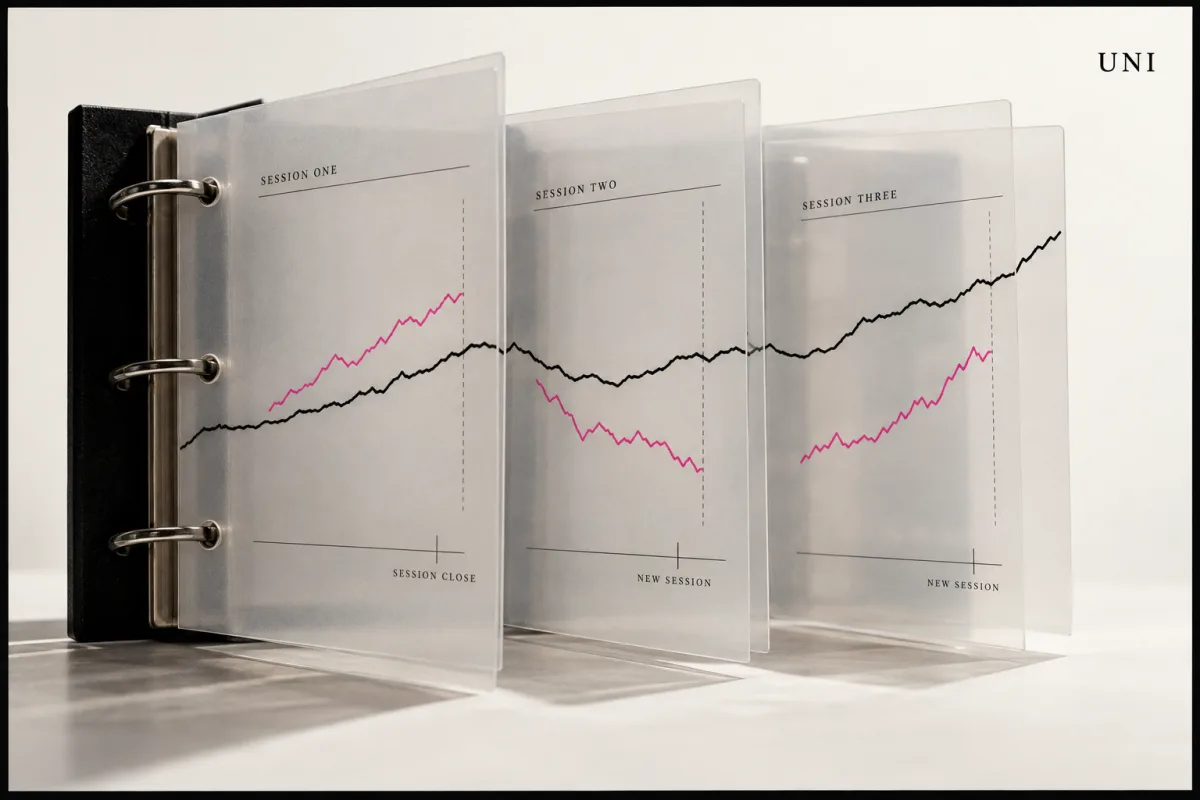
Follow the UNI session accounting example
A UNI session reset changes the ledger, not the whole trade
Combined price result: +100 USDC
Read the whole result before judging the contract
A screenshot of only the second session can look like a losing trade even though the position is above its original entry. The realized and unrealized components must be read together. This accounting event also does not mean the UNI quantity has been sold and bought again at an exchange fee on every settlement.
Funding remains a separate item. A positive price settlement is not a funding payment, and a funding debit does not establish that the position itself lost value. This matters when comparing the USDC contract with a USDT account whose trade display looks different.
Trading UNI futures with USDC already in a DeFi wallet
The wallet-based contract confirmed here is Hyperliquid’s native UNI market. The current instrument metadata reports 0.1-UNI quantity precision, an initial 10× maximum and a margin table that moves from 10× to 5× beyond 20 million USDC of position value. That large risk band is not evidence of equally large executable depth.
Hyperliquid’s onboarding instructions describe supported funding paths, including USDC on Arbitrum. USDC held on a different chain does not automatically become derivatives margin merely because the wallet address is recognizable. The route must credit the supported balance used by the intended UNI market.
The contract can be inexpensive while the route into it is not
Our 1,000-per-side UNI estimate on Hyperliquid is roughly one USDC. A separate conversion or bridge charge of several dollars could exceed that modeled trading charge. Such a setup cost is not included in the book table, and there is no universal bridge fee that can be assigned to every reader’s starting network.
For a balance already usable on Hyperliquid, that setup question may disappear. The decision then rests more directly on its 10× limit, measured small-order cost and account margin mode. An existing USDT balance at a centralized venue raises a different question and should not be sent through extra steps solely because the asset’s name is associated with DeFi.
Cross margin can share collateral with other positions, while isolated margin confines the margin supporting the individual position according to the venue’s rules. For UNI, an unrelated open trade can therefore change available cross-account capacity even when the UNI book itself is unchanged. The margin documentation explains that distinction.
UNI exposure versus an LP position
A UNI perpetual provides the chosen contract’s price exposure and funding cash flows. It does not allocate a Uniswap liquidity position or put voting UNI in a wallet. Uniswap governance describes token-based voting separately, and its LP fee guide describes fees earned by qualifying liquidity positions. A derivatives balance is neither of those positions.
UNI minimum orders and the quantity that actually fits
The captured Binance UNIUSDT and UNIUSDC contracts use whole-UNI order increments and a minimum notional of five settlement units. Bybit uses 0.1 UNI with a five-unit value minimum. At an illustrative UNI price of eight, Binance’s smallest whole-coin order is worth eight, while 0.7 UNI on Bybit is worth 5.60.
The finer Bybit step can matter for a small allocation. A 100-unit target at that price rounds down to twelve UNI, worth 96, on Binance; on Bybit it can be 12.5 UNI, worth 100. The step does not make Bybit cheaper to execute, but it permits that particular exposure more precisely.
Order capacity is different from the position’s leverage band
Bybit UNIUSDT’s captured single-market-order ceiling was 11,000 UNI, approximately 90,051 USDT at the lowest observed midpoint. UNIPERP allowed 4,100 UNI, approximately 33,567 USDC. Thus the 50,000 UNIPERP row is a depth model above the observed one-order limit, even where enough quoted size was returned.
MEXC UNI_USDC has a more restrictive captured maximum: 5,100 contracts, each representing 0.1 UNI. That is 510 UNI, approximately 4,176 USDC at the observed price. The larger USDC table rows cannot be treated as executable single orders under that limit.
Its UNI_USDT instrument uses the same 0.1-UNI contract unit but a much larger published volume cap and a 200× instrument maximum, compared with 125× for the USDC variant. Those maxima are instrument-level figures; they are not verified promises of the same leverage at every account size.
OKX UNI-USDT-SWAP uses one UNI per contract and whole-contract increments. Its first reported cross-margin band covers 9,500 UNI at up to 50×. This is a quantity-based band, unlike Bybit’s published USDT position-value thresholds, so the numbers should not be compared as though both represented dollars.
A second order-book option and two different GMX pools
The dYdX instrument list reports UNI-USD as active with one-UNI steps and a base 10% initial margin fraction, before size-related adjustments. Its public book returned both sides on October 7. That makes it a verified alternative to Hyperliquid, although one additional book response does not establish a lower all-in UNI cost.
GMX also lists two UNI/USD pools on Arbitrum: one backed by UNI/USDC and another by ETH/USDC. Their saved market records show different backing assets and capacity. A UNI trader should select the intended pool, then price its fee, borrowing and output token; neither pool inherits the order-book estimate above.
More UNI contracts, including coin-settled products
The coin-settled OKX alternative deserves its own payout decision.
OKX also lists UNI-USD-SWAP, with ten USD per contract and settlement in UNI. That product is relevant to a trader deliberately seeking coin-denominated collateral and results. It is not included in the stablecoin execution ranges and should not inherit the UNI-USDT-SWAP result.
For most readers comparing a USDT or USDC balance, the measured linear contracts answer the immediate question more directly. Where residence restricts derivatives access, use the country pages to identify the applicable entity before relying on a globally listed instrument. The product and the account’s eligibility both have to match.
20 contract records across 15 venues. Each instrument has its own record; a listing does not establish country eligibility. Quantity, increment and minimum value requirements apply together; an omitted value is not a zero minimum.
Aster1 contracts
UNIUSDT
- Settlement / P&L
- USDT
- Published ceiling
- Not supplied
- Minimum quantity
- 1 UNI
- Quantity increment
- 1 UNI
- Minimum order value
- 5 USDT
- Funding interval
- See product schedule
Binance2 contracts
UNIUSDC
- Settlement / P&L
- USDC
- Published ceiling
- Not supplied
- Minimum quantity
- 1 UNI
- Quantity increment
- 1 UNI
- Minimum order value
- 5 USDC
- Funding interval
- See product schedule
UNIUSDT
- Settlement / P&L
- USDT
- Published ceiling
- Not supplied
- Minimum quantity
- 1 UNI
- Quantity increment
- 1 UNI
- Minimum order value
- 5 USDT
- Funding interval
- See product schedule
Bitget1 contracts
UNIUSDT
- Settlement / P&L
- USDT
- Published ceiling
- 75×
- Minimum quantity
- 1 UNI
- Quantity increment
- Not supplied
- Minimum order value
- 5 USDT
- Funding interval
- 8 hours
Bybit2 contracts
UNIPERP
- Settlement / P&L
- USDC
- Published ceiling
- 20×
- Minimum quantity
- 0.1 UNI
- Quantity increment
- 0.1 UNI
- Minimum order value
- 5 USDC
- Funding interval
- 4 hours
UNIUSDT
- Settlement / P&L
- USDT
- Published ceiling
- 75×
- Minimum quantity
- 0.1 UNI
- Quantity increment
- 0.1 UNI
- Minimum order value
- 5 USDT
- Funding interval
- 8 hours
dYdX1 contracts
UNI-USD
- Settlement / P&L
- USDC
- Published ceiling
- 10×base initial margin; size adjustment can lower it
- Minimum quantity
- 1 UNI
- Quantity increment
- 1 UNI
- Minimum order value
- Not supplied
- Funding interval
- See product schedule
edgeX1 contracts
UNIUSDC
- Settlement / P&L
- USDC
- Published ceiling
- 20×
- Minimum quantity
- 8 UNI
- Quantity increment
- Not supplied
- Minimum order value
- Not supplied
- Funding interval
- 4 hours
Gate1 contracts
UNI_USDT
- Settlement / P&L
- USDT
- Published ceiling
- 75×
- Minimum quantity
- 1 contracts1 contract = 1 UNI
- Quantity increment
- 1 contracts
- Minimum order value
- Not supplied
- Funding interval
- 8 hours
Hyperliquid1 contracts
UNI
- Settlement / P&L
- USDC
- Published ceiling
- 10×
- Minimum quantity
- Not supplied
- Quantity increment
- Not supplied
- Minimum order value
- Not supplied
- Funding interval
- See product schedule
Kraken1 contracts
PF_UNIUSD
- Settlement / P&L
- USDUSD P&L; selectable profit currency can incur conversion fees
- Published ceiling
- Not supplied
- Minimum quantity
- Not supplied1 contract = 1 UNI
- Quantity increment
- Not supplied
- Minimum order value
- Not supplied
- Funding interval
- See product schedule
KuCoin1 contracts
UNIUSDTM
- Settlement / P&L
- USDT
- Published ceiling
- 75×
- Minimum quantity
- 1 contracts1 contract = 1 UNI
- Quantity increment
- 1 contracts
- Minimum order value
- Not supplied
- Funding interval
- 8 hours
MEXC2 contracts
UNI_USDC
- Settlement / P&L
- USDC
- Published ceiling
- 125×
- Minimum quantity
- 1 contracts1 contract = 0.1 UNI
- Quantity increment
- 1 contracts
- Minimum order value
- Not supplied
- Funding interval
- See product schedule
UNI_USDT
- Settlement / P&L
- USDT
- Published ceiling
- 200×
- Minimum quantity
- 1 contracts1 contract = 0.1 UNI
- Quantity increment
- 1 contracts
- Minimum order value
- Not supplied
- Funding interval
- See product schedule
OKX2 contracts
UNI-USD-SWAP
- Settlement / P&L
- UNI
- Published ceiling
- 20×
- Minimum quantity
- 1 contracts1 contract = 10 USD
- Quantity increment
- 1 contracts
- Minimum order value
- Not supplied
- Funding interval
- See product schedule
UNI-USDT-SWAP
- Settlement / P&L
- USDT
- Published ceiling
- 50×
- Minimum quantity
- 1 contracts1 contract = 1 UNI
- Quantity increment
- 1 contracts
- Minimum order value
- Not supplied
- Funding interval
- See product schedule
Paradex1 contracts
UNI-USD-PERP
- Settlement / P&L
- USDC
- Published ceiling
- 20×base initial margin; size adjustment can lower it
- Minimum quantity
- Not supplied
- Quantity increment
- 0.1 UNI
- Minimum order value
- 10 USDC
- Funding interval
- 8 hours
Phemex2 contracts
UNIUSDC
- Settlement / P&L
- USDC
- Published ceiling
- 50×
- Minimum quantity
- Not supplied
- Quantity increment
- 0.01 UNI
- Minimum order value
- 1 USDC
- Funding interval
- 8 hours
UNIUSDT
- Settlement / P&L
- USDT
- Published ceiling
- 50×
- Minimum quantity
- Not supplied
- Quantity increment
- 0.01 UNI
- Minimum order value
- 1 USDT
- Funding interval
- 8 hours
WEEX1 contracts
UNIUSDT
- Settlement / P&L
- USDT
- Published ceiling
- 200×
- Minimum quantity
- 1 UNI1 contract = 1 UNI
- Quantity increment
- Not supplied
- Minimum order value
- Not supplied
- Funding interval
- 8 hours
UNI futures questions
How much margin does a UNI position worth 5,000 USDT or USDC need on Bybit?
For 5,000 USDT of UNIUSDT exposure, the first 75× band implies about 66.67 USDT of initial margin. For 5,000 USDC of UNIPERP exposure, the 20× band implies 250 USDC. These are position values, not 5,000 UNI tokens, and exclude fees and additional account requirements.
Can I open a 10,000-USDC UNIPERP position at 20×?
Not under the captured bands. Twenty times applies through 5,000 USDC; 10,000 falls in the 18× band through 13,000. Its theoretical initial margin is about 555.56 USDC before other requirements.
Why did my UNIPERP average entry change after four hours?
USDC session settlement realizes the session’s P&L and resets the displayed entry to the settlement mark price. It does not, by itself, change the number of UNI in the position. Include realized settlements when assessing the whole trade.
Is Hyperliquid’s UNI market suitable for 10,000 orders?
The contract is confirmed, but our returned books did not fully cover both directions at that size in all three samples. Its competitive 1,000 result cannot establish the cost of a 10,000 order. This is incomplete measurement, not proof that no further liquidity exists.
Does a 200× MEXC UNI headline also apply to UNI_USDC?
The captured UNI_USDT instrument publishes 200×, while UNI_USDC publishes 125× and a much smaller maximum order volume. The USD-pegged settlement currencies do not make their limits interchangeable.
Why can a 100-USDT UNI target produce only 96 of exposure?
At an illustrative price of eight, Binance’s whole-UNI increment rounds that target down to twelve coins. Bybit’s 0.1-UNI step can represent 12.5 coins instead. Minimum order value must also be satisfied.
Sources and research
Comparisons use the public records linked below, not funded account tests. How we research · Report a correction.
Three public-book rounds were initiated between 03:32:30 and 03:34:59 UTC on October 7, 2026: 96 responses covering 32 contracts. Requests within each round were not simultaneous. These nearby observations do not establish typical daily execution or performance during stress.
Buy and sell books were independently swept at equal notionals of 1,000, 10,000, 25,000 and 50,000. Contract quantities were converted into coin quantities for Gate, OKX and MEXC. Full-size ranges require complete returned depth on both sides in all three observations; incomplete responses are not evidence that no additional liquidity exists.
Costs add midpoint price impact and cited taker fees on both sides, before quantity rounding, funding, conversions or transfers. Stablecoins are compared at par. Binance USDC uses its displayed promotional fee; USDT uses the regular fee. MEXC uses API pricing, not a presumed manual-account offer. This model is not realized trading profit or loss.
Funding adds actual October 4–6 UTC events at a constant reference notional. Combining that history with October 7 execution costs is a sensitivity scenario, not an observed multi-day trade. Actual fixed-token positions change notional with price.
Instrument units and public risk bands were collected alongside the books. Checked Bybit and MEXC order caps use observed midpoint values; a depth model above a cap is not a single executable order. Other directory entries retain their own evidence dates.
No trading, account opening, authenticated checks, deposits or withdrawals were performed. Regional eligibility, personal fees and the account order ticket remain separate from the public contract evidence. Hypothetical examples are labeled; leverage maxima are not liquidation calculations.
- UNI public books, contract bands and funding ↗
Eleven exact stablecoin products, three research rounds; raw responses available with the cost table.
- Bybit USDC session settlement ↗
Current interval follows funding; separates settlement from closing the position.
- Hyperliquid margining ↗
Cross and isolated margin, initial margin and account balances.
- Uniswap governance ↗
Governance rights belong to eligible token holdings, not perpetual positions.
- Uniswap LP fees ↗
Liquidity-position fees distinct from UNI derivatives.
- Binance USDⓈ-M fee table ↗
Regular USDT 0.05% taker; displayed USDC promotional 0.04%, without BNB discount. Rendered table checked October 7, 2026; the locale is not an eligibility determination.
- Bybit derivatives trading fees ↗
Regular 0.055% taker reference; account and regional conditions can differ.
- MEXC API futures fee update ↗
Effective June 1, 2026: 0.06% maker, 0.08% taker on API orders. Manual promotions are separate.
- Hyperliquid fee schedule ↗
Regular 0.045% perpetual taker reference.
- WEEX fee schedule ↗
VIP 0 reference used in the comparison.
- Aster crypto fees ↗
Crypto General regular tier, without token discount.